

Has the NHSA Truly Removed the 'Glass Door' for Establishing Medical Institutions? Not So Fast!
On June 19, the National Health Commission issued the “Notice on Further Reforming and Improving the Approval Processes for Medical Institutions and Physicians,” which calls for “simplifying application materials for medical institution approvals,” “merging the setup approval and practice registration into a single license for secondary-level and below medical institutions,” and “allowing public hospitals to outsource certain services to third-party medical institutions.” Will these measures truly break down the invisible barriers facing applicants seeking to establish medical institutions?
More than a month ago, rumors circulated online that the National Health Commission was studying the introduction of a policy under which “the establishment of medical institutions at Level II and below would no longer require administrative approval,” hailed as the most open healthcare reform policy in history. Now that the policy has been officially announced, it is clear that administrative approval for medical institutions has not been entirely abolished; rather, only partial optimizations have been implemented.
“Integration of Approval for Establishment and Practice Registration into a Single License for Medical Institutions at Level II and Below. Except for tertiary hospitals, tertiary maternal and child health care hospitals, emergency centers, emergency stations, clinical laboratory centers, Sino-foreign joint venture or cooperative medical institutions, and wholly-owned medical institutions from Hong Kong, Macao, and Taiwan, the health administrative departments will no longer issue the Approval Certificate for Establishing Medical Institutions for other medical institutions; instead, they will only issue the Medical Institution Practice License during practice registration.”
Those without experience in establishing medical institutions may not fully grasp the practical significance of this requirement. The main process for applying to establish a medical institution is shown in the figure below and typically takes six months to two years. Eliminating the step of obtaining the “Approval Letter for Establishing a Medical Institution” appears to streamline a substantial portion of the procedural workflow, seemingly making it easier to set up medical institutions.
However, this is not necessarily the case in reality.
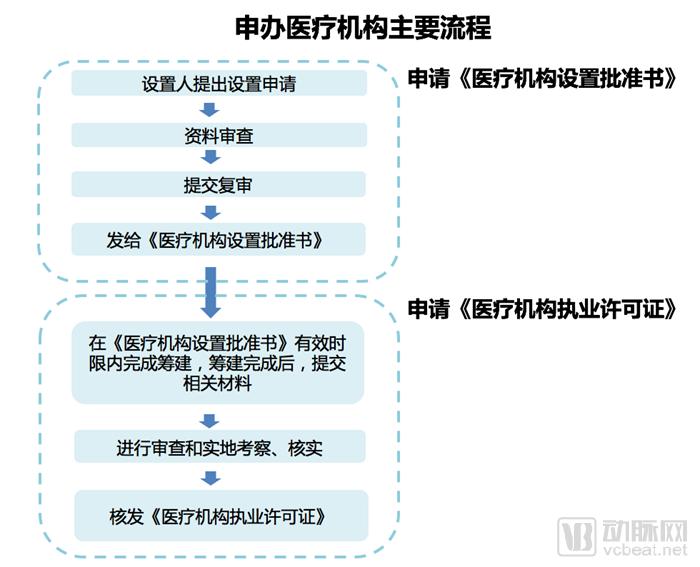
Image compiled by the author
The core issue in applying to establish a medical institution is the site. Locations with high foot traffic are conducive to developing medical services, but it is difficult to find sites that meet approval requirements; areas with sparse populations have plenty of available sites, but they are unfavorable for subsequent operations.
Identifying a suitable location that meets operational requirements is an exceptionally challenging task. Even after securing a site, there is no guarantee that the medical institution will obtain the necessary approvals for operation. Should one proceed with leasing the property? If not, the landlord may repurpose the space for other uses; if so, the operator must bear the financial burden of paying rent during the 6- to 24-month preparatory phase independently.。
In accordance with traditional practice, the applicant signs a non-binding lease agreement with the property owner and, upon payment of certain fees, initiates the application process as soon as possible. After preparing the relevant documentation, the applicant promptly commences the approval process for the establishment of the medical institution. This establishment approval serves a function similar to a preliminary review, during which officials from the Health Commission, environmental impact assessment authorities, fire safety departments, industry and commerce administrations, and administrative approval agencies visit the site to assess its suitability for operating a medical institution. If no significant issues are identified with the premises and all documentation is complete, the applicant should obtain the “Approval Certificate for the Establishment of a Medical Institution” as quickly as possible.
The applicant then proceeds with renovations, equipment procurement, staff recruitment, environmental impact assessments, fire safety inspections, and other requirements. Once all tasks are completed, the Health Commission organizes an expert review panel for final inspection. Upon compliance with all regulations, the Medical Institution Practice License is issued, allowing the medical institution to officially commence operations.
Costs such as rent, renovation, personnel, environmental impact assessment, and fire safety compliance incurred during this process are all sunk costs. If the competent authorities deem the facility non-compliant and deny approval for operation, these investments will be entirely lost. The difficulty in establishing privately run medical institutions stems precisely from these high barriers to entry and significant uncertainties.
With the cancellation of the “Approval Certificate for the Establishment of Medical Institutions,” how will the uncertainty in the application process for medical institutions be addressed? No supporting measures have been observed thus far. If the pre-approval step is eliminated, applicants may only discover non-compliance with application requirements after leasing premises, recruiting staff, completing renovations, and installing equipment. This would create substantial pitfalls and prove even more detrimental than the previous procedural framework.
If full deregulation of approval processes is not feasible, yet there is a desire to streamline procedures and encourage enthusiasm for private healthcare provision, then the following measures should be taken:
First,Establish a Negative List System for Medical Institution Licensing. It is necessary to collaborate with relevant departments, including the National Health Commission, environmental protection agencies, fire safety authorities, and industry and commerce administrations, to clearly define the “disqualifying factors” that preclude the approval of medical institution applications. For instance, medical institutions configuring large-scale radioactive medical equipment must be located at least 50 meters away from residential areas and schools. Once the negative list is established, all applicants can prepare their submissions in accordance with it, thereby avoiding unnecessary detours. If an application violates any item on the negative list, it should rightfully be rejected; conversely, if an application does not contravene any provisions of the negative list, the National Health Commission shall not withhold approval.
Second,Improve the Specific Conditions of Medical Institutions: Many Requirements and Standards in Healthcare Facilities Still Reflect Mindsets from the Planned Economy Era and Should Be Adjusted.
Third,After the applicant completes the opening preparations in accordance with the requirements, the Health Commission organizes reviewers to conduct an evaluation as required. Applications containing items on the negative list shall be rejected outright; for matters failing to meet the requirements, the applicant shall be required to make rectifications; if all aspects are compliant, the medical institution shall be permitted to operate on a trial basis for one month.
Fourth,During the trial operation period, oversee the service performance of medical institutions, with a primary focus on medical quality and safety, as well as patient experience and feedback. If performance meets the required standards during the trial period, formal operation will be approved. In the event of issues, operations must be suspended for rectification.
Fifth,Only by making approval standards transparent and predictable, and prioritizing the oversight of medical quality and patient safety, can we address the issue of “emphasizing approval while neglecting regulation and providing weak services.”
The “Notice on Further Reforming and Improving the Approval Processes for Medical Institutions and Physicians” demonstrates that the state remains strongly committed to encouraging privately run medical services.
However, there remains significant uncertainty regarding the implementation of these policies. For instance, while certain services in public hospitals may be outsourced to third-party medical institutions, public hospitals have already eliminated drug markups, implemented the two-invoice system for pharmaceuticals, and imposed controls on the proportion of revenue derived from drugs and consumables. With the two-invoice system also set to apply to medical consumables in the future, public hospitals’ financial flexibility is becoming increasingly constrained. Given that government funding for public hospitals has not kept pace, why would these hospitals be willing to outsource profitable services such as medical imaging and laboratory testing to third-party providers?
Public policies must be grounded in reality; let us hope they do not become mere directives that never leave the National Health Commission.Will this policy achieve the desired results? Let us wait and see.

Author Profile: Liu Weiqi (Founder and CEO of Tongxin Medical Alliance)
B.A. in Civil Engineering and Finance from Shanghai Jiao Tong University; M.S. in Management Science and Engineering from Stanford University.
Honored with the titles of “Zhongguancun Entrepreneurial Leading Talent” and “Haidian District Entrepreneurial Leading Talent.”
The company he founded, Tongxin Medical Alliance, has been recognized as a Zhongguancun Golden Seed Enterprise and a Zhongguancun High-Tech Enterprise by the Zhongguancun Administrative Committee. It has currently completed its fourth round of financing, led by CICC Kangrui.
This article is fromLiu WeiqiOriginal content. Reproduction without prior consent is strictly prohibited. Violators will be held legally accountable.