

Draft Amendment to the Regulations on Supervision and Administration of Medical Devices Released: Full Implementation of MAH System and 'Four Strictest' Requirements
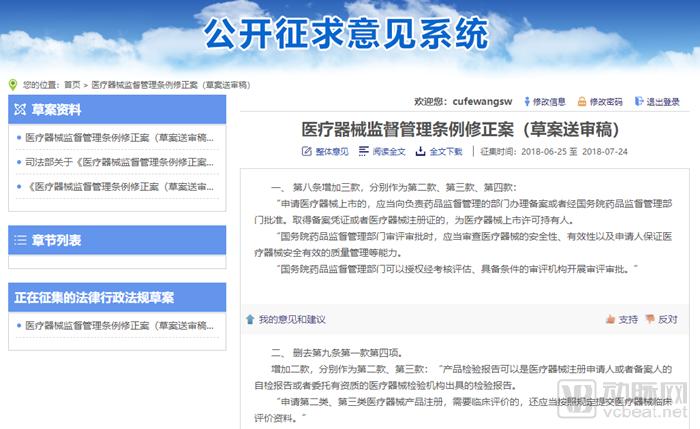
VCBeat (WeChat ID: vcbeat) has learned that on June 25, the Ministry of Justice released the “Amendment to the Regulations on the Supervision and Administration of Medical Devices (Draft for Review)” (hereinafter referred to as the “Draft Amendment”) and solicited public comments. The Draft Amendment adds 12 articles, deletes 2 articles, and revises 39 articles of the current Regulations. The comment period runs from June 25, 2018, to July 24, 2018.
In January 2000, the Regulations on the Supervision and Administration of Medical Devices (hereinafter referred to as the “Regulations”) were promulgated by State Council Decree No. 276. In February 2014, the State Council’s executive meeting conducted the first comprehensive revision of the Regulations. In May 2017, partial amendments were made to the Regulations. VCBeat has learned that these amendments were adopted in the form of an amendment bill, marking a concrete step toward implementing the Opinions on Deepening the Reform of the Review and Approval System to Encourage Innovation in Drugs and Medical Devices (hereinafter referred to as the “Innovation Opinions”), which were issued by the General Office of the CPC Central Committee and the General Office of the State Council in October 2017, and addressing the urgent needs of reform.
This revision adheres to three principles: first, it is based on the “Opinions on Innovation,” amending inconsistent provisions in the current Regulations and supplementing and improving relevant regulations; second, it makes targeted supplements to address prominent issues constraining supervision, thereby meeting urgent regulatory needs; and third, it implements the “four strictest” requirements by strictly enforcing legal liability and imposing penalties on individuals.
Fully implement the Marketing Authorization Holder (MAH) system for medical devices. A dedicated article on the MAH system is included in Chapter II, “Registration and Filing of Medical Device Products,” which clearly specifies the obligations of marketing authorization holders (Articles 8 and 14) and reinforces their primary responsibility in relevant chapters.
In Chapter III, “Medical Device Production,” and Chapter IV, “Medical Device Distribution and Use,” it is stipulated that marketing authorization holders may manufacture and distribute their products themselves or entrust other enterprises to do so. In cases of entrusted production and distribution, the marketing authorization holder shall be responsible for product quality (Articles 27 and 35). It is further specified that marketing authorization holders shall ensure the effective operation of their quality management systems, strictly adhere to production requirements, guarantee that released products meet applicable standards, and submit annual self-inspection reports on their quality management systems to the drug regulatory departments of provinces, autonomous regions, and municipalities directly under the Central Government (Article 28). Should production conditions change such that they no longer comply with quality management system requirements, the holder shall immediately implement corrective measures and report to the drug regulatory departments of provinces, autonomous regions, and municipalities directly under the Central Government (Article 29). It is also required that medical device instructions for use and labels indicate the name, address, and contact information of the medical device marketing authorization holder, as well as the agent of overseas medical device marketing authorization holders (Article 31).
In Chapter 5, “Handling of Adverse Events and Recall of Medical Devices,” it is explicitly stipulated that marketing authorization holders shall establish a medical device adverse event monitoring system, directly report medical device adverse events in accordance with regulations (Article 52), proactively conduct post-market re-evaluation of marketed medical devices (Article 56), and assume primary responsibility for the recall of defective products (Article 57).
To address the challenges of supervising and penalizing overseas registrants and filers in regulatory practice, while reinforcing the obligations of marketing authorization holders, provisions have been added to regulate the domestic agents of overseas marketing authorization holders. These provisions clarify the obligations to be fulfilled by such agents (Article 15), require agents to annually report relevant agency information to the drug regulatory departments of provinces, autonomous regions, and municipalities directly under the Central Government (Article 28), and introduce corresponding legal liability clauses (Article 80).
Summarize regulatory experience, clarify the concept of clinical evaluation, delineate the relationship between clinical evaluation and clinical trials, and establish clear regulatory requirements for clinical evaluation. Change the previous management approach of determining medical devices exempt from clinical trials based on a catalog, and reintroduce regulations for clinical trials based on product maturity, risk, and the specific applicant’s research and development process.
Class I medical device filing does not require clinical evaluation; in principle, Class II medical device registration does not require clinical evaluation; Class III medical device registration shall undergo clinical evaluation, among which, Class III medical devices used to support or sustain life or with high risk in clinical use shall, in principle, conduct clinical trials (Articles 9 and 19).
Change the approval process for clinical trials of Class III high-risk products from explicit approval to implicit approval (Article 21); add provisions on the acceptance of overseas clinical trial data and expanded access to investigational drugs (Articles 19 and 22).
According to the “Opinions on Innovation,” the review and approval of Class II medical device product registrations, previously conducted by the drug regulatory departments of provinces, autonomous regions, and municipalities directly under the Central Government, shall be transferred to the drug regulatory department under the State Council. It further stipulates that the drug regulatory department under the State Council may authorize qualified review institutions, subject to assessment and evaluation, to carry out such review and approval (Article 8).
For innovative medical devices that have not been marketed domestically or abroad, the requirement to provide proof of overseas marketing and sales is no longer applicable (Article 11). For Class II and Class III medical device registration applications, the product testing report, which previously had to be issued by a medical device testing institution, may now be either the applicant’s self-test report or a test report issued by a qualified medical device testing institution (Article 9). Provisions explicitly establish conditional approval for medical devices used to treat rare diseases, serious life-threatening conditions with no effective treatment options available, and those urgently needed in response to public health emergencies (Article 13), and flexibly stipulate the validity period of the medical device registration certificate in accordance with the attached conditions (Article 17).
Improving the Management of Class II Medical Device Operations
The Regulations promulgated and implemented in 2000 instituted a licensing system for the distribution of Class II medical devices. In 2004, the Measures for the Administration of Medical Device Distribution Enterprise Licenses, issued by the former State Food and Drug Administration, stipulated that a limited number of Class II medical devices, whose safety and efficacy can be assured through routine management during circulation, were exempt from the requirement to obtain a distribution license.
The former State Food and Drug Administration published two batches of product catalogs in May 2005 and November 2011, respectively, stipulating that the operation of 19 products, including thermometers and condoms, does not require a Medical Device Operation Enterprise License.
The 2014 revision of the Regulations implemented a filing-based management system for the distribution of Class II medical devices. In May 2014, the former China Food and Drug Administration (CFDA) issued the Announcement on Matters Concerning the Filing for Medical Device Production and Distribution Operations, explicitly requiring distributors of certain Class II medical device products that were previously exempt from applying for distribution licenses to complete filing procedures. In practice, these products pose minimal risks in the circulation chain; however, the number of distributors is substantial, with most supermarkets and convenience stores carrying such products.
To implement the requirements of “streamlining administration, delegating power, and improving services,” the requirement for operation filing is waived for certain Class II medical devices whose safety and effectiveness can be ensured through routine management during circulation (Article 33).
Strengthening the Regulation of Used Medical Devices
Since current laws and regulations do not explicitly prohibit the import and sale of used medical devices, and the Catalogue of Old Mechanical and Electrical Products Prohibited from Import issued by departments such as the General Administration of Quality Supervision, Inspection and Quarantine and the General Administration of Customs fails to cover most medical devices, there are prominent difficulties in characterizing and handling illegally imported used medical devices. The Draft Amendment explicitly prohibits the import and sale of used medical devices (Article 48).
Cancellation of Approval for Medical Device Advertising
In alignment with the arrangements for reforming the administrative approval system, the approval requirement for medical device advertisements is abolished. Market supervision authorities shall be responsible for monitoring, inspecting, and investigating and penalizing violations related to medical device advertisements (Article 66).
Add the concept of counterfeit medical devices.
Unlicensed medical devices seized in regulatory practice cannot be tested due to the absence of applicable standards; some products counterfeiting those of legitimate enterprises may yield compliant test results, thereby complicating enforcement and criminal prosecution. The Draft Amendment introduces the concept of “counterfeit medical devices,” prohibits the production, distribution, and use of counterfeit medical devices, and specifies the circumstances constituting counterfeit medical devices (Article 62).
Clarify supervisory and inspection responsibilities, enhance regulatory measures, and address the insufficiency of regulatory tools.
It is explicitly stipulated that the research and development activities of medical devices shall be subject to supervision and inspection organized by the drug regulatory department under the State Council; the production activities of medical devices shall be subject to supervision and inspection by the drug regulatory departments at or above the provincial level; and the distribution and use activities of medical devices shall be subject to supervision and inspection by the drug regulatory departments at the municipal and county levels. Overseas inspections shall be uniformly organized and implemented by the drug regulatory department under the State Council. When necessary, the drug regulatory departments may conduct extended inspections (Article 59).
For cases involving safety hazards, the department responsible for drug supervision and administration may, based on the circumstances and in accordance with the law, make decisions such as conducting regulatory interviews, ordering rectification within a specified time limit, issuing warning letters, ordering recalls, and suspending production, importation, distribution, or use (Article 61).
Improve the Re-examination System
The current Regulations stipulate that if a party has objections to the inspection conclusions, it may, within seven working days from the date of receipt of such conclusions, select a qualified medical device testing institution for re-inspection, with the re-inspection institution being freely chosen by the party. Due to the lack of specific requirements for re-inspection institutions, in practice, phenomena such as parties selecting testing institutions with which they have long-term commercial relationships for re-inspection, or choosing re-inspection institutions whose testing capabilities are inferior to those of the original institution, occur from time to time. To further standardize re-inspection activities, the Draft Amendment improves the re-inspection system by stipulating that if a party has objections to the inspection results, it shall apply for re-inspection to either the original testing institution or a medical device testing institution designated by the drug regulatory department under the State Council (Article 64).
Strengthening the Construction of Regulatory Teams
It is explicitly stipulated that the State shall establish a system of professionalized medical device inspectors. Inspectors shall possess knowledge of medical device laws, regulations, and specialized expertise, and may engage in inspection activities only after passing the required assessments (Article 58).
Implement the spirit of the central authorities’ instructions and add specific provisions for imposing penalties on individuals.
Where there is intentional commission of illegal acts, gross negligence, or where the illegal acts are serious in nature, egregious in character, result in severe consequences, or cause other serious adverse social impacts, the directly responsible supervisors and other directly liable personnel shall be fined an amount ranging from 30% to 100% of their income obtained from the entity in the previous year. Provisions have been added to impose a 10-year industry ban on medical device marketing authorization holders, manufacturing and trading enterprises whose licenses have been revoked, as well as their directly responsible supervisors and other directly liable personnel; furthermore, a lifetime industry ban is imposed on those sentenced to fixed-term imprisonment or heavier criminal penalties. Additionally, penalties such as suspension of production and business operations or revocation of licenses are established for medical device research, manufacturing, and trading entities that employ individuals subject to industry bans (Article 81). To further clarify the liabilities of natural persons, specific interpretations regarding directly responsible supervisors are provided in the Supplementary Provisions (Article 86).
Increase Penalties for Intentional Illegal Acts
For the production and operation of counterfeit medical devices, or engaging in production and business activities without permission, the minimum fine has been adjusted from 50,000 to 100,000 yuan, and the maximum fine has been adjusted from 20 times the value of the goods to 30 times (Article 70). For those who obtain licenses by providing false materials or using other deceptive means, the minimum fine has been adjusted from 50,000 to 100,000 yuan; for forging, altering, buying, selling, leasing, or lending relevant medical device licenses, the minimum fine has been adjusted from 10,000 to 100,000 yuan, and the maximum fine has been adjusted from five times the illegal gains to 30 times (Article 71).
Amendment to the Regulations on the Supervision and Administration of Medical Devices
(Draft for Review)
To deepen the reform of the review and approval system and encourage innovation in medical devices, the Regulations on the Supervision and Administration of Medical Devices are hereby amended as follows:
I. Three paragraphs are added to Article 8, as the second, third, and fourth paragraphs, respectively:
“Entities applying for the marketing of medical devices shall file with the department responsible for drug supervision and administration or obtain approval from the drug regulatory department under the State Council. Those who have obtained a filing certificate or a Medical Device Registration Certificate shall be the Marketing Authorization Holders for medical devices.”
“During the review and approval process, the drug regulatory department under the State Council shall examine the safety and effectiveness of medical devices, as well as the applicant’s quality management capabilities to ensure the safety and effectiveness of such devices.”
“The drug regulatory department under the State Council may authorize qualified review and evaluation institutions, which have been assessed and evaluated, to carry out review and approval.”
II. Delete Item 4 of Paragraph 1 of Article 9.
Add two paragraphs as the second and third paragraphs, respectively: “The product inspection report may be a self-inspection report prepared by the medical device registration applicant or filer, or an inspection report issued by a qualified medical device testing institution entrusted for such purpose.”
“For applications for registration of Class II and Class III medical devices, where clinical evaluation is required, clinical evaluation data for the medical devices shall also be submitted in accordance with regulations.”
Amend Paragraph 2 to become Paragraph 4, revised as follows: “Medical device registration applicants and filers shall ensure the authenticity, completeness, and traceability of submitted materials.”
III. Amend the first paragraph of Article 10 to read: “For the filing of Class I medical device products, the filer shall submit the filing materials to the drug regulatory department of the municipal people’s government divided into districts where the filer is located.”
Article 2 is amended to read: “For Class I medical devices exported to China, the overseas filer shall, through its representative office established in China or by designating a corporate legal person within China as its agent, submit filing materials and certification documents issued by the competent authority of the country (region) where the filer is located, approving the marketing and sale of such medical device, to the drug regulatory department under the State Council.”
IV. Amend Article 11 to read: “For registration of Class II and Class III medical devices, the registration applicant shall submit registration application materials to the drug regulatory department under the State Council.”
“Overseas registration applicants exporting Class II and Class III medical devices into China shall establish representative offices in China or designate corporate legal entities within China as agents to submit registration application materials and certification documents from the competent authorities of the applicant’s country (region) permitting the marketing of such medical devices to the drug regulatory department under the State Council. For innovative medical devices not yet marketed domestically or abroad, the certification documents from the competent authorities of the applicant’s country (region) permitting the marketing of such medical devices may be exempted from submission.”
V. A new paragraph is added to Article 13 as Paragraph 2: “For medical devices that are urgently needed for the treatment of rare diseases, life-threatening conditions with no effective therapeutic options, and responses to public health emergencies, the drug regulatory authority may grant conditional approval and specify relevant matters in the Medical Device Registration Certificate.”
Paragraph 2 is renumbered as Paragraph 3 and amended to read: “Where the drug regulatory department of the State Council deems it necessary to conduct an inspection of the quality management system during the technical review of medical devices, it shall organize and carry out such an inspection.”
VI. Add one article as Article 14: “The marketing authorization holder of a medical device shall fulfill the following obligations:
“(1) Establish a quality management system appropriate for the product and maintain its effective operation;
“(2) Develop post-marketing continuous research and risk management plans, and ensure their effective implementation;”
“(3) Conduct adverse event monitoring and re-evaluation in accordance with the law;”
“(4) Establish and implement a product traceability and recall system;”
“(5) Other obligations stipulated by the drug regulatory department under the State Council.”
“Enterprises, institutions, and individuals entrusted by the medical device marketing authorization holder to conduct research and development, clinical trials, production, and operation shall bear the responsibilities stipulated by laws and regulations and agreed upon in the contract.”
VII. Add one article as Article 15: “The agent of an overseas medical device marketing authorization holder shall perform the following obligations:
“(1) Handle medical device registration or filing matters in accordance with the provisions of these Regulations;”
“(2) Responsible for liaising between the drug regulatory authorities and overseas medical device marketing authorization holders, and promptly informing the overseas medical device marketing authorization holders of relevant laws, regulations, and technical requirements;”
“(3) Undertake the monitoring and reporting of adverse events involving imported medical devices sold domestically, and promptly report adverse events involving medical devices that occur overseas to the drug regulatory authorities in accordance with regulations;”
“(4) Responsible for post-market recall of medical devices and reporting to the drug regulatory authorities;”
“(5) Assist the drug regulatory authorities in conducting inspections of overseas medical device marketing authorization holders and investigating and penalizing illegal activities;”
“(6) Bear joint and several liability with overseas medical device marketing authorization holders for illegal acts concerning product quality and related services;”
“(7) Other obligations stipulated by the drug regulatory department of the State Council.”
“The medical device registration certificate or filing voucher of an overseas medical device marketing authorization holder shall specify the name, address, and contact information of its agent.”
VIII. Amend Article 15 to become Article 17, and revise the first paragraph to read: “The validity period of a Medical Device Registration Certificate shall be five years; for devices granted conditional approval for registration, the National Medical Products Administration shall specify the validity period in the Medical Device Registration Certificate. Where continuation of registration is required upon expiration of the validity period, an application for continuation of registration shall be submitted to the original registration authority six months prior to the expiration of the validity period.”
Item 3 of Paragraph 3 is amended to read: “Where conditional approval has been granted, the matters specified in the medical device registration certificate have not been completed within the prescribed time limit.”
IX. Amend Article 17 to become Article 19, revised to read: “Clinical evaluation of medical devices refers to the process by which the applicant confirms whether the product meets the intended clinical scope and usage requirements through information such as clinical literature, clinical experience data, and clinical trials.”
“Filing of Class I medical device products does not require clinical evaluation; registration applications for Class II medical device products generally do not require clinical evaluation; registration applications for Class III medical device products shall undergo clinical evaluation. However, clinical evaluation may be exempted under any of the following circumstances:”
“(1) The working mechanism is clear, the design is finalized, and the production process is mature; similar medical devices have been on the market for many years with no records of serious adverse events in clinical applications, and their conventional intended use remains unchanged;”
“(2) The safety and effectiveness of the medical device can be demonstrated through non-clinical evaluation.”
“For Class II and Class III medical devices exempt from clinical evaluation, the applicant shall demonstrate the safety and effectiveness of the product in terms of its basic principles, structural composition, performance, and intended use.”
“Clinical evaluation of medical devices may be conducted by performing clinical trials within or outside China, or by analyzing and evaluating clinical literature and clinical experience data from similar medical devices, to demonstrate the safety and effectiveness of the medical device, depending on factors such as product characteristics, clinical risks, and existing clinical data.”
“Class III medical devices used to support or sustain life, or those posing a high risk in clinical use, are in principle required to undergo clinical trials.”
X. Article 19 is renumbered as Article 21, and its first paragraph is amended to read: “Where clinical trials of Class III medical devices pose relatively high risks to the human body, they shall be subject to approval by the drug regulatory department under the State Council. The drug regulatory department under the State Council shall, within 60 working days from the date of accepting the application for clinical trials, decide whether to approve the conduct of such clinical trials; if no decision is made within the specified period, the registration applicant may proceed with the clinical trials. The catalog of Class III medical devices whose clinical trials pose relatively high risks to the human body shall be formulated, adjusted, and published by the drug regulatory department under the State Council.”
XI. Add one article as Article 22: “For medical devices under clinical trials intended to treat diseases that are seriously life-threatening and for which no effective treatment is available, if preliminary observations indicate potential benefit and ethical requirements are met, such devices may be used for other patients within the institutions conducting the medical device clinical trials after obtaining informed consent. The safety data generated therefrom may be used for medical device registration applications.”
XII. Add a new article as Article 27: “The marketing authorization holder of a medical device may manufacture the medical device on its own, or entrust a medical device manufacturer that complies with the provisions of these Regulations and possesses the corresponding qualifications to manufacture the medical device.”
“Where a medical device marketing authorization holder manufactures medical devices on its own, it shall obtain a medical device production license or complete the filing procedures in accordance with the provisions of these Regulations.”
“For medical devices produced under contract, the medical device marketing authorization holder shall be responsible for the quality of the contracted medical devices, strengthen the management of the contractor’s production activities, and ensure that production is conducted in accordance with statutory requirements. The medical device marketing authorization holder shall enter into a contractual agreement with the contractor to clearly define the rights, obligations, and liabilities of both parties.”
“Implantable medical devices with high risks shall not be manufactured under contract; the specific catalog shall be formulated, adjusted, and published by the drug regulatory department of the State Council.”
XIII. Article 24 is renumbered as Article 28 and amended to read: “Marketing authorization holders of medical devices shall, in accordance with the Good Manufacturing Practice for Medical Devices, establish and improve a quality management system appropriate to the medical devices they manufacture and ensure its effective operation; strictly organize production in accordance with the product technical requirements approved through registration or filing; and ensure that the medical devices released from the factory comply with mandatory standards and the product technical requirements approved through registration or filing.”
“Marketing authorization holders of medical devices shall conduct regular self-inspections of the operation of their quality management systems and submit annual self-inspection reports to the drug regulatory departments of the people’s governments of the provinces, autonomous regions, or municipalities directly under the Central Government where they are located; among them, overseas marketing authorization holders of medical devices shall submit their self-inspection reports to the National Medical Products Administration through their agents.”
"The agent of the overseas medical device marketing authorization holder shall annually report relevant agency information to the drug regulatory department of the people's government of the province, autonomous region, or municipality directly under the central government where it is located."
XIV. Article 25 is renumbered as Article 29 and amended to read: “Where the production conditions of a medical device change such that they no longer comply with the requirements of the medical device quality management system, the medical device marketing authorization holder shall immediately take corrective measures. If such changes may affect the safety or effectiveness of the medical device, the medical device marketing authorization holder shall immediately suspend production activities and report to the drug regulatory department of the people’s government of the province, autonomous region, or municipality directly under the Central Government where it is located; among them, overseas medical device marketing authorization holders shall report to the National Medical Products Administration through their agents.”
XV. Article 26 is renumbered as Article 30, with a new paragraph added as the second paragraph: “Medical device products shall be assigned unique identifiers. The rules for medical device unique identification shall be formulated and promulgated by the drug regulatory department under the State Council.”
XVI. Article 27 is renumbered as Article 31, and two items are added to paragraph 2 as Item 1 and Item 2, respectively: “(1) The name, address, and contact information of the medical device marketing authorization holder; the name, address, and contact information of the agent of an overseas medical device marketing authorization holder;
“(2) Medical device registration certificate number or filing voucher number;”
Delete paragraph 3.
XVII. Delete Article 28.
XVIII. Article 30 is renumbered as Article 33, and “Article 29” in the first paragraph is amended to read “Article 32”.
Add a new paragraph as the second paragraph: “No filing for business operation is required for the operation of Class II medical devices whose safety and effectiveness can be ensured through routine management. The catalog of Class II medical device products exempt from such filing shall be formulated by the drug regulatory department under the State Council.”
XIX. Article 31 is renumbered as Article 34, and “Article 29” in the first paragraph is amended to read “Article 32”.
XX. Add one article as Article 35: “The marketing authorization holder of a medical device may sell the medical device by itself, or may entrust a medical device operating enterprise that complies with the provisions of these Regulations and meets the corresponding conditions to sell the medical device.”
“Where a medical device marketing authorization holder sells medical devices on its own, it is not required to obtain a medical device operation license or file for record, but shall comply with the operational conditions stipulated in these Regulations.”
“For medical devices sold under a consignment arrangement, the marketing authorization holder shall be responsible for the quality of the consigned medical devices, strengthen oversight of the consignee’s business conduct, and ensure that sales are conducted in accordance with statutory requirements. The marketing authorization holder shall enter into a consignment agreement with the consignee, clearly specifying the rights, obligations, and liabilities of both parties.”
XXI. Add one article as Article 36: “Entities engaged in the operation of medical devices shall, in accordance with the Good Supply Practice for Medical Devices formulated by the drug regulatory department under the State Council, establish and improve a quality management system appropriate to the medical devices they deal in, and ensure its effective operation.”
XXII. Amend Article 32 to become Article 37, and revise Item 3 of Paragraph 2 to read: “(3) the names of the medical device marketing authorization holders and manufacturers;”
XXIII. Add a new article as Article 38: “Entities engaged in the online sale of medical devices shall be the marketing authorization holders of such medical devices, or medical device operating enterprises that have obtained a medical device operation license or completed filing in accordance with the law. Entities engaged in the online sale of medical devices shall file with the drug supervision and administration department of the people’s government at the level of a city divided into districts where they are located, in accordance with relevant regulations, and comply with the Good Supply Practice for Medical Devices and other applicable provisions.”
“Third-party platforms for online medical device transactions shall be filed with the drug regulatory departments of the people’s governments at the provincial level. Providers of such third-party online transaction platforms shall assume obligations including verification of the qualifications of enterprises residing on the platform, supervision of sales activities, and handling of quality-related complaints; upon discovering any illegal conduct by resident enterprises, they shall promptly halt such conduct and immediately report it to the provincial-level drug regulatory department; in cases of serious violations, they shall immediately suspend provision of online transaction platform services. Where personal injury or property damage is caused to others, civil liability shall be borne in accordance with relevant laws and regulations.”
XXIV. Article 40 is renumbered as Article 46 and amended to read: “Medical device distributors and user entities shall not distribute or use medical devices that have not been registered or filed in accordance with the law, lack qualified certification documents, or are expired, ineffective, or obsolete.”
XXV. Article 42 is renumbered as Article 48, with two additional paragraphs added as the third and fourth paragraphs: “Where medical devices need to be imported due to urgent clinical needs of medical institutions, import procedures shall be handled in accordance with relevant state regulations.”
“The import and sale of used medical devices are prohibited.”
XXVI. Delete Article 45.
XXVII. Amend Article 47 to become Article 52, and add a new paragraph as the first paragraph: “The marketing authorization holder of medical devices shall establish a system for monitoring adverse events involving medical devices and directly report such adverse events in accordance with relevant regulations. The marketing authorization holder of medical devices shall be equipped with an adverse event monitoring organization and personnel commensurate with its products, and proactively conduct adverse event monitoring for its products; upon discovery of any adverse event or suspected adverse event involving a medical device, it shall report to the technical institution for medical device adverse event monitoring in accordance with the provisions of the drug regulatory department under the State Council, promptly carry out investigation, analysis, and evaluation, take proactive measures to control product risks, and report the evaluation results.”
Replace the first paragraph with the second, revised as follows: “Medical device distributors and user entities shall conduct adverse event monitoring for the medical devices they distribute or use. Upon discovering any adverse events or suspected adverse events related to medical devices, they shall promptly notify the marketing authorization holder of the medical devices and report such events to the technical institution for medical device adverse event monitoring in accordance with the regulations of the drug regulatory department under the State Council.”
XXVIII. Article 51 is renumbered as Article 56 and amended to read: “In any of the following circumstances, the marketing authorization holder of a medical device shall proactively conduct post-marketing re-evaluation of the medical device:
(1) Where advances in scientific research have led to changes in the understanding of the safety and effectiveness of medical devices;
“(2) Monitoring and evaluation results of adverse events involving medical devices indicate that the medical devices may have defects;”
(3) Other circumstances requiring re-evaluation as stipulated by the drug regulatory department under the State Council.
“Where a medical device marketing authorization holder fails to fulfill its obligations for post-market re-evaluation of medical devices as required, the drug regulatory department of the people’s government at or above the provincial level shall order the medical device marketing authorization holder to conduct such re-evaluation. Where necessary, the drug regulatory department of the people’s government at or above the provincial level may directly organize and carry out the post-market re-evaluation of medical devices.”
“The marketing authorization holder of a medical device shall, based on the results of post-market re-evaluation, take appropriate control measures, implement continuous improvements to marketed medical devices, and carry out registration changes or filing amendments in accordance with relevant regulations. If the re-evaluation results indicate that a registered or filed medical device cannot ensure safety and effectiveness, the marketing authorization holder shall proactively apply for cancellation of the medical device registration certificate or withdrawal of the filing. Where the marketing authorization holder fails to apply for such cancellation or withdrawal, the original issuing authority shall cancel the registration certificate or withdraw the filing and announce this action to the public. Medical devices whose registration certificates have been cancelled or filings withdrawn shall not be manufactured, imported, distributed, or used.”
XXIX. Article 52 is renumbered as Article 57 and amended to read: “Where a medical device marketing authorization holder discovers that the medical devices it manufactures fail to comply with mandatory standards or the product technical requirements approved through registration or filing, or have other defects, it shall immediately cease production, notify relevant manufacturing and trading enterprises, user entities, and consumers to halt manufacturing, trading, and use, recall medical devices already marketed and sold, take remedial measures such as destruction, document the relevant circumstances, release related information, and report the recall and disposal of the medical devices to the drug regulatory department and the health administrative department.”
“Where a medical device distributor discovers that the medical devices it distributes are subject to the circumstances specified in the preceding paragraph, it shall immediately cease distribution, notify the relevant marketing authorization holders, other distributors, user entities, and consumers, and document the cessation of distribution and notifications. Where a medical device marketing authorization holder determines that the medical devices fall within the scope requiring recall under the preceding paragraph, it shall immediately initiate a recall.”
“Where a marketing authorization holder or distributor of medical devices fails to implement a recall or cease operations in accordance with the provisions of this Article, the drug regulatory authority may order it to conduct a recall or cease operations.”
30. Add one article as Article 58: “The State shall establish a system of professional medical device inspectors. Inspectors shall possess knowledge of laws, regulations, and specialized expertise related to medical devices, and may engage in inspection activities only after passing the required assessments.”
31. Amend Article 53 to become Article 59, revised as follows: “The drug regulatory department under the State Council shall organize supervision and inspection of medical device research and development activities; the drug regulatory departments of people’s governments at or above the provincial level shall be responsible for supervision and inspection of medical device manufacturing activities; and the departments responsible for drug regulation under the people’s governments at the municipal level divided into districts and at the county level shall be responsible for supervision and inspection of medical device distribution and use activities.”
“Overseas inspections of medical devices shall be uniformly organized and implemented by the drug regulatory department under the State Council.”
“The departments responsible for drug supervision and administration shall conduct key supervisory inspections on the following matters when carrying out supervisory inspections of activities related to the research and development, production, operation, use, and importation of medical devices:”
“(1) Whether production is organized in accordance with the product technical requirements that have been registered or filed;”
“(2) Whether the quality management system remains effectively operational;
(3) Whether the conditions for production and operation continue to meet statutory requirements.
“When necessary, the drug regulatory department may conduct extended inspections of other relevant entities and individuals that provide products or services for activities such as the research and development, production, distribution, use, and importation of medical devices.”
32. Article 54 is renumbered as Article 60, with a new paragraph added as Paragraph 2: “The department responsible for drug supervision and administration shall implement sealing and seizure measures in accordance with relevant provisions. The period for sealing and seizure shall not exceed 30 days; where circumstances are complex, the period may be extended upon approval by the head of the food and drug supervision and administration department that implemented the sealing and seizure measures, provided that the extension shall not exceed 45 days.”
Paragraph 3 is renumbered as Paragraph 4 and amended to read: “Relevant entities and individuals shall cooperate with the supervision and inspection conducted by the drug regulatory authorities, provide relevant documents and materials, and shall not conceal any relevant information, nor refuse, obstruct, or evade such inspection.”
XXXIII. Amend Article 55 to become Article 61, revised as follows: “Where safety hazards exist in the production and distribution of medical devices and measures are not taken in a timely manner to eliminate them, the drug regulatory department may, in accordance with the law, make decisions such as conducting regulatory interviews, ordering rectification within a specified time limit, issuing warning letters, and ordering recalls. For medical devices that have caused harm to the human body or for which there is evidence proving they may endanger human health, or where there are serious violations of Good Manufacturing Practice for Medical Devices that may have a direct impact on product quality, the drug regulatory department may take emergency control measures such as suspending production, importation, distribution, and use.”
XXXIV. Add one article as Article 62: “The production, operation, and use of counterfeit medical devices are prohibited.”
"Medical devices that fall under any of the following circumstances shall be deemed counterfeit:"
“(1) Producing or importing medical devices without obtaining a medical device registration certificate or filing voucher;”
“(2) Passing off non-medical devices as medical devices, or passing off one type of medical device as another;”
“(3) Obtaining a medical device registration certificate or filing voucher by fraudulent means for the purpose of manufacturing or importing;”
“(4) Forging or fraudulently using another party’s medical device registration certificate or filing voucher, enterprise name, production address, etc.”
35. Article 56 is renumbered as Article 63, and the first paragraph is amended to read: “The departments responsible for drug supervision and administration shall strengthen spot checks and testing of medical devices manufactured, distributed, or used by marketing authorization holders, distributors, and user entities of medical devices. No inspection fees or any other charges shall be imposed for such spot checks and testing; the required expenses shall be included in the budget of the people’s government at the corresponding level. The drug supervision and administration departments of the people’s governments at or above the provincial level shall timely release announcements on the quality of medical devices based on the conclusions of the spot checks and testing.”
36. Article 57 is renumbered as Article 64, and the third paragraph is amended to read: “Where a party has objections to the inspection conclusions, it may, within seven working days from the date of receipt of such conclusions, apply for re-inspection to the original inspection institution or to a medical device inspection institution designated by the drug regulatory department under the State Council. Failure to submit an application for re-inspection within the prescribed time limit shall be deemed as acceptance of the inspection conclusions by the party concerned. The medical device inspection institution undertaking the re-inspection shall issue its re-inspection conclusions within the time limit prescribed by the drug regulatory department under the State Council. The re-inspection conclusions shall be final.”
37. Article 58 is renumbered as Article 65 and amended to read: “For medical devices that may contain harmful substances or for which the design, raw materials, and production processes have been altered without authorization, thereby posing safety hazards, where the inspection items and methods prescribed by national or industry standards for medical devices are insufficient for inspection, medical device testing institutions may conduct inspections using supplementary inspection items and methods approved by the drug regulatory department under the State Council. The inspection conclusions derived from such supplementary inspection items and methods may serve as the basis for the departments responsible for drug supervision and administration to determine the quality of medical devices.”
38. Amend Article 59 to become Article 66, revised to read: “Advertisements for medical devices shall be truthful and lawful, and shall not contain any false, exaggerated, or misleading content.”
“Market supervision and administration departments shall, in accordance with the provisions of laws and administrative regulations on advertising management, conduct supervision and inspection of medical device advertisements and investigate and punish illegal acts.”
39. Article 60 is renumbered as Article 67 and amended to read: “The drug regulatory department under the State Council shall establish a unified information platform for the supervision and administration of medical devices. The departments responsible for drug supervision and administration shall, through the information platform, promptly disclose in accordance with the law routine supervisory and administrative information, including information on medical device licensing, filing, spot-check testing, and the investigation and handling of illegal acts. However, trade secrets of the parties concerned shall not be disclosed.”
“The departments responsible for drug supervision and administration shall establish credit files for medical device marketing authorization holders, production and operation enterprises, and user entities, and increase the frequency of supervision and inspections for those with adverse credit records.”
XL. Article 63 is renumbered as Article 70, and Paragraph 1 is amended to read: “Where any of the following circumstances occurs, the department responsible for drug supervision and administration under the people’s government at or above the county level shall confiscate the illegal gains, the medical devices illegally produced or traded, and the tools, equipment, raw materials, and other items used for such illegal production or trading; if the total value of the illegally produced or traded medical devices is less than RMB 10,000, a fine of not less than RMB 100,000 but not more than RMB 150,000 shall also be imposed; if the total value is RMB 10,000 or more, a fine of not less than 15 times but not more than 30 times the total value shall also be imposed; where the circumstances are serious, no application for medical device licensing submitted by the relevant responsible persons or the enterprise shall be accepted within five years:”
“(1) Producing or dealing in counterfeit medical devices;”
“(2) Engaging in the production of Class II and Class III medical devices without a production license;”
“(3) Engaging in the business operations of Class III medical devices without a business license.”
Paragraph 2 is amended to read: “Where the circumstances specified in Item 1 of the preceding paragraph exist and are serious, the original issuing authority shall revoke the Medical Device Registration Certificate, the Medical Device Production License, or the Medical Device Operation License.”
41. Article 64 is renumbered as Article 71 and amended to read: “Where a Medical Device Registration Certificate, Medical Device Production License, Medical Device Operation License, Configuration License for Large-Scale Medical Equipment, or any other license or permit is obtained by submitting false materials or employing other fraudulent means, the original issuing authority shall revoke the license or permit already obtained, impose a fine of not less than RMB 100,000 but not more than RMB 150,000, and shall not accept any medical device licensing applications submitted by the relevant responsible persons and entities within five years. Where production, operation, or use has already commenced, the illegal gains and the medical devices illegally produced, operated, or used shall be confiscated; if the total value of the illegally produced or operated medical devices is less than RMB 10,000, a fine of not less than RMB 100,000 but not more than RMB 150,000 shall also be imposed; if the total value is RMB 10,000 or more, a fine of not less than 15 times but not more than 30 times the total value shall also be imposed.”
“Those who forge, alter, buy, sell, lease, or lend relevant medical device licenses and certificates shall have such documents confiscated or revoked by the original issuing authority, and any illegal gains shall be confiscated; where the illegal gains are less than RMB 10,000, a fine of not less than RMB 100,000 but not more than RMB 150,000 shall be imposed; where the illegal gains amount to RMB 10,000 or more, a fine of not less than 15 times but not more than 30 times the illegal gains shall be imposed; if the act constitutes a violation of public security administration, the public security organ shall impose administrative penalties for public security in accordance with the law.”
XLII. Article 65 is renumbered as Article 72 and amended to read: “Where a medical device manufacturer or distributor fails to file for record in accordance with the provisions of these Regulations, the drug supervision and administration department of the people’s government at or above the county level shall order it to make corrections within a specified time limit; if it fails to make corrections within the time limit, the names of the entities that have failed to file for record shall be announced to the public, and a fine of not more than RMB 50,000 may be imposed.”
“Where false information is submitted for record-filing, the department responsible for drug supervision and administration under the people’s government at or above the county level shall publicly announce the name of the filing entity to the society. If production or business operations have already commenced, the illegal gains and the medical devices illegally produced or traded shall be confiscated; where the value of the illegally produced or traded medical devices is less than RMB 10,000, a fine of not less than RMB 10,000 but not more than RMB 30,000 shall be imposed; where the value is RMB 10,000 or more, a fine of not less than three times but not more than five times the value shall be imposed. In serious circumstances, the directly responsible personnel shall be prohibited from engaging in the production and operation activities of medical devices for five years.”
XLIII. Article 66 is renumbered as Article 73, and the first paragraph is amended to read: “Where any of the following circumstances occurs, the department responsible for drug supervision and administration under the people’s government at or above the county level shall order correction, confiscate the medical devices that were illegally produced, distributed, or used; if the total value of the illegally produced, distributed, or used medical devices is less than RMB 10,000, a fine of not less than RMB 20,000 but not more than RMB 50,000 shall be imposed; if the total value is RMB 10,000 or more, a fine of not less than five times but not more than ten times the total value shall be imposed; in serious cases, orders shall be issued to suspend production and business operations, up to and including revocation of the Medical Device Registration Certificate, Medical Device Production License, and Medical Device Distribution License by the original license-issuing authority, as well as cancellation of the filings for medical device production, medical device distribution, and third-party platform filing for online medical device transaction services; directly responsible personnel shall be prohibited from engaging in medical device production and distribution activities for five years.”
“(1) Producing, operating, or using medical devices that do not comply with mandatory standards or with the product technical requirements approved through registration or filing;”
“(2) Failure to formulate post-marketing continuous study and risk control plans in accordance with regulations, and to ensure their effective implementation;”
“(3) failing to organize production in accordance with the registered or filed product technical requirements, or failing to establish a quality management system and maintain its effective operation as required by these Regulations;”
“(4) There is data falsification and other serious illegal activities in the research, production, or business operations;”
“(5) Operating or using medical devices that lack qualified certification documents, are expired, have become ineffective, or have been phased out, or using counterfeit medical devices;”
“(6) Importing and selling used medical devices;”
“(7) Where a third-party platform for online medical device transactions fails to fulfill the obligations stipulated in these Regulations, and the circumstances are serious;”
“(8) Failing to establish a medical device traceability system and fulfill medical device traceability responsibilities in accordance with the provisions of these Regulations;”
“(9) Where, after the drug supervision and administration department orders a recall or suspension of business operations in accordance with the provisions of these Regulations, the entity still refuses to recall the medical devices or suspend their business operations;”
“(10) Entrusting the production and operation of medical devices to an enterprise that does not meet the conditions stipulated in these Regulations, or failing to manage the production and operational activities of the entrusted party;”
“(11) Refusing or obstructing inspections organized by the department responsible for drug supervision and administration.”
Amend “Item 3” in the second paragraph to “Item 5”.
XLIV. Article 67 is renumbered as Article 74 and amended to read: “Where any of the following circumstances occurs, the drug regulatory department of the people’s government at or above the county level shall order rectification and impose a fine of not less than RMB 10,000 but not more than RMB 30,000; where the circumstances are serious, it shall order suspension of production and business operations, and may even revoke the Medical Device Production License and Medical Device Operation License issued by the original licensing authority, and cancel the filing for medical device production and the filing for medical device operation; the directly responsible personnel shall be prohibited from engaging in medical device production and operation activities for three years:
“(1) Where the conditions for medical device production have changed and no longer meet the requirements of the medical device quality management system, and the entity fails to rectify the issues, suspend production, or submit reports in accordance with the provisions of these Regulations;”
“(2) Manufacturing or trading medical devices whose instructions for use and labels do not comply with the provisions of these Regulations;”
“(3) Failure to transport or store medical devices in accordance with the requirements specified in the instructions for use and labeling;”
“(4) Transferring in-use medical devices that are expired, invalid, obsolete, or have failed inspection.”
45. Article 68 is renumbered as Article 75 and amended to read: “Where any of the following circumstances occurs, the drug regulatory department and the health administrative department of the people’s government at or above the county level shall, in accordance with their respective duties, order rectification and issue a warning; if the party fails to make rectification within the specified period, a fine of not less than RMB 5,000 but not more than RMB 20,000 shall be imposed; where the circumstances are serious, an order shall be issued to suspend production or business operations, up to and including revocation of the medical device registration certificate, the medical device operation license, or cancellation of the medical device product filing certificate by the original issuing authority:
“(1) Failure to submit the self-inspection report on the quality management system as required;”
“(2) Procuring medical devices from marketing authorization holders or operating enterprises that lack the required qualifications;”
“(3) Medical device operating enterprises and user institutions fail to establish and implement the system for recording inspection of incoming medical devices in accordance with the provisions of these Regulations;”
“(4) Business enterprises engaged in the wholesale of Class II and Class III medical devices, as well as the retail of Class III medical devices, that fail to establish and implement a sales record system in accordance with the provisions of these Regulations;”
“(5) Where medical device user facilities fail to process reusable medical devices in accordance with disinfection and management regulations;”
“(6) Medical device user facilities reuse single-use medical devices, or fail to destroy used single-use medical devices in accordance with regulations;”
“(7) Where a medical device user fails to inspect, test, calibrate, service, and maintain medical devices that require regular inspection, testing, calibration, servicing, and maintenance in accordance with the product instructions for use, and fails to keep records thereof, conduct timely analysis and evaluation, and ensure that the medical devices are in good working condition;”
“(8) Where a medical device user fails to properly preserve the original documentation for purchased Class III medical devices, or fails to record information on large-scale medical devices and implantable/interventional medical devices in medical records and other relevant documentation as required;”
“(9) Where a medical device user fails to immediately cease use and notify for maintenance upon discovering safety hazards in the medical devices in use, or continues to use medical devices that still fail to meet safety standards after maintenance;”
“(10) Medical device user entities violate regulations in the use of large-scale medical equipment, failing to ensure the quality and safety of medical care;”
“(11) Failure to conduct monitoring of adverse events involving medical devices in accordance with the provisions of these Regulations, failure to report adverse events as required, or failure to cooperate with investigations into adverse events conducted by technical institutions for medical device adverse event monitoring or by departments responsible for drug supervision and administration;”
“(12) Failure to conduct post-market re-evaluation of medical devices in accordance with the provisions of these Regulations, concealment of re-evaluation results, failure to submit an application for cancellation when required, or non-cooperation with the post-market re-evaluation of medical devices organized by the drug regulatory department.”
46. Article 71 is renumbered as Article 78 and amended to read: “Where the provisions of these Regulations on the administration of medical device advertisements are violated, the market supervision and administration department shall impose penalties in accordance with the provisions of laws and administrative regulations on advertisement administration.”
XLVII. Add one article as Article 79: “Where activities such as the development, production, distribution, use, and import/export of medical devices violate the provisions of these Regulations, the medical device marketing authorization holder shall bear legal liability; where enterprises, institutions, or individuals entrusted by the medical device marketing authorization holder to conduct activities such as research and development, clinical trials, production, and distribution simultaneously violate relevant provisions, they shall bear corresponding liabilities in accordance with the law.”
XLVIII. Add one article as Article 80: “Where the agent of an overseas medical device marketing authorization holder fails to perform relevant obligations in accordance with the provisions of these Regulations, the drug regulatory department of the people’s government of the province, autonomous region, or municipality directly under the Central Government shall issue a warning, order rectification, and may impose a fine of not less than RMB 30,000 but not more than RMB 100,000; if rectification is refused, a fine of not less than RMB 100,000 but not more than RMB 200,000 shall be imposed, and the importation of the relevant medical devices shall be ordered to be suspended; where the circumstances are serious, the agency and the persons directly responsible shall be prohibited from engaging in activities related to the production and operation of medical devices for five years.”
XLIX. Add one article as Article 81: “Where, in violation of the provisions of these Regulations, penalties are imposed in accordance with these Regulations, and any of the following circumstances exists, the persons directly in charge and other directly responsible persons of the entity shall be fined an amount ranging from 30% to 100% of their income obtained from the entity in the previous year:
“(1) Intentionally committing illegal acts or having gross negligence;”
“(2) The illegal act is serious in circumstances and egregious in nature;”
(3) The illegal act has caused serious consequences.
“Medical device marketing authorization holders, manufacturing and operating enterprises, and their directly responsible supervisors and other directly liable personnel whose licenses have been revoked shall be prohibited from applying for medical device licenses or engaging in medical device production and operation activities for ten years from the date the penalty decision is made; if a crime is constituted and a criminal sentence of fixed-term imprisonment or heavier penalty is imposed, they shall be permanently prohibited from applying for medical device licenses or engaging in medical device production and operation activities.”
“Where an entity engaged in the research and development, production, or operation of medical devices employs personnel in violation of the provisions of the second paragraph of this Article, the drug regulatory department of the people's government at or above the county level shall order it to suspend production and business operations or revoke its license.”
L. Article 72 is renumbered as Article 82 and amended to read: “Where a medical device technical review institution, a medical device adverse event monitoring technical institution, or a medical device quality management system inspection technical institution fails to perform its duties in accordance with the provisions of these Regulations, resulting in major errors in the review, monitoring, or quality management system inspection work, or causing serious consequences, the drug supervision and administration department of the people’s government at or above the county level shall order it to make corrections, circulate a notice of criticism, and issue a warning; where serious consequences are caused, the persons directly in charge and other directly responsible persons shall be subject to administrative sanctions of demotion, dismissal from office, or expulsion in accordance with the law.”
51. Article 73 is renumbered as Article 83 and amended to read: “The drug regulatory departments, the health administrative departments, and their staff shall strictly exercise administrative penalty powers in accordance with the types and scope of penalties prescribed in these Regulations, based on the nature and specific circumstances of the illegal acts. Specific measures shall be formulated by the drug regulatory department and the health administrative department under the State Council in accordance with their respective responsibilities.”
52. Article 76 is renumbered as Article 86, and the following definition is added to the “Definitions of Terms” section: “‘Directly responsible supervisors’ refers to the legal representative or principal person in charge, quality management personnel, and other personnel responsible for managing activities related to the research and development, production, distribution, and use of medical devices.”
53. Article 77 is renumbered as Article 87 and amended to read: “Fees may be charged for the registration of medical device products, and annual fees may be charged for the regulatory oversight of medical device manufacturing sites and product varieties. The specific fee items and standards shall be formulated respectively by the finance and price control departments of the State Council in accordance with relevant national regulations.”
54. Amend “registrant” in Article 14 to “medical device marketing authorization holder”; amend “manufacturer” in Article 38 to “medical device marketing authorization holder”; and amend “medical device manufacturing and trading enterprises” in Article 50 to “medical device marketing authorization holders, and manufacturing and trading enterprises”.
55. The term “food and drug administration departments” in Paragraphs 1 and 3 of Article 3, Articles 4, 6, 12, 13, 15, 16, 17, 18, 19, 22, 26, 32, 62, and 78 shall be amended to read “drug administration departments.”
Replace “food and drug administration departments” with “departments responsible for drug supervision and administration” in Paragraph 2 of Article 3, Articles 21, 30, 31, and 39, Paragraph 2 of Article 47, Paragraph 2 of Article 48, Paragraph 1 of Article 49, Articles 50 and 61, Paragraphs 1 and 2 of Article 54, Paragraph 2 of Article 57, Article 69, and Article 74.
Replace “the food and drug regulatory department under the State Council” in Articles 43, 48, 57, and 60 with “the drug regulatory department under the State Council.”
Amend “the food and drug supervision and administration department of the people's government at the level of a city divided into districts” in Article 43 to “the department responsible for drug supervision and administration of the people's government at the level of a city divided into districts”.
Replace “the food and drug administration departments of the people’s governments at or above the provincial level” in Article 49 with “the drug administration departments of the people’s governments at or above the provincial level”.
56. Replace “health and family planning administrative department” with “health administrative department” in Articles 6, 18, 19, 34, 35, 39, 48, 49, 56, 63, and 78.
This amendment shall come into force as of the date of its promulgation.
The Regulations on the Supervision and Administration of Medical Devices shall be amended accordingly in accordance with this Decision and re-promulgated.
Source: Ministry of Justice