

DeepThinking AI Files IPO Prospectus: Dominating China's Third-Party Testing Market with 'Rule-Out-Negative' Cervical Cancer Screening Platform
Recently, the 16th National Congress of Cytopathology of the Chinese Medical Association, hosted by the Chinese Medical Association and its Branch of Pathology, and co-organized by the Second Xiangya Hospital of Central South University, was held in Changsha.
Li Yawei, Head of Technology at Deepwise, delivered an insightful presentation titled “Human-Machine Collaboration: Breaking Through the Bottleneck in Cervical Cancer Screening,” elucidating how medical institutions can better address cervical cancer screening challenges with the assistance of the Deepwise AI system.
According to VCBeat, the core team of DeepThink comprises scientists specializing in artificial intelligence and industry experts from institutes under the Chinese Academy of Sciences (CAS)—including the Institute of Automation, the Institute of Software, the Institute of Computing Technology, and the Institute of Microelectronics—as well as from Tsinghua University and renowned overseas universities.The company’s AI-powered auxiliary screening system for cervical cancer has achieved a sensitivity of 98.4% and a specificity of 99.77%. It can classify 70,000 cells in 90 seconds and automatically generate preliminary screening reports within 1–3 minutes. The system currently covers more than 70% of third-party clinical laboratories, with a big data repository of over one million pathological samples.
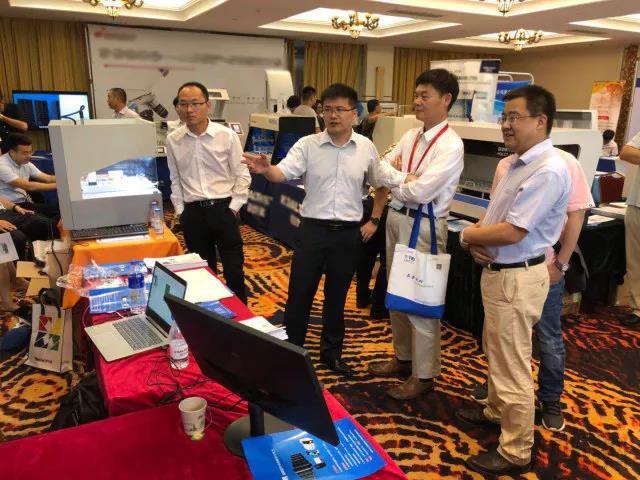
Professor Liu Dongge, Director of the Department of Pathology at Beijing Hospital, Visited the DeepWisdom Booth for Guidance
Based on this background, VCBeat interviewed Dr. Yang Zhiming, CEO of DeepThinking, to conduct an in-depth follow-up report on the company.
Team Background of the Chinese Academy of Sciences
In recent years, the advent of deep learning technology has ushered in a new wave of development in artificial intelligence. Moreover, healthcare represents a fundamental need for the general public and has received significant attention from the Chinese government. However, the uneven distribution of medical resources in China creates an urgent need for new technologies to alleviate and address these issues. Therefore, Yang Zhiming, a Ph.D. candidate specializing in artificial intelligence at the Institute of Software, Chinese Academy of Sciences, and his team have focused their entrepreneurial efforts on the healthcare sector.
Regarding the choice of cervical cancer screening, Yang Zhiming stated that the incidence of cancer is currently high and rising annually in China and worldwide, particularly for cancers such as cervical cancer and breast cancer. There is an urgent need to address a critical issue: the current state of cervical cytology screening. Domestic medical resources and physician staffing are severely insufficient; the ratio of pathologists to the population in China is only 1:70,000, compared with 1:2,000 in the United States.
Furthermore, manual interpretation of medical images by radiologists is time-consuming and labor-intensive. Each image requires approximately 5–10 minutes for review, limiting the daily workload to a maximum of around 100 images. The high volume of cases imposes significant pressure on radiologists, and factors such as fatigue, varying levels of expertise, and subjective interpretation result in a sensitivity of only about 65%.
Especially at the grassroots level, primary healthcare institutions are required by the government to conduct cervical and breast cancer screening for the local population; however, due to shortages in technology and professional personnel, the workload for these screenings is immense.AI-enabled approaches can rapidly enhance primary healthcare service capabilities and meet grassroots screening needs.
According to reporters, iDeepWise possesses a diverse array of AI capabilities, focusing on addressing critical needs and building healthcare solutions. iDeepWise AI uniquely integrates three core AI competencies—natural language processing and understanding, computer vision, and deep learning processors—a combination not typically found in other AI companies. In response to market demands in healthcare and wellness, Dr. Yang Zhiming and his team leverage these three AI technologies to provide both edge and cloud-based solutions.
“Cloud” and “Edge” Integrated Solution
In response to the challenges of high technical difficulty and low screening rates in primary cervical cancer screening, iDeepWise has developed productized solutions for AI-assisted cervical cytology screening in two forms: “cloud” and “edge.”
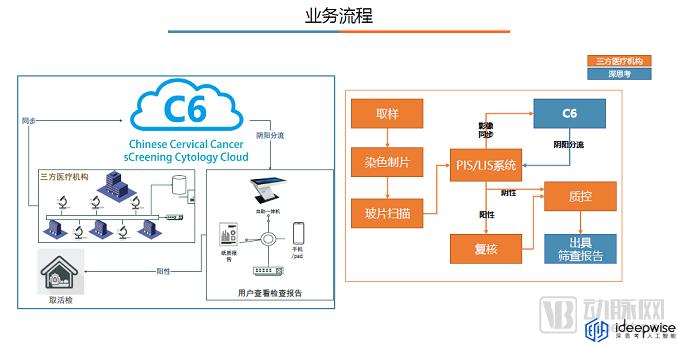
"Cloud" Model“AI Cloud for Cervical Cell Screening”: DeepThinking has established the Cervical Cancer Screening Cytology Cloud (C6). Primary care hospitals can connect to the C6 Cloud via pathology scanners, microscopes, and other devices. The C6 Cloud consists of a cluster of AI servers in the cloud. Once pathology scanners or microscopes are connected, the system automatically analyzes pathological cells, performing AI tasks such as segmentation, detection, and classification, and generates a screening report within 1–3 minutes.
High Adaptability: The system is compatible with terminal pathology scanners from the vast majority of manufacturers and accommodates pathological cell images generated by most reagent and consumable producers. Currently, numerous third-party agencies and medical institutions offer cervical cytology preparation services, employing varying methods, consumables, and staining protocols. Cell clusters in samples are common. DeepThinking addresses this by optimizing the adaptability and learning capabilities of its AI models to segment clustered cells and accommodate diverse sample types.
Dr. Yang Zhiming stated,Product-as-a-Service is a business model that DeepThinking highly emphasizes. By transforming products into services, large-scale adoption can be achieved. Therefore, from the outset of research and development, the DeepThinking team not only set extremely high standards for functional metrics such as sensitivity and specificity but also conducted in-depth R&D focused on non-functional factors, including high adaptability, ease of use, and user experience.。
In terms of usability, with deep consideration to ensure that it is exceptionally user-friendly for experts at tertiary hospitals, physicians at primary healthcare institutions, and staff at third-party health checkup and laboratory testing facilities. Furthermore, the system is seamlessly integrated into clinicians’ workflows, imposing no additional operational burden; in short, it is transparent, simple, and easy to use.
"Terminal" Mode: Leveraging the advantages of its independently developed M-DPU, an AI chip dedicated to the medical field, Deep Thinking has integrated common visual algorithms in healthcare with the M-DPU to create a one-stop solution. By embedding the M-DPU into a wide range of medical devices from partner companies, it serves as the “AI brain” for these devices, thereby empowering them with advanced intelligent capabilities.
Solutions based on “cloud” and “edge” models enable AI medical algorithm models to operate offline with high performance and high precision on medical terminal devices. The algorithm component comprises two parts: medical image recognition in diagnosis and treatment, and natural language description and interaction for medical images. Leveraging deep learning-based artificial intelligence technologies, the system supports functionalities such as screening for the “two cancers” (cervical cancer and breast cancer) and clinical consultations (including preoperative counseling and postoperative rehabilitation guidance).
Yang Zhiming told VCBeat that the core advantages of solutions based on the “cloud” and “edge” models can be summarized as follows:
High Speed: 70,000 Cells Classified in 90 Seconds
High performance, with classification accuracy up to 99.3%
High-throughput, single-load scanning of 1–480 samples
Multi-source, compatible with mainstream manufacturing methods
Multi-device compatibility, supporting a wide range of mainstream scanning devices
Functional positioning: rule out negatives (healthy)
Addressing the issue of positioning, Yang Zhiming stated that the difficulty in implementing artificial intelligence lies primarily in how AI is positioned and what expectations are placed upon it.
Unlike many other companies in the market,DeepThinking positions its product as ruling out negatives.(Normal and Healthy Samples)。Yang Zhiming stated that the ultimate function achieved by DeepThinking’s cervical cancer screening system is “triage of positive and negative results,” which excludes negative samples and subjects the remaining suspicious samples to further examination for confirmation.。
This product's functional positioning,The most critical issue is how to ensure that no false negatives occur.。
Dr. Yang Zhiming told reporters that, to ensure no diagnoses are missed, DeepThink has refined its algorithmic models to avoid false negatives, adhering to the principle of “better to falsely flag a thousand cases than to miss a single one,” thereby ensuring no omissions.
This results in a slightly higher false-positive rate. In response to this situation, Yang Zhiming stated,Currently, the negative exclusion rate of DeepThink’s new system stands at 81%, meaning that primary care physicians using DeepThink’s products can reduce their image interpretation workload by 81%.. Improving the rate of negative result detection has been a key focus of Shensikao’s R&D efforts, and Shensikao will continue to optimize this metric in the future.
Covering over 70% of third-party clinical laboratories
Yang Zhiming told VCBeat that with the reform of the medical and health system, cost containment in medical insurance and preventive measures for serious diseases have become concerns for all parties in the healthcare industry; therefore, the volume of health check-up screenings will continue to increase.
Currently, Deep Thinking primarily provides technical services to hospitals, third-party health examination centers, and clinical laboratories. This is particularly true for third-party clinical laboratories, which handle massive screening volumes and have an urgent demand for such technologies.
DeepThink generates technical service fees by conducting high-concurrency, large-scale cervical cell screening for these institutions. The fee structure is diverse, with options including per-screening charges or bundled service packages.service.
Since many primary healthcare institutions in practice outsource their pathological testing to third-party laboratories, Shensikao will prioritize collaborations with third-party testing providers in its future market development. Currently, its coverage among third-party testing institutions exceeds 70%.
Furthermore, DeepThink has co-established pathology departments with dozens of renowned Grade 3A hospitals to jointly build smart pathology departments. By empowering pathology services with AI technology, the company aims to establish viable business models for AI in the medical sector, effectively implement solutions in the broader healthcare industry, and ultimately benefit the general public.