

Yitu Healthcare and West China Hospital Launch Global First Multidisciplinary AI Diagnostic System for Lung Cancer
“Jointly established by West China Hospital and Yitu HealthcareIntelligent Disease-Specific Database for Clinical Research in Lung CancerCompleted2.8“Cross-system integration of full-cycle data from 10,000 lung cancer patients, with over one million clinical documents and reports and more than ten million raw medical images in the database.”
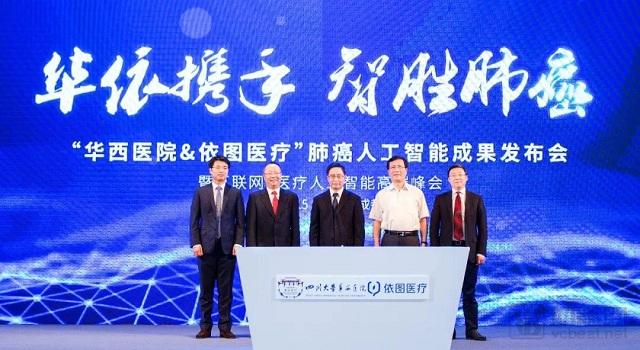
Recently, at the press conference on AI achievements in lung cancer held by West China Hospital and Yitu Healthcare, Dr. Li Weimin, President of West China Hospital, presented key data from China’s first intelligent disease-specific database for clinical research on lung cancer.
Additionally, both parties releasedThe World's First Multidisciplinary Intelligent Diagnostic System for Lung Cancer, the system is based onClinical Intelligence Research Disease Database for Lung Cancerand developed,It has evolved from merely describing imaging features to providing physicians with diagnostic and treatment plans, as well as similar cases for reference.
As a startup, Yitu Healthcare’s products have been integrated into clinical workflows, deeply penetrating every stage of disease prevention, screening, diagnosis, treatment, and scientific research, while establishing in-depth partnerships with top-tier hospitals across China, such as West China Hospital.
On what basis does Yitu Healthcare position its product R&D direction to ensure that all products find application scenarios? And how has it gained the favor of top-tier hospitals such as West China Hospital? VCBeat conducted an interview and report to address these questions.
Disease Library Provides Support for Medical AI R&D
As is well known, the research and development of artificial intelligence applications relies heavily on high-quality medical big data. In particular, with the advancement of medical AI, enterprises have moved beyond developing products based solely on single-modality imaging or text data.
In actual clinical practice, when making diagnoses or formulating treatment plans for serious conditions such as cancer, physicians often comprehensively integrate multidisciplinary and cross-domain medical information, including imaging, genomics, pathology, and clinical text. Conclusions drawn from a single source of information offer limited assistance to clinicians. Therefore, constructing a comprehensive clinical database covering the entire patient journey and leveraging it for product development is highly meaningful.
The national release by West China Hospital and Yitu HealthcareThe First Intelligent Disease-Specific Database for Clinical Research in Lung CancerThis study incorporates comprehensive, de-identified data from patients with pathologically confirmed lung cancer treated at West China Hospital from 2009 to the present. The dataset encompasses imaging, genomic, pathological, and textual information. By leveraging artificial intelligence technologies, we performed data cleaning, parsing, and reconstruction on large volumes of non-standardized, unstructured clinical data, thereby achieving visualization and structuring. This process transforms the data into authentic medical big data, laying a solid foundation for the research and development of AI-driven comprehensive diagnostic applications for lung cancer.
Multidisciplinary Intelligent Diagnostic System Meets Clinical Needs
Ni Hao, President of Yitu Healthcare, stated that prior to collaborating with West China Hospital, Yitu Healthcare already had relatively mature products in the field of imaging assistance integrated into clinical workflows. However, the company never ceased its exploration of more cutting-edge product development to maintain the forward-looking nature of its offerings. Through this collaboration with the team at West China Hospital, both parties have jointly embarked on a path toward intelligent comprehensive diagnosis that is better suited for clinical practice.
Based on the jointly established clinical intelligent research disease library for lung cancer,Intelligent Multidisciplinary Diagnostic System for Lung CancerIt has evolved from merely describing imaging features to providing physicians with diagnostic and treatment plans, as well as similar cases for reference.
This system leverages deep learning and natural language processing technologies to build disease risk prediction models based on genetic factors, lifestyle habits, and environmental risks. It integrates and structures clinical records, multimodal imaging, tumor markers, and genetic testing results, while conducting comprehensive patient diagnoses in accordance with authoritative medical guidelines, thereby providing physicians with practical and effective support.
R&D Direction Determines a Company’s AI Prospects
Since the rise of the new generation of artificial intelligence technologies, VCBeat has conducted a brief statistical analysis, revealing that hundreds of medical AI companies have emerged worldwide, with over 100 based in China. Among them, some companies have grown increasingly larger and stronger, while others have failed and gradually vanished in this era of fierce competition. Many factors underlie these outcomes, but R&D direction and partnerships are particularly critical.
As the new generation of medical AI emerges, most companies position their products as auxiliary diagnostic tools developed based on single-modality imaging data, covering a wide range of major diseases and tumors. These products are largely designed to improve upon or replace Computer-Aided Diagnosis (CAD) systems that originated in the 1990s, which failed to achieve widespread adoption due to issues with accuracy and usability. However, there is market demand for such auxiliary diagnostic systems for initial diagnosis, and the rise of new-generation AI technology enables more precise auxiliary diagnostics.
As R&D efforts deepen, these technology companies are gaining an increasingly profound understanding of clinical practice. How to effectively address clinicians’ challenges and determine the direction for new product development has become one of the key factors determining the survival of many medical AI startups.
For physicians, clinical practice, scientific research, and teaching constitute the three core components of their professional responsibilities. Clinical practice, in particular, encompasses diagnosis and treatment, a process that involves the analysis and interpretation of diverse data types, including textual records and medical imaging. As a tool, AI must be leveraged to develop products that align with physicians’ work habits and seamlessly integrate into their clinical workflows; this is the key to the viability and sustainability of medical AI products.
In September 2017, Yitu Healthcare unveiled its “AI + Healthcare” end-to-end medical R&D platform for the first time, covering areas such as intelligent auxiliary diagnosis of lung cancer, electronic medical records (EMR), mammography/ultrasound imaging, neurological MRI, clinical decision support systems, and research assistance platforms.
These end-to-end medical products, covering both imaging and text, are clinically based and integrated into healthcare workflows.
The newly released Intelligent Disease-Specific Database for Clinical Lung Cancer Research and the Intelligent Multidisciplinary Diagnostic System for Lung Cancer were both developed through deep engagement with clinical practice, addressing real-world clinical and research needs. Building upon the description of lesion imaging features, these products aim to provide physicians with diagnostic and treatment recommendations as well as similar case references. Guided by multidisciplinary medical guidelines and leveraging multimodal, full-cycle clinical data, the systems achieve comprehensive coverage of lung cancer–related signs and findings.
Ni Hao, President of Yitu Healthcare, stated that these products will further facilitate the decentralization of high-quality medical resources and enhance the service capacity of primary healthcare institutions.
Medical AI Requires Multi-Party Collaboration Among Government, Industry, Academia, Research, and Healthcare
One of the co-launchers of this product, West China Hospital, has ranked first in China for its scientific research strength in multiple rankings. The hospital had its own considerations in selecting Yitu Healthcare as its partner.
Dean Li Weimin stated, “The development of medical AI requires multi-party collaboration among government, industry, academia, research institutions, and end users. While there are numerous medical AI enterprises currently, hospitals exercise great caution in selecting partners, as unsuccessful collaborations can undermine the confidence of both hospitals and physicians in medical AI. West China Hospital boasts the strongest scientific research capabilities in China, with distinct advantages in clinical practice, talent, and research. We need a partner capable of effectively implementing products into clinical practice, and Yitu Healthcare meets these requirements.”
In addition, President Li Weimin stated that another reason for the collaboration is the mutual willingness to establish a standardized database. West China Hospital possesses extensive patient data; however, much of this data remains unprocessed, and its value has not been fully realized. The hospital aims to build a comprehensively annotated database to maximize the utility of its data.