

Hengrui and BMS reach $15.2 billion global strategic collaboration: Co-Co two-way licensing + anniversary payment, 13 early-stage projects to advance in parallel

Hengrui Pharma
Innovative and High-Quality Pharmaceutical Developer
Bristol-Myers Squibb
Biopharmaceutical and Nutritional Product R&D and Sales
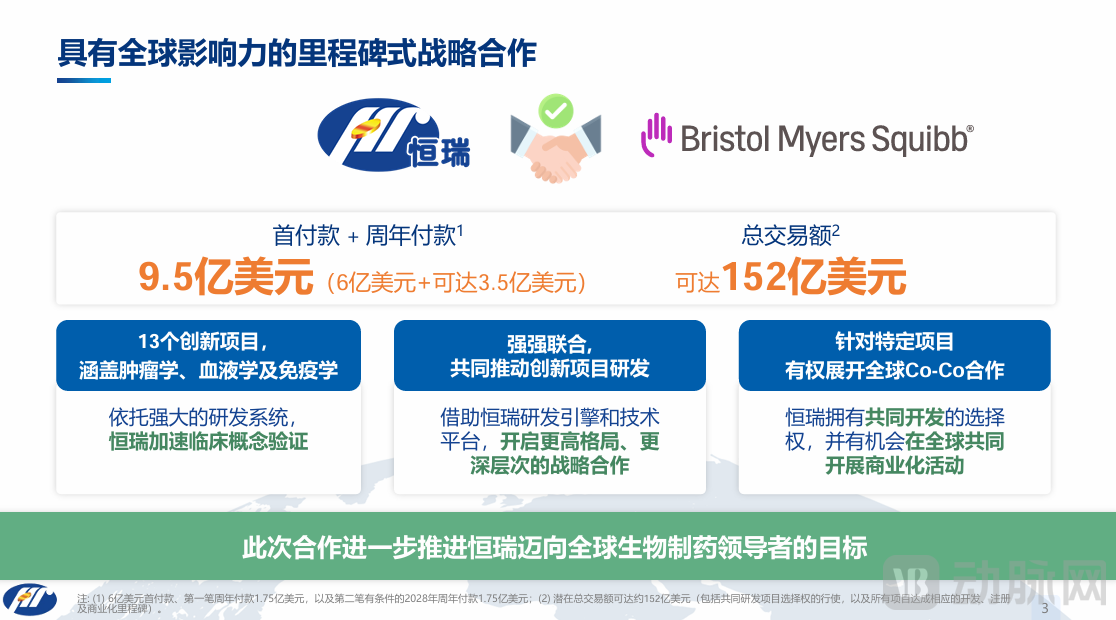
On May 12, Hengrui Pharma and Bristol Myers Squibb announced that they had reached a global strategic cooperation and licensing agreement to jointly advance 13 early-stage projects covering oncology, hematology, and immunology.
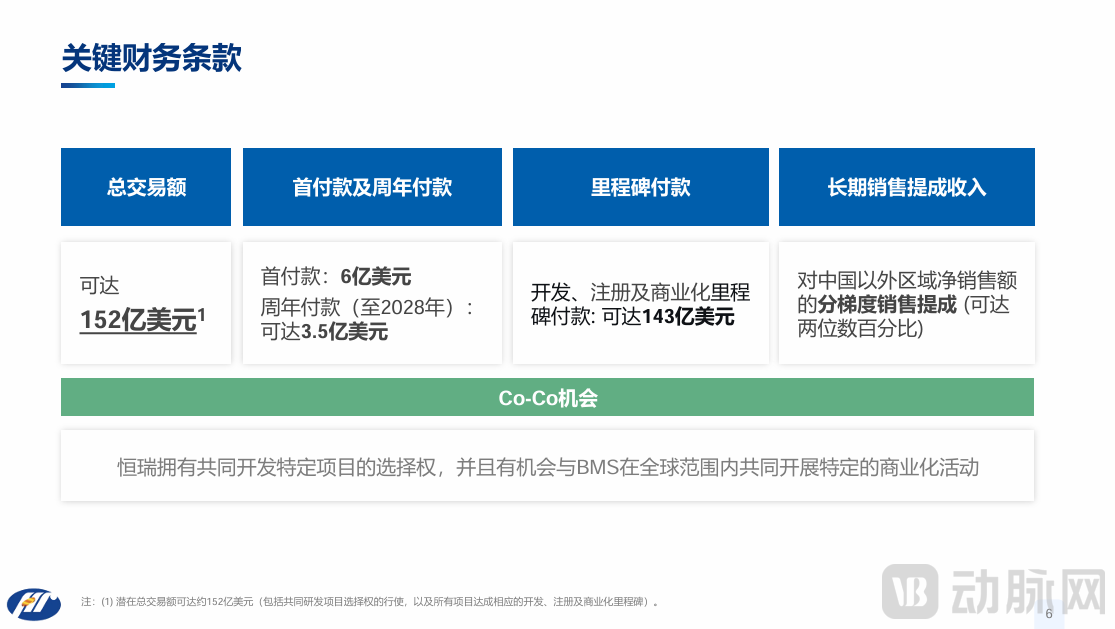
The potential total transaction value of the agreement can reach approximately $15.2 billion (including the exercise of co-development project selection rights, and all projects achieving corresponding development, registration, and commercialization milestones). According to the terms of the agreement, BMS will pay Hengrui Pharma up to $950 million related payments ($600 million upfront payment, the first anniversary payment of $175 million, and the second conditional anniversary payment of $175 million in 2028). Moreover, Hengrui Pharma has the right to collect corresponding tiered sales royalties from BMS based on the net sales of the product (excluding mainland China, the Hong Kong Special Administrative Region, and the Macao Special Administrative Region).
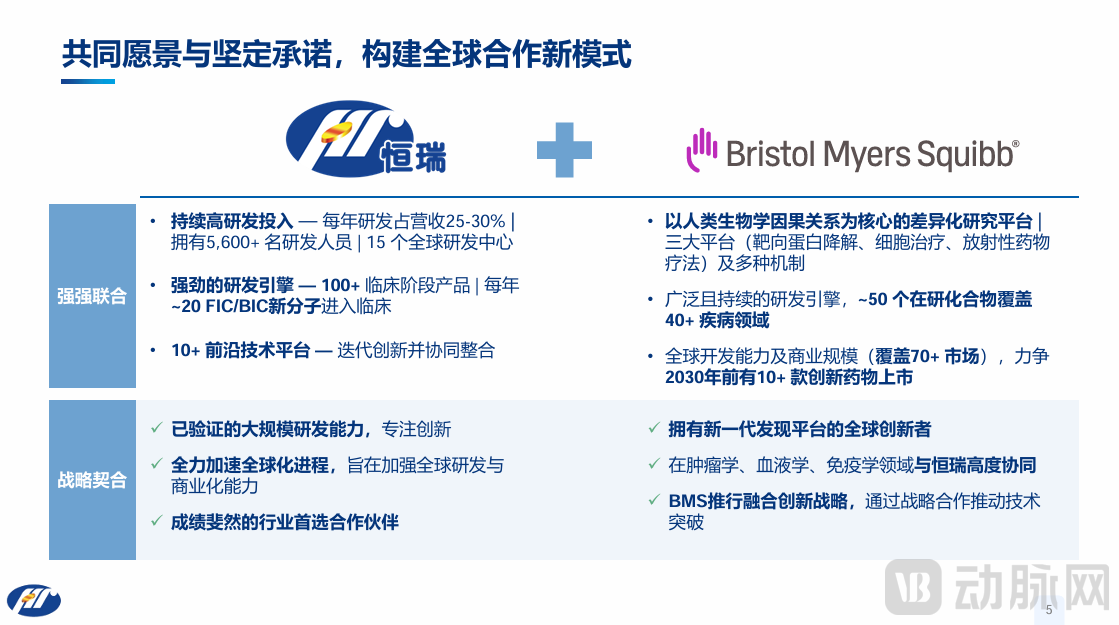
This cooperation agreement includes four Hengrui Pharma oncology and hematology projects, four BMS immunology projects, and five innovative projects jointly developed by both parties leveraging Hengrui's R&D engine and diversified innovative technology platforms. Hengrui Pharma has the option to co-develop specific projects and the opportunity to collaborate with BMS on specific commercialization activities globally.
Affected by the licensing news, the share price of Hengrui Pharma surged in the afternoon. Its A-share once rose over 9%, with its market value breaking through the 380 billion RMB mark; its H-share once surged over 16%.
Hengrui Pharma, the leading innovator, has transitioned from purely exporting pipelines to embracing a new licensing ecosystem of "two-way licensing" and "shared Co-Co opportunities."
113 Pipeline "Bi-directional Authorization" and the Co-Co Opportunities Behind It
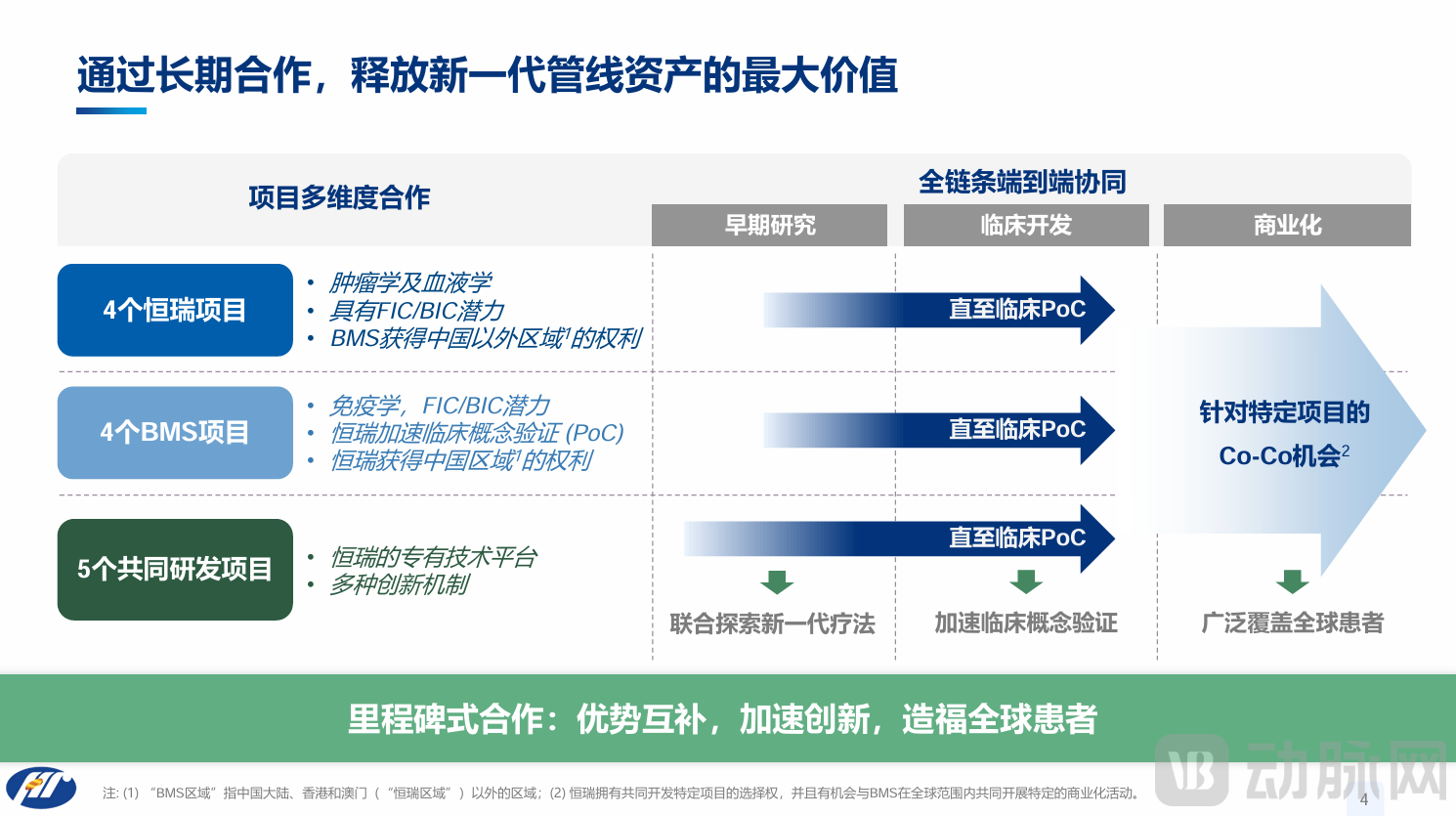
Under the framework of this cooperation, BMS receives exclusive global rights (excluding mainland China, the Hong Kong Special Administrative Region, and the Macao Special Administrative Region) to the aforementioned Hengrui-discovered projects (four oncology and hematology projects) and the projects co-developed leveraging Hengrui's platform (five innovative projects). Hengrui Pharma receives exclusive rights to the aforementioned BMS-discovered projects (four immunology projects) in mainland China, the Hong Kong Special Administrative Region, and the Macao Special Administrative Region, while BMS retains rights to the rest of the world outside these regions.
In brief, the 13 early-stage innovative projects under this agreement come from three sources: Hengrui's independent R&D, BMS's independent R&D, and joint R&D leveraging Hengrui's platform. The two parties will share exclusive global rights to these 13 projects — meaning that Hengrui and BMS have effectively formed a "two-way licensing" arrangement. Meanwhile, Hengrui will be fully responsible for the early clinical development of the aforementioned projects to accelerate clinical proof-of-concept.
During Hengrui's online investor meeting held on the afternoon of May 12, the company indicated that the transaction involves a portfolio of best-in-class / first-in-class products and "leverages Hengrui's platform for joint R&D of innovative projects." This includes not only clinical proof-of-concept for individual pipelines but also collaborative exploration of next-generation therapies.
In the press release, Dr. Robert Plenge, Executive Vice President and Chief Research Officer of BMS, used a rare expression—"demonstrating our disciplined and prudent approach to portfolio management"—directly pointing to the "partner relationship" of shared risks and mutual benefits underlying the "two-way licensing."
The investor online meeting further highlighted the "Co-Co opportunities" of this collaboration: Hengrui has the option to co-develop specific projects and the opportunity to collaborate with BMS on specific commercialization activities globally.
"Co-Co" refers to a novel collaboration model of "co-development + co-commercialization." For Hengrui, the leading innovator, the Co-Co model represents an overall enhancement of its bargaining power in global collaboration, channels, clinical development, and pricing, minimizing the resistance of "borrowing a boat to go global." For MNCs represented by BMS, they are willing to cede a portion of profit shares and territorial rights in exchange for exclusive rights to high-quality Chinese innovative drug pipelines in their core U.S. market, while jointly advancing clinical development and commercialization in China, the second largest market.
However, a fact is often overlooked: Co-Co opportunities are essentially a "game for the strong"—requiring the partner (typically the innovative drug company) to have sufficient cash flow to support at least 40% or 50% of global clinical R&D costs, as well as an international medical and regulatory affairs team capable of engaging with MNCs as equals.
Co-Co is not for everyone. But the leading innovator more than has the strength, directly stepping up to take full responsibility for early clinical development. In particular, Hengrui's retention of exclusive rights to the 13 projects in mainland China, the Hong Kong Special Administrative Region, and the Macao Special Administrative Region is a direct manifestation of sharing risks and benefits.
Drawing on past global Co-Co models, as the programs advance to later stages, the two parties may further establish a "risk-sharing, profit-sharing" agreement:
Cost sharing: Both parties jointly fund subsequent high-cost global multi-center clinical trials according to an agreed ratio (e.g., 4:6 or 5:5).
Benefit sharing: After product launch, in specific markets, both parties jointly establish teams for promotion according to an agreed ratio, or build respective commercialization teams based on exclusive territorial rights, and ultimately share a certain percentage of the profits earned.
2$600 Million Upfront payment, $350 million "transitional" anniversary payment
Corresponding to the relatively complex structure of "two-way licensing + joint R&D," the most noteworthy feature of this transaction is its payment model. Unlike traditional licensing deals, which typically adopt a binary structure of "upfront payment + milestone payments," Hengrui and BMS have introduced an "Anniversary Payment" as an interim payment mechanism.
The core innovation lies in the fact that the Anniversary Payment is a payment obligation triggered by both "time and milestones." The underlying logic is as follows:
$600 million upfront payment: Payable upon official closing of the agreement, subject to regulatory approvals and customary closing conditions.
First $175 million anniversary payment: Payable one year after the effective date of the agreement, unconditionally (as long as the agreement remains in effect) or subject to undisclosed conditions.
Second $175 million anniversary payment: Payable in 2028, but designated as "conditional," potentially subject to specific prerequisites.
Under past transaction models, the originating party (typically the innovative drug company) was constrained by a single evaluation dimension: milestone/outcome-triggered payments. As a result, BD revenue was highly dependent on milestone payments, performance was closely tied to clinical progress, and long-term evaluation in both primary and secondary markets was limited.
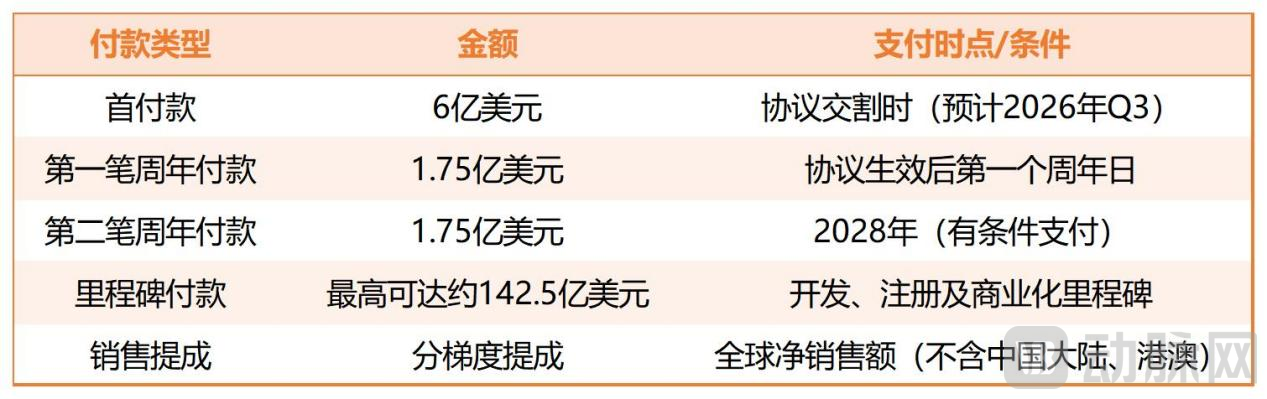
(Chart by VCBeat)
This transaction as a whole adopts a four-tier payment structure of "upfront payment + anniversary payment + milestone payments + sales royalties," achieving a balance among short-term certainty, medium-term sustainability, and long-term potential. For Hengrui, the anniversary payment will provide additional near-term predictable income, significantly improving its financial outlook for the next two to three years. Under the dual conditions of "time and milestones," it will reduce the revenue risk associated with clinical uncertainty to a certain extent. For BMS, deferring a portion of the consideration in staged payments will optimize its short-term cash flow and financial reporting. The first anniversary payment and the second conditional anniversary payment provide it with decision-making flexibility across multiple projects, allowing for multiple assessments over time.
At a fundamental level, the two parties are establishing a closer strategic relationship of mutual trust and long-term collaboration through the substantive terms of the anniversary payment. In essence, this transaction is closer to a strategic alliance—from the collaboration structure to the payment model. It is not merely a consideration for products, but also a pricing of the continuity of the collaborative relationship. This structure may become a new paradigm for platform-based, multi-project collaborations between Chinese pharmaceutical companies and multinational giants.
3Over $42.2 Billion Potential Total, Hengrui Pharma Accelerates Global Licensing Deals
Looking further, this transaction represents the normalization of Chinese innovative drug licensing deals entering the "tens of billions of dollars club." In less than a year, Hengrui has consecutively completed two mega-deals—one with GSK valued at 12.5 billion RMB and another with BMS valued at 15.2 billion USD—demonstrating that the global value of Chinese innovative drugs has been systematically recognized by top-tier MNCs.
According to Hengrui's 2025 annual report, the company has completed 12 overseas licensing deals since 2023, including out-licensing, NewCo, and strategic alliances, with a total potential transaction value exceeding 27 billion USD. With the addition of this transaction's potential total of 15.2 billion USD, the total potential value of Hengrui's overseas licensing deals exceeds 42.2 billion USD.
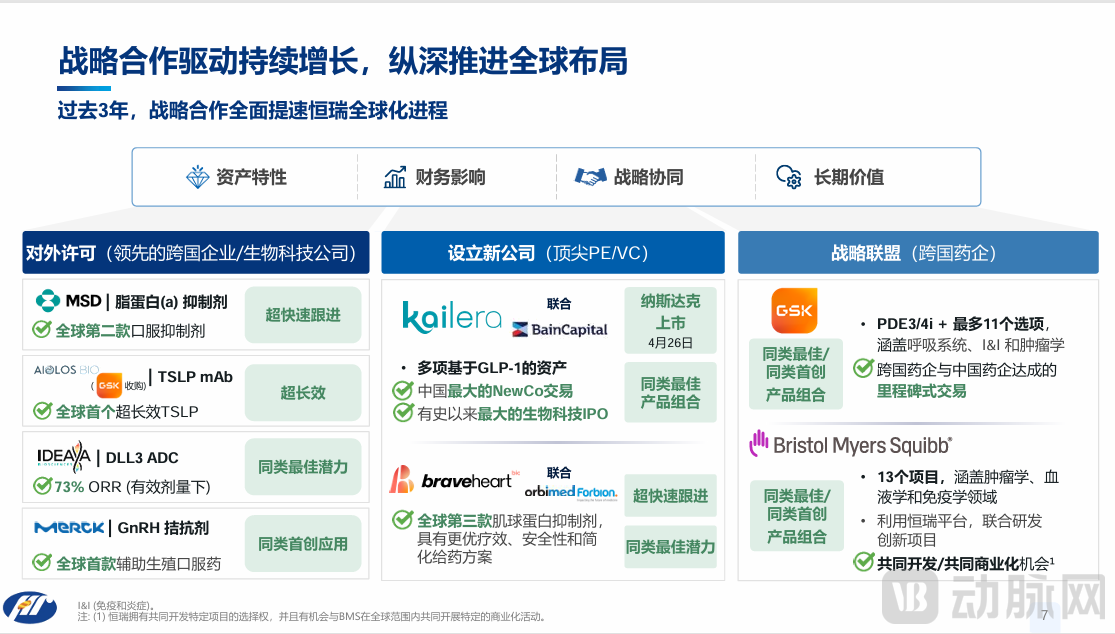
Breaking it down, the two recent mega-deals exceeding 10 billion USD each are both long-term strategic alliances with MNCs, fully demonstrating the deep collaboration and abundant trust between the parties. The collaboration with BMS involves 13 pipelines covering oncology, hematology, and immunology. The collaboration with GSK involves the co-development of up to 12 innovative drugs, including the PDE3/4 inhibitor HRS-9821, with Hengrui receiving an upfront payment of 500 million USD and potential option exercise fees, milestone payments, and corresponding sales royalties totaling approximately 12 billion USD.
On the other hand, Hengrui's comprehensive responsibility for the early clinical development in this collaboration (with BMS) can be seen as a milestone achievement from its accelerated advancement of global clinical trial processes in recent years. Recently, Hengrui opened a new clinical R&D and collaboration center in Boston, USA. It currently has 15 R&D centers across Asia, Europe, the Americas, and Australia, and has initiated first-in-human overseas clinical trials for multiple innovative drugs.
In 2025, Hengrui appointed Yu Liu, former Vice President of Oncology at Bristol Myers Squibb, as its International Chief Medical Officer, responsible for driving clinical development in the United States and regions outside of China.