

Beijing-based sports medicine-focused Star Sports Medicine lists on HKEX

Star
Provider of Comprehensive Clinical Solutions in Sports Medicine
On May 5th, Beijing Star Sports Medicine officially debuted on the Hong Kong Stock Exchange. With an offering price of HK$98.5 per share, it opened at HK$288. As of press time, its latest share price stands at HK$246, valuing the company at HK$13.49 billion.
Headquartered in Beijing E-Town (Beijing Economic-Technological Development Area), the company is widely regarded as the "first domestically listed sports medicine company on the Hong Kong stock market." As a Chinese domestic enterprise highly focused on the sports medicine sector, Star Sports Medicine does not engage in cardiovascular or major joint orthopedics, but instead concentrates all its efforts on the specialized field of sports medicine. According to its prospectus, as of the end of 2025, its products had been adopted in more than 3,000 hospitals, covering over 1,000 top-tier hospitals in China. In the Chinese sports medicine implant market, the company ranks first among domestic players and fourth overall. In the surgical equipment market, it ranks first among domestic players and sixth overall.
This milestone represents not only a capitalization event for a single company, but also a symbolic moment in which the Chinese domestic sports medicine industry has transitioned from "following" to "running alongside" global leaders.
Star Sports Medicine is registered in Beijing E-Town. On the surface, it is merely a corporate location choice; but if we take a longer-term perspective, Beijing E-Town has played a far bigger role in the company's growth than acting as a simple landlord.
In 1992, the construction of Beijing Economic-Technological Development Area officially broke ground in what is now Beijing E-Town. Back then, the area was nothing but farmland, 20 kilometers away from Tiananmen, and barely marked on the map.
More than 30 years later, Beijing E-Town has grown into the core hub of Beijing's real economy. It features four major industrial clusters: new-generation information technology, high-end automobiles and new energy intelligent vehicles, biotech and big health, as well as robotics and intelligent manufacturing, with its total output value exceeding 600 billion RMB.
Biomedicine was not an initial flagship industry in Beijing E-Town. As late as 2001, the output value of its bioengineering and pharmaceutical industry was only 667 million RMB. Nevertheless, local authorities clearly recognized the enormous potential of the biomedical sector and listed it as one of the leading industries for priority development in the Tenth Five-Year Plan.
In 2008, Beijing E-Town was accredited as the National Beijing Biomedical Base. Since then, the local biomedical industry has entered a high-speed growth track. By 2022, the output value of the biomedical industry in Beijing E-Town had reached 90 billion RMB, with 21 listed enterprises accumulated. By 2025, the zone had home to over 5,300 biomedical market entities, 25 listed companies, and a workforce of more than 50,000 employees.
After years of cultivation, the biomedical industrial layout of Beijing E-Town has become remarkably strong and complete.
Two global giants, Bayer and GE Healthcare, have set up production bases here. Leading domestic pharmaceutical enterprises including Pharmaron, JOINN Laboratories, SinoCellTech and Tide Pharmaceutical have established solid roots in Beijing E-Town. Innovative enterprises such as Jacobio Pharma, Youcare Pharmaceutical, Staidson and Biocytogen have also flourished here. Covering new drug R&D, CRO/CDMO services, diagnostic reagents and medical devices, Beijing E-Town has basically built a full industrial chain ecosystem.
Frankly speaking, the success of Beijing E-Town relies not only on favorable land prices and tax incentives, but more importantly on a comprehensive innovative service system supporting enterprises across all links. As early as 2011, Beijing E-Town Biomedical Park established a full-life-cycle incubation system of nursery — incubator — accelerator — industrialization, accommodating over 340 technology-oriented enterprises and more than 200 ongoing R&D projects.
Later, six major institutions including the NMPA Center for Drug Evaluation (CDE) and Center for Medical Device Evaluation (CMDE) settled in Beijing E-Town, fundamentally shortening the time and distance for innovative drugs and medical devices to go from laboratory to market. In 2023, Beijing had 5 Class I innovative drugs approved for marketing, among which 4 were developed by enterprises based in Beijing E-Town.
In accordance with the latest development plan, Beijing E-Town strives to lift the industrial output value of its healthcare industry to over 120 billion RMB by 2027, with the number of approved innovative drugs and medical devices rising to more than 25.
Within the biomedical landscape of Beijing E-Town, high-end medical devices represent a distinctive niche segment. Unlike the prosperous new drug R&D track, medical devices impose stricter requirements on manufacturing craftsmanship, supply chain management and clinical registration, and usually require a longer industrial incubation cycle.
The settlement of Bayer and GE Healthcare is of landmark significance to Beijing E-Town, bringing in international talent reserves, supporting supply chains, and sophisticated quality management standards — vital industrial soft infrastructure. These benchmark systems have provided valuable references for later local enterprises. For example, Longwood Valley MedTech excels in orthopedic surgical robots, Union Strong in cerebrovascular intervention, and WeMed in high-end imaging equipment.
Star Sports Medicine has anchored itself in an even more segmented track — sports medicine implants, filling the last blank of Beijing E-Town's layout in specialized high-value medical consumables.
Founded in 2017, Star Sports Medicine has enjoyed notably higher registration and approval efficiency for its products than the industry average, backed by the full industrial chain services of Beijing E-Town. Up to now, the company has obtained 27 NMPA Class III registration certificates and 25 NMPA Class II registration certificates, with two products recognized as innovative medical devices.
Beijing E-Town's "1+N" industrial policies and "Ten Talent Policies" have accompanied Star Sports Medicine throughout its journey from startup to IPO. Policy tools such as R&D investment incentives, international market expansion subsidies and output growth rewards have delivered targeted support at critical stages of corporate development. The annual 1 billion RMB talent fund pool has also helped the company attract and retain high-end R&D talents.
According to the prospectus, by the end of 2025, Star Sports Medicine's R&D team had 180 members, accounting for 21.7% of the total staff, including 38 PhD holders and 62 master's graduates, with master and PhD talents accounting for over 55% of the team. Fueled by continuous R&D input, the company won the Second Prize of Beijing Municipal Science and Technology Progress Award in 2024 for core breakthroughs including the preparation technology of functionally graded bioabsorbable materials.
Another highlight lies in Beijing E-Town's unique approach to helping local enterprises go global. Local authorities regularly organize enterprises into an "Intelligent Manufacturing Delegation" to attend top international medical device exhibitions such as MEDICA in Düsseldorf, Germany. For Star Sports Medicine, this model of going global in clusters allows it to build overseas brand recognition at lower cost, bringing enormous benefits to the company.
All these efforts have helped Beijing E-Town welcome its 26th listed enterprise in the medical and healthcare sector.
Enterprises nurtured in such an environment naturally develop a systemic product logic.
As of the end of 2025, Star Sports Medicine had 63 approved products, covering three major segments: implants, surgical equipment and consumables, and regenerative repair and rehabilitation. These address soft tissue repair in six major joints: shoulder, knee, ankle, elbow, wrist, and hip.
Implants are Star Sports Medicine's core business, contributing 77% of its revenue. Among these, the suture anchor is its flagship product, including China's first all-suture anchor and the first knotless all-suture anchor. Together with interference screws, cortical fixation buttons, and meniscal repair systems, these form a complete implant matrix covering mainstream surgical scenarios from rotator cuff repair to anterior cruciate ligament (ACL) reconstruction.
Surgical equipment and consumables contribute the remaining 23% of revenue, including powered devices (e.g., plasma surgery systems) and supporting consumables. It is worth noting that Star Sports Medicine provides both equipment and procedure-specific consumables – this "device + consumable" combination helps enhance customer loyalty and increase revenue per customer.
Regenerative repair and rehabilitation represents a key strategic move to complete the full "prevention – treatment – rehabilitation" chain. Currently, products for joint soft tissue regeneration and repair have been approved. In addition, an AI-guided postoperative rehabilitation product, the "Exercise Prescription Rehabilitation System," has also been approved, extending services from in-hospital surgery to out-of-hospital recovery.
According to its prospectus, Star Sports Medicine has built four technology platforms: biomaterials, imaging and power, smart healthcare, and tissue engineering. Its pipeline includes more than 30 products in development. Among these, the most anticipated is the AI-driven arthroscopic surgical robot, which is expected to receive approval in 2027. Once this product successfully reaches the market, Star Sports Medicine will evolve from a medical device and consumables supplier into a comprehensive surgical solution provider.
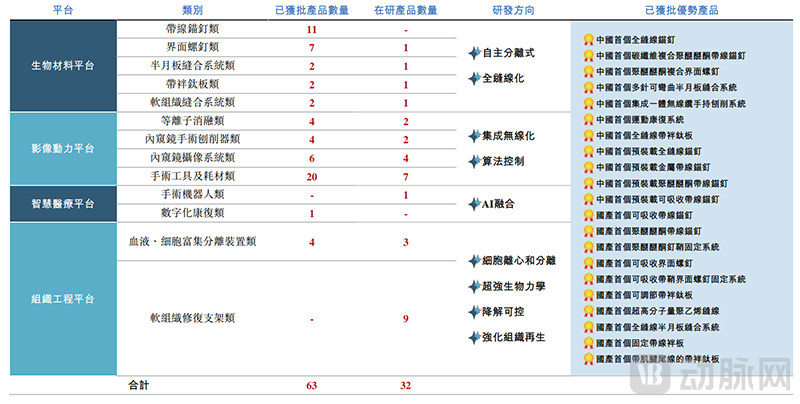
Star Sports Medicine Product Pipeline (Image from the prospectus)
However, this product system faces a market where volume-based procurement (VBP) has become the norm. The impact of VBP is an unavoidable topic. How Star Sports Medicine can achieve growth under the backdrop of VBP is the focal point of industry attention.
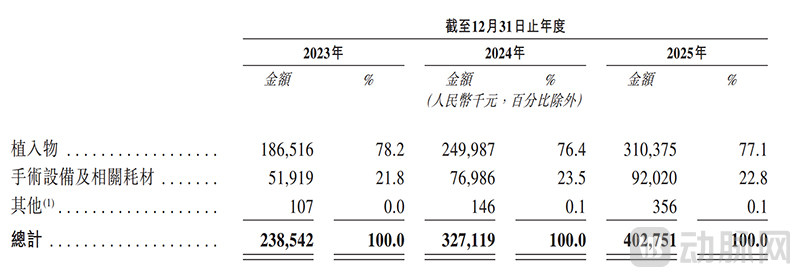
Star Sports Medicine Financial Data (Image excerpt from the prospectus)
From 2023 to 2025, Star Sports Medicine's revenue grew from RMB 238.5 million to RMB 402.8 million, representing a compound annual growth rate of approximately 30%, while net profit increased from RMB 57.11 million to RMB 137.0 million. The selling expense ratio decreased from 27.7% in 2023 to 20.0% in 2025, demonstrating a clear cost dilution effect driven by economies of scale.
In 2024, 14 of Star Sports Medicine's core implant products were included in volume-based procurement. The weighted average unit price dropped from RMB 711.9 to RMB 436.9, a decline of over 37%. However, sales volume surged from 262,000 units to 710,000 units, growing 1.7 times in two years. These 14 products generated RMB 186.5 million in revenue in 2023, which increased to RMB 310.4 million in 2025. At least in Star Sports Medicine's case, the strategy of exchanging price for volume has delivered tangible results.
In addition, Star Sports Medicine reduced costs by improving manufacturing processes, optimizing raw material procurement, and increasing product yield, while also launching new high-value-added products to offset the pricing pressure from volume-based procurement. In terms of gross margin, the gross margin for implants fell from 79.0% in 2023 to 72.4% in 2024, but rebounded to 77.1% in 2025, with the overall gross margin recovering to 74.1%. The gross margin for surgical equipment and consumables also increased from 57.6% to 64.2%.
The growth in overseas revenue is equally noteworthy. In 2023, Star Sports Medicine's overseas revenue, including Hong Kong, Macau, and Taiwan, was only RMB 6.666 million. By 2025, it had reached RMB 70.266 million, growing more than tenfold in three years, with its share rising from 2.8% to 17.4%. Currently, the company covers more than 66 overseas distributors, and international markets are becoming its fastest-growing business segment.
Star Sports Medicine previously terminated its application for a listing on the STAR Market in Shanghai in June 2024. However, it subsequently shifted its focus to Hong Kong and ultimately succeeded in its initial public offering. The rapidly growing sports medicine market played a significant role in this success.
According to data from Frost & Sullivan, China's sports medicine market was approximately RMB 5.4 billion in 2024 and is expected to reach RMB 12.1 billion by 2030, representing a compound annual growth rate of 14.3%. Although international giants still hold approximately 59.3% of the market share, and Star Sports Medicine still lags significantly behind global leaders such as Smith & Nephew and Johnson & Johnson, it has established a leading position among domestic Chinese companies.
Considering the significant headroom for domestic substitution in China, along with its demonstrated cost-control capabilities under the volume-based procurement regime, Star Sports Medicine has built certain competitive moats in this sector. Furthermore, its full-cycle strategy covers the entire prevention, treatment, and rehabilitation chain, and the tenfold growth in overseas revenue over three years is a force that cannot be ignored.
Overall, from its setback on the STAR Market to its breakthrough in Hong Kong, Star Sports Medicine's path to listing has not been smooth. In less than ten years, it has grown from a startup in E-Town into a sector leader with over 3,000 hospital adoptions and revenue exceeding RMB 400 million. Whether it will stop at the glory of being the first domestic sports medicine stock listed in Hong Kong, or go on to write a much bigger story — only time will tell.