

At the world's largest academic conference, Chinese innovative drugs edge out MNCs
Hansoh Pharma
Pharmaceutical Research, Production, and Sales
From April 18 to 22, local time, the 2026 American Association for Cancer Research (AACR) Annual Meeting was held as scheduled in San Diego, USA. AACR is the oldest, largest, most comprehensive, and most source-innovative top academic organization in the global oncology field, serving as the "source and bellwether" of cancer research. Cancer Research, published by AACR, is revered as the "bible-level" journal in oncology and has consistently ranked first globally in citation volume.
Since the concentrated breakthroughs of ADCs stole the spotlight at AACR in 2024, presenting at AACR has become one of the core priorities for China's domestic biotech companies in the first half of each year. In 2026, the enthusiasm of Chinese biotechs remains undiminished, with 104 pharmaceutical companies presenting over 250 achievements at the conference, setting a new historical record. More importantly, at AACR 2026, Chinese innovative drugs have, for the first time, collectively taken center stage at this premier international academic event. Although the disruptive impact has not been enormous, this shift will have a more profound influence on Chinese innovative drugs than the boom in out-licensing deals.
Stand on the Highest Stage
At this year's AACR, the biggest highlight for China's domestic biotech companies was that four China-developed pipeline assets managed to secure spots in the Clinical Trial Plenary (CTP) session, a segment long dominated by multinational corporations (MNCs).
As the centerpiece of each year's AACR, the CTP is the most hardcore part of the entire annual meeting. Under the conference structure, AACR provides multiple tiers of presentation platforms for researchers and pharmaceutical companies, including the oral presentation platform (CTP), Clinical Trial Mini Symposia, and the poster presentation platform (Clinical Trial Posters). Among these, the CTP represents the highest tier, with only around a dozen research achievements selected each year. According to the official definition, the CTP is a platform that showcases innovative therapies and key data that have the potential to significantly change clinical practice. Research findings presented at the CTP are often regarded as important references by global treatment guidelines, regulatory authorities, and pharmaceutical companies alike.
For pharmaceutical companies, the significance of the CTP is even more direct: securing a spot provides the most authoritative endorsement for a pipeline asset, after which subsequent clinical advancement, out-licensing deals, and commercial rollout become much easier, sometimes even triggering a surge in stock price. As a result, many companies make it their primary goal to get their assets into the CTP. Historically, CTP slots have been locked down by MNCs. China's domestic biotech companies have been presenting at AACR for many years, yet it was not until 2025 that Hansoh Pharma made the first breakthrough into the CTP. At the CTP of AACR 2025, Hansoh Pharma presented two studies on data for almonertinib. Two months after the conference, almonertinib was approved in the United Kingdom, becoming the first China-discovered and developed EGFR-TKI to be launched in a major European country, marking the transition of "Made in China, Good Drugs" toward becoming a global standard-of-care.
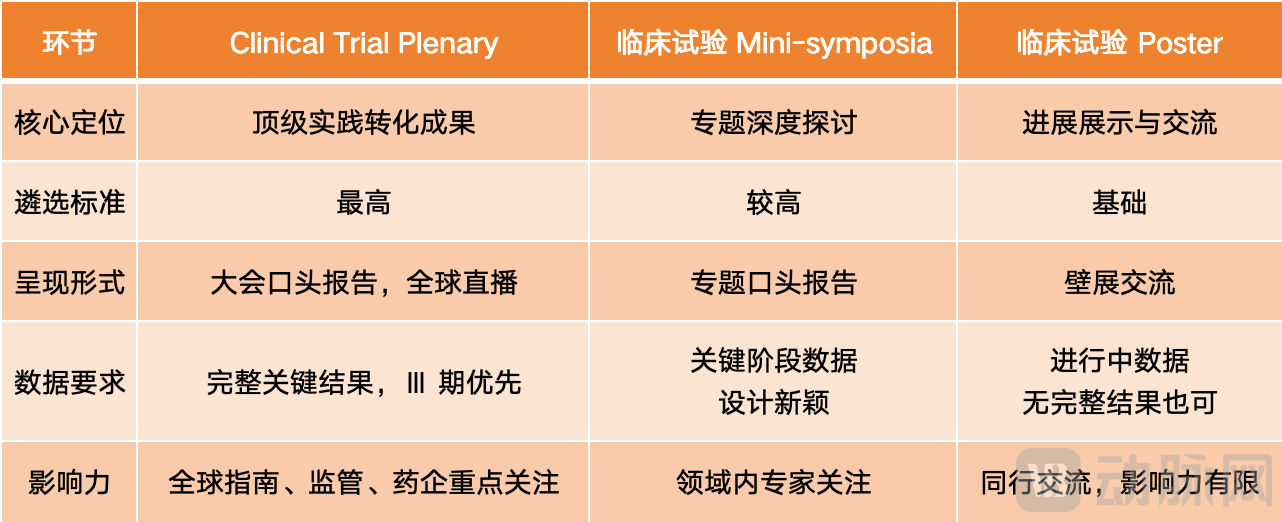 Comparison of Different Agendas at AACR Data Source: Collated from Public Information
The four China-developed pipeline assets that entered the CTP this year are D3 Bio's Elisrasib, CSPC Pharmaceutical Group's SYS6010, Qilu Pharmaceutical's QLS5132, and Hansoh Pharma's HS-20093. These assets are currently in Phase II or Phase III clinical trials and presented data from their earlier Phase I or Phase II trials at the CTP. Selected from hundreds of candidates, these pipelines possess all the qualities that the industry seeks in high-quality pharmaceutical innovation: differentiation, scarcity, and breakthrough potential.
Specifically, in terms of differentiation, none of the four pipelines avoided currently popular targets to force pure innovation. Instead, they leveraged smart approaches to break through in red oceans. Among them, D3 Bio's Elisrasib belongs to this year's high-profile KRAS inhibitor class; CSPC's SYS6010 targets EGFR, a classic target for over 40 years; Qilu Pharmaceutical's QLS5132 targets CLDN6, and Hansoh Pharma's HS-20093 targets B7H3 — both of which are novel hot targets. Their differentiation lies in key mechanistic optimizations. For example, D3 Bio's Elisrasib employs an innovative GDP-bound (OFF conformation) mechanism that can overcome resistance to first-generation KRAS G12C inhibitors. CSPC's SYS6010 is conjugated with the topoisomerase I inhibitor JS-1, making it a more potent payload.
In terms of scarcity, these pipeline assets take a relatively focused approach, directly addressing long-standing and difficult-to-treat clinical pain points. For instance, Qilu Pharmaceutical's QLS5132 targets platinum-resistant ovarian cancer; CSPC's SYS6010 is intended for advanced nasopharyngeal carcinoma; and D3 Bio's Elisrasib targets KRAS-mutant non-small cell lung cancer. Currently, there are no effective treatment options for these conditions.
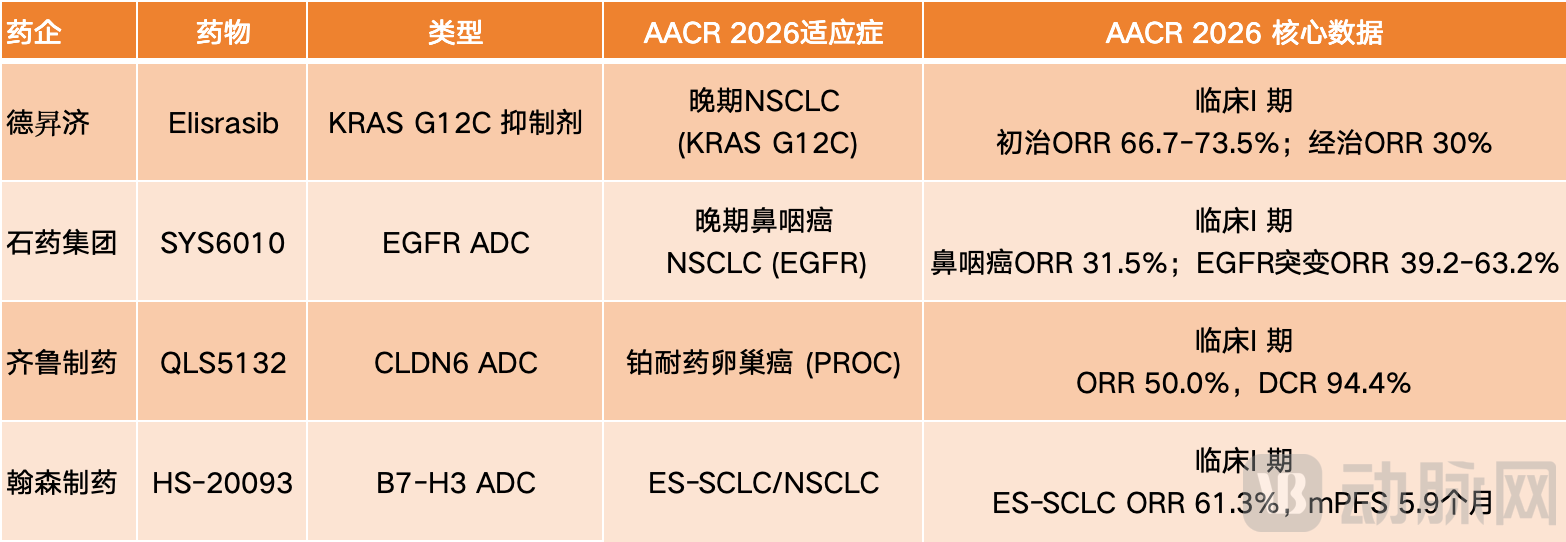 AACR 2026 Clinical Trial Plenary: Data on Innovative Drugs Produced in China Source: Collated from Public Information
In terms of breakthrough potential, compared to existing therapies, key clinical metrics such as objective response rate (ORR) and disease control rate (DCR) have shown significant improvements. For example, D3 Bio's Elisrasib achieved an ORR of 73.5% in its Phase I solid tumor clinical data presented at AACR, far exceeding the 25% to 35% ORR of currently marketed drugs. Qilu Pharmaceutical's QLS5132 achieved an ORR of 50% and a DCR of 94.4% in its Phase I clinical trial for platinum-resistant ovarian cancer, representing a breakthrough improvement.
Moving from the more peripheral data-sharing scenarios at AACR into the CTP demonstrates that these China-developed innovative drugs are truly standing shoulder to shoulder with MNCs in at least specific disease areas, possessing capabilities that their MNC counterparts lack. More importantly, transitioning from being scrutinized followers to being heard breakthrough players signifies that the quality of China's domestic innovative drugs has gained recognition from the global top-tier academic community. Past doubts about Chinese clinical trial data may be becoming history. For China's domestic innovative drug industry, this represents a far more significant proposition than any single-drug or single-disease breakthrough.
Two New Directions
Stepping back from the grand narrative, the vast majority of China's domestic innovative drugs at AACR 2026 remain active in the poster presentation area outside the CTP. In a sense, the collective portrait of China's domestic biotech companies in the poster area serves as a microcosm of the evolving ecosystem of China's domestic innovative drug industry. At this year's AACR, we observed two clear trends: technological upgrading and asset transactions.
In terms of the technological upgrading logic, the trend is moving away from overcrowded competition toward diversification, with new targets and novel mechanisms emerging one after another. The most notable change among them is the rise of multi-payload ADCs. In fact, the poster presentation area at AACR is also the best place to observe the development trajectory of ADCs. Since Chinese domestic biotech companies began attending AACR as a group in 2024, their ADC pipelines have consistently accounted for half of the presentations. However, anxieties about ADC overcrowding and competition, as well as debates about where the post-ADC era should head, have never ceased.
Multi-payload ADCs have opened up new possibilities, representing an iteration of the traditional engineering-based ADC technological upgrading logic. A traditional ADC attaches only one type of toxin to an antibody. In contrast, a multi-payload ADC can attach two or even more toxins with different mechanisms of action to the same antibody, and through more refined linker design, achieve precise ratios and orderly release of the two payloads. At the same time, it employs more mature site-specific conjugation technology to "pin" the payloads in fixed positions, making every ADC molecular structure highly homogeneous, thereby solving the problems of component heterogeneity and unstable efficacy seen in traditional ADCs.
Compared to traditional ADCs, multi-payload ADCs offer significant improvements in efficacy, addressable indications, and resistance profiles, but the manufacturing complexity also rises sharply. For example, the two toxins may have different release rates and metabolic pathways, potentially damaging healthy cells, or the ratio of the two payloads may be difficult to control, resulting in poor batch-to-batch stability. However, overcoming such drug manufacturing challenges is precisely what China's domestic pharmaceutical industry excels at. At a time when ADC pipeline transactions have cooled down, China's domestic biotech companies have, for once, collectively placed heavy bets on multi-payload ADCs.
In the past two years, multiple Chinese domestic biotech companies have built multi-payload ADC pipelines. At AACR 2026, China-developed multi-payload ADCs saw a concentrated breakout, with 11 Chinese domestic biotech companies presenting 19 multi-payload ADC pipelines, far exceeding the number from the previous year. More importantly, unlike the previous year when most could only demonstrate technical advantages, at AACR 2026, some China-developed multi-payload ADCs have already entered clinical trials. As the first multi-payload ADC to enter the clinical trial stage, Innovent Biologics' bispecific dual-payload pipeline IBI3020 completed its first patient dosing in May 2025. Another representative pipeline is Kanghong Pharmaceutical's globally leading KH815, which completed the first patient dosing in its Phase I clinical trial in China in July 2025. Additionally, Duality Biotherapeutics, GeneQuantum, Hangzhou DAC Biotechnology, Alphamab Oncology, and others presented preclinical data on multiple dual-payload ADCs, demonstrating potential for superior efficacy compared to single-payload ADCs and strong capabilities in overcoming resistance.
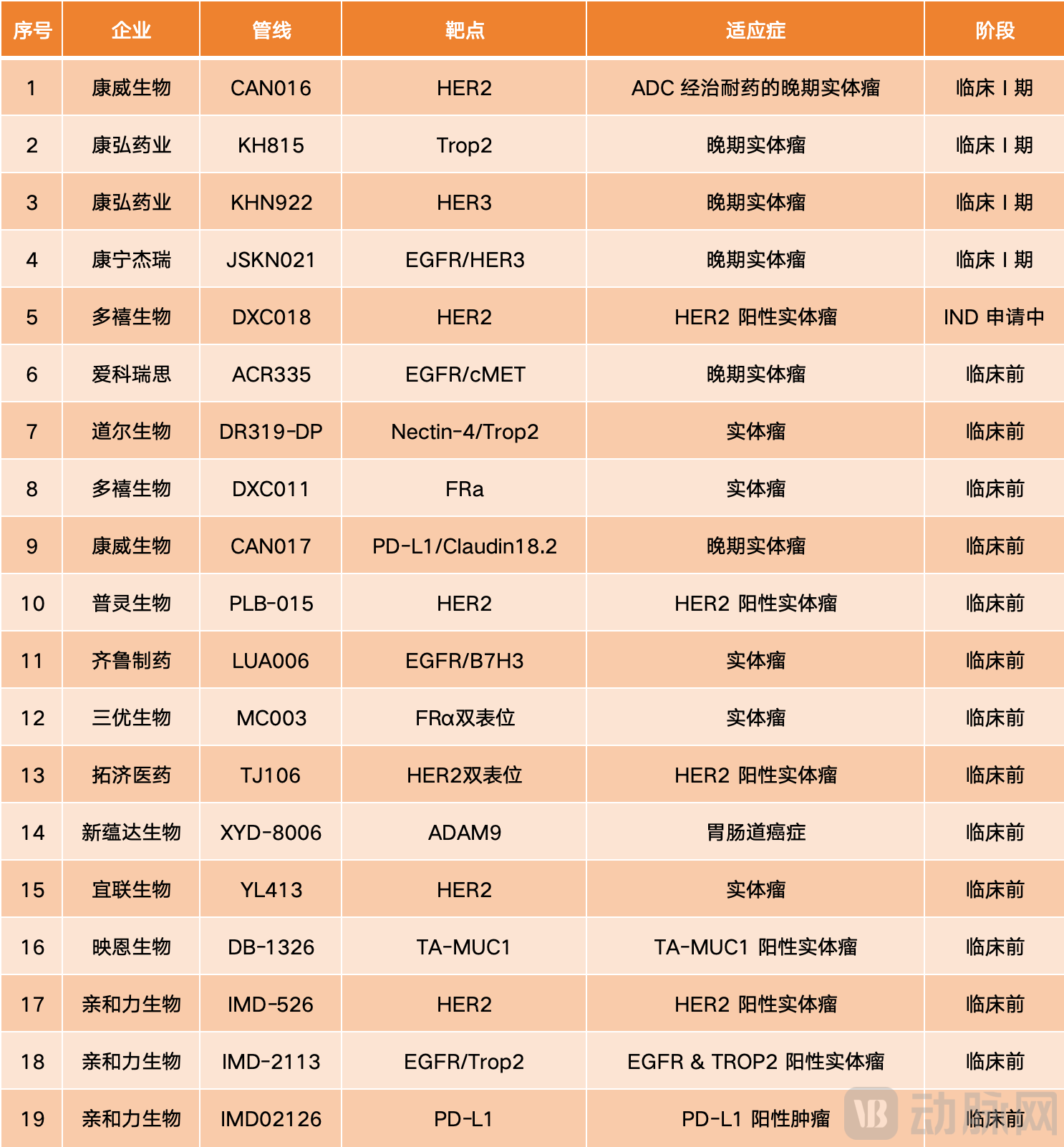
Data on China-produced Multi-payload ADC at AACR 2026 Source: Collated from Public Information
In terms of asset transaction logic, China's domestic biotech companies are also attempting to extract themselves from the past dilemma of "selling green seedlings" (selling early-stage assets before value maturation) and are becoming exporters of platform-based technologies. For a long time, China's domestic biotech companies primarily focused on developing a single outstanding pipeline asset against a specific hot target, which would then be out-licensed or acquired. However, this year, what Chinese domestic biotechs are prominently showcasing is no longer scattered individual products, but rather a complete set of mature technology platforms. Examples include Henlius' Hanjugator™ ADC platform, Qilu Pharmaceutical's ADC and TCE platforms, and Lepu Medical's bispecific ADC platform. These platforms function like standardized "production lines," capable of rapidly generating a series of pipeline assets covering different targets and tumor types, with a fixed and efficient workflow from early design to clinical translation.
This export of technological systems is gradually transforming the ecosystem of China's domestic innovative drugs. On the one hand, Chinese domestic biotech companies are transitioning from "selling individual projects" to "exporting entire R&D capabilities." Amid the out-licensing deal boom, the fruits of innovation are being retained. Cooperation under the platform model has also shifted from one-time licensing to long-term platform co-development. For example, Lepu Medical has out-licensed its platform technology overseas, securing high-value milestone payments. Henlius and Qilu Pharmaceutical have also leveraged their platforms to attract global partnerships, significantly enhancing their pricing power and revenue potential. On the other hand, platformization makes R&D more efficient and stable, mitigating the risk of single-project failure. It is driving the industry from fragmented innovation toward systematic, scalable development, upgrading from product globalization to technology and standard globalization, thereby building sustainable global competitiveness.
Challenges Under the Halo
On the flip side, while the technological iteration and platformization capabilities of Chinese innovative drugs at AACR 2026 are impressive, the bustling scene has also further exposed two perennial underlying challenges.
On the one hand, diversified innovation coexists with pipeline homogenization. At AACR 2026, although the logic of technological iteration has shifted from overcrowded competition toward diversification, of the over 90 ADCs brought by China's domestic biotech companies, nearly 60% remain concentrated on a few hot targets such as HER2, CLDN18.2, and TROP2. At the same time, most of these programs have adopted similar designs featuring cleavable linkers combined with Exatecan-class toxins, resulting in highly overlapping molecular structures and mechanisms of action. For example, Hengrui Pharma's SHR-A1811, Kelun-Biotech's A166, and CTTQ's TQB2102, which disclosed key Phase II clinical data at AACR 2026, are all HER2 ADCs. Although Hengrui Pharma's SHR-A1811 presented first-line lung cancer data this time, all three pipelines primarily target breast cancer, and their overall clinical data are quite similar, with ORRs ranging from approximately 70% to 80%. Beyond AACR, there are even more HER2 ADCs, such as RemeGen's RC48, Biokin Pharmaceutical's BL-M07D1, and Lepu Biotech's MRG002, targeting similar indications and having reached similar clinical stages.
Furthermore, in drug areas such as bispecific antibodies and TCEs, the phenomenon of homogenization is equally prevalent. Most pipelines have adopted mainstream target combinations such as PD-1/VEGF and EGFR/MET, with preclinical data and indication selections also highly convergent. In a sense, diversified innovation is merely providing new battlegrounds for homogenized competition at a faster pace. Admittedly, investing in popular pipelines can mitigate early-stage development risks and seize commercially certain scenarios, but it also results in low-quality competition. Pharmaceutical companies, in their pursuit of a larger market share, inevitably face trade-offs between pipeline quality and commercial interests, which is not conducive to the sustainable development of the industry.
At its core, the homogenization of pipelines reflects a systemic lack of source innovation. At present, while China's domestic biotech companies are becoming increasingly adept at commercial expansion, they seem to be neglecting source innovation — this is another underlying concern beneath the bustling surface of AACR 2026. Within AACR's agenda, the core sessions include the Opening Plenary (OP), New Drugs on the Horizon (NDH), and the Clinical Trial Plenary (CTP) mentioned at the beginning of this article. According to the official definitions, the OP sets the scientific tone for the year, the NDH features more than a dozen of the most anticipated drugs being disclosed for the first time, and the CTP presents data that may change clinical practice. Typically, the OP is a stage for breakthrough researchers who have made outstanding contributions in specific fields, the NDH gathers high-quality biotech companies from around the world, and the CTP is occupied by capable pharmaceutical companies.
At AACR 2026, four Chinese domestic pharmaceutical companies made it to the CTP, but no Chinese domestic biotech company appeared in the NDH. According to AACR requirements, pipelines entered into the NDH must feature entirely new targets, novel molecular scaffolds, and new mechanisms of action. Behind this absence, beyond the formal constraints of the conference's submission rules, lies a deeper reason: the continued lack of source innovation capability for China-developed innovative drugs. The vision of developing first-in-class (FIC) drugs has been repeatedly voiced by Chinese domestic biotech companies, but what they consistently invest resources in — and what can be rapidly advanced — remains follow-on innovation: optimizing around validated targets such as HER2, PD-1, and Claudin18.2 to surpass the pioneers. Even in the newly emerging field of multi-payload ADCs, Chinese domestic biotech companies remain outstanding followers. The long-term lack of source innovation capability has caused China's domestic innovative drug industry to lose its voice and continues to feed back into homogenized competition.
From being concentrated in the poster area to collectively stepping onto the highest stage, Chinese innovative drugs have completed a new round of advancement. However, beneath the halo, the issue of unbalanced development within China's domestic innovative drug industry is becoming increasingly severe. Only by addressing the shortfall in source innovation can China-developed innovative drugs complete the leap from large to strong.