

From Single-point Tools to Intelligent Foundation: Deepwise Completes Strategic Leap in Medical AI through Scenario-based Solutions

DeepWise
Developer of Artificial Intelligence Medical Imaging Diagnosis System
This year's CMEF reaches the peak of AI content.
Whether it is the ubiquitous imaging intelligent agents within exhibition halls or the underlying algorithms embedded in top-tier equipment like CT and MRI for image enhancement and lesion detection, artificial intelligence is penetrating every corner of medical devices with unprecedented breadth and depth.
Moving away from the once much-discussed but hard-to-implement pie in the sky, AI is gradually embracing pragmatism by meeting clinical needs and solving real-world problems.
In this conceptual transformation, Deepwise Medical has brought a set of highly differentiated strategies.
It follows the actual diagnostic thinking of doctors, connecting numerous independent solutions from the past into a loop, clearing all data bottlenecks in the process, and ultimately forming a digital and intelligent solution with "scenario-based" thinking, deeply integrating into the clinical workflow of doctors.
From "What AI Can Do" to "What AI Doctors Need," Deepwise has already completed the critical transition from a technology-centric approach to a clinically-oriented one.
The so-called scenario-based thinking refers to Deepwise's AI construction for specific diseases, focusing on the entire clinical diagnosis and treatment process, including disease screening, diagnosis, treatment, and follow-up. This AI provides full-process system empowerment and scenario-based value implementation, offering a complete solution for departments.
The logic of the new solution is fundamentally different from single-point AI solutions in the market. The latter typically focuses on specific segments. Improvements in these segments hardly drive optimization of the entire process, offering limited clinical value empowerment. Moreover, due to the lack of interconnectivity between applications, there are operational breakpoints that require additional interfaces to ensure smooth operations, leading to high integration costs for hospital systems and less-than-smooth process execution.
Starting from scenario-based approach, Deepwise Medical presented the multi-modal clinical intelligence platform Deepwise MetAI X at this year’s CMEF. Its positioning is not a single imaging system, but an all-in-one, hospital-wide multi-modal intelligent hub and digital-intelligent foundation built for medical institutions.
Relying on the unique "dual bus" architecture and "imaging + text" dual AI engines, the platform can uniformly schedule multimodal imaging data such as radiology, ultrasound, and endoscopy. It deeply integrates key processes like intelligent image reconstruction, precise lesion detection, and automatic generation of structured reports, ultimately forming a comprehensive intelligent service system that spans the entire process of screening, diagnosis, treatment, management, education, and research—reconstructing the operational logic of the radiology department from the ground up.
Compared with traditional PACS, PACS + AI add-ons, and other patchwork solutions, the core breakthrough of Deepwise MetAI X lies in its fully native AI integration. It deeply embeds clinical essentials such as assisted image reading, intelligent diagnosis, report generation, and multi-modal research, while relying on high computing power and high-concurrency processing capabilities to intelligently schedule and dynamically allocate GPU resources within departments, seamlessly integrating AI capabilities into daily workflows without adding extra operational burdens.
Moreover, Deepwise MetAI X is no longer limited to the traditional PACS "storage, retrieval, and transmission" tool attributes. Instead, it has been upgraded to a capability platform that is growable, expandable, and sustainably loadable with AI applications, providing hospitals with a one-stop intelligent imaging hub. Doctors can achieve data interoperability, efficient interaction, and process collaboration across all aspects of screening, diagnosis, treatment, follow-up, teaching, and research, thereby building a core foundation to support the long-term digital and intelligent transformation of medical institutions.
Specifically in practical scenarios, this year's CMEF exhibition showcasedChina's First Multimodal, Full-process, Integrated Hardware and Software AI Diagnosis, Treatment, and Management Intelligent Solution for Breast DiseasesThis is a typical example. The solution covers the full dimension from screening and assessment, diagnosis and treatment, to research and management, intuitively demonstrating the leapfrog upgrade of AI technology from single-point tool empowerment to full-process system empowerment, and from technical display to scenario-based value implementation.
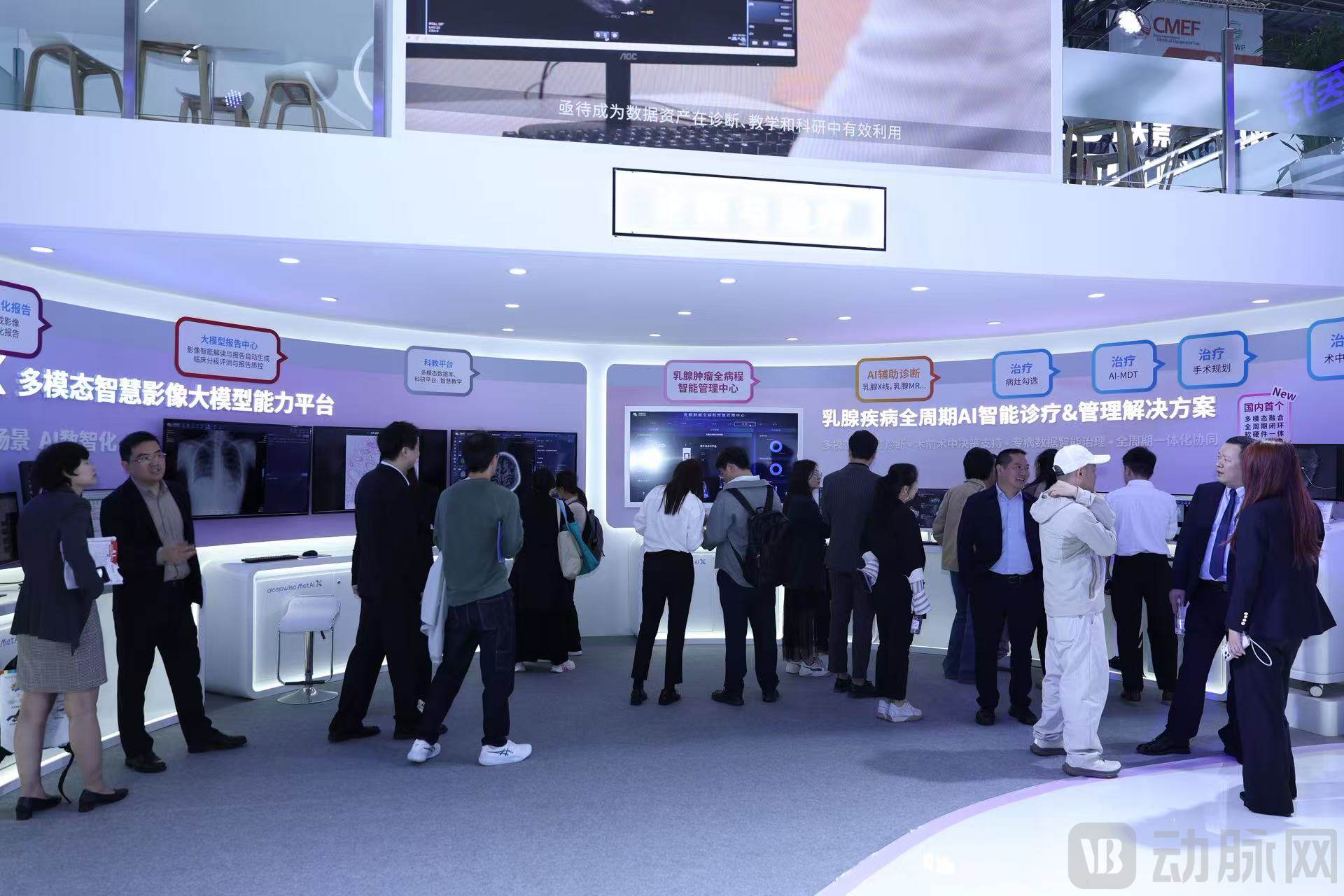
During the screening and diagnosis phase, the mammography and MR AI systems accurately identify tiny lesions, automatically generate structured reports, and precisely classify and grade suspicious lesions, providing comprehensive clinical support. In the treatment phase, the AI-MDT system integrates multi-dimensional patient data to offer personalized surgical and radiochemotherapy recommendations; intraoperative assessment of margins through real-time imaging effectively avoids secondary surgeries. Post-surgery, the intelligent bone densitometer helps optimize rehabilitation plans to address the risk of osteoporosis caused by endocrine therapy. On the research front, the Deepwise TrioData X platform establishes a specialized breast cancer database, creating a closed loop of "diagnosis-treatment–research–outcome" to accelerate technological innovation and optimization of rehabilitation strategies, promoting high-quality development in breast disease diagnosis and treatment.
Under the full-process empowerment, the value of Deepwise lies in truly enhancing clinical value.Perceivable, Experiential, Manageable。
The same approach can also be replicated in the diagnosis and treatment of organs such as the lungs and liver. Currently, in addition to being equipped with various native scenario-based solutions independently developed by Deepwise MetAI X, it also supports hospitals in expanding their capabilities according to their own needs, maximizing the value of the "digital and intelligent base."
Overall, the application of AI in the medical field is currently transitioning from single-point efficiency improvement to systematically empowering the entire medical process, with contextualization being the core path to achieving this transformation.
As Deepwise's co-founder and CEO Qiao Xin said: "Deepwise hopes to demonstrate the true value of AI in healthcare throughout this process—it is not just a technological innovation, but a 'collaborative partner' that can integrate into doctors' daily work, address real clinical pain points, and improve the efficiency and quality of diagnosis and treatment."
For hospitals, it is important to extract additional value through the optimization of clinical processes. They also hope to沉淀the data generated during the diagnosis and treatment process to build their own data assets.
However, the IT environment in hospitals often contains a large number of systems that are not fully interconnected, resulting in multi-source and heterogeneous data lacking unified standards. This has prevented the much-discussed data governance from truly being implemented in hospitals.
In response to these needs, Deepwise Medical launched the multimodal medical big data platform Deepwise TrioDaTa in 2024, leveraging large model capabilities to help hospitals integrate multimodal data and unlock its value.
At this year's CMEF, Deepwise Medical unveiled the upgraded Deepwise TrioDaTa X platform. Building on Deepwise Medical's strengths in deep mining of multimodal data, the platform leverages breakthrough applications of large model technology to打通 "data governance—capability innovation—scenario implementation"闭环, converting multisource heterogeneous medical data into high-quality, reliable data assets, providing comprehensive support for research and management scenarios.
As can be seen from the solutions displayed in the exhibition area, today's Deepwise TrioDaTa X is designed for diverse scenarios such as hospital big data asset centers, AI innovation centers, scientific research big data centers, and intelligent clinical application centers.
On the one hand, it can facilitate the standardized data governance of the aforementioned systems, enhancing data quality and usability, thereby accelerating the translation of research outcomes into clinical practice. On the other hand, through full-process data empowerment, the platform can optimize hospital management procedures, comprehensively improving hospital operational efficiency.
It should be noted that Deepwise TrioDaTa X and Deepwise MetAI X are not standalone platforms.
In practical applications, Deepwise TrioDaTa X can combine with the scenario-based capabilities of Deepwise MetAI X to integrate patient information previously scattered across various systems. This builds a complete patient profile, enhancing the clinical capabilities of Deepwise MetAI X while creating high-quality data assets for hospitals from the source. This allows medical institutions to truly own their own high-quality, usable data assets, providing sustainable data-driven momentum for high-quality development.
At this stage, Deepwise's AI is no longer just a tool for improving quality and efficiency; it has achieved true data value creation.
When high-quality, accessible data assets are truly owned and driven by medical institutions, the precision of clinical decision-making, the efficiency of scientific research innovation, and the effectiveness of management optimization gain a sustainable source of momentum. A positive cycle of "data assets empowering scenarios, and scenarios nurturing data iteration" has been formed, which will continuously propel the healthcare system toward a fully digital and intelligent era.