

Top 100 Innovators | From Mass Spectrometry to Exosome Delivery, Zhang Hao and His EN144 Scaffold Protein
In the biopharmaceutical field,Drug DeliveryIt has always been one of the most challenging aspects. Many drug molecules that perform well in in vitro models often fail in clinical trials due to an imbalance between toxicity and targeting once inside the body.Exosomes, a nanoscale vesicle naturally secreted by cells, is considered a highly promising next-generation drug delivery carrier due to its biocompatibility and low immunogenicity.
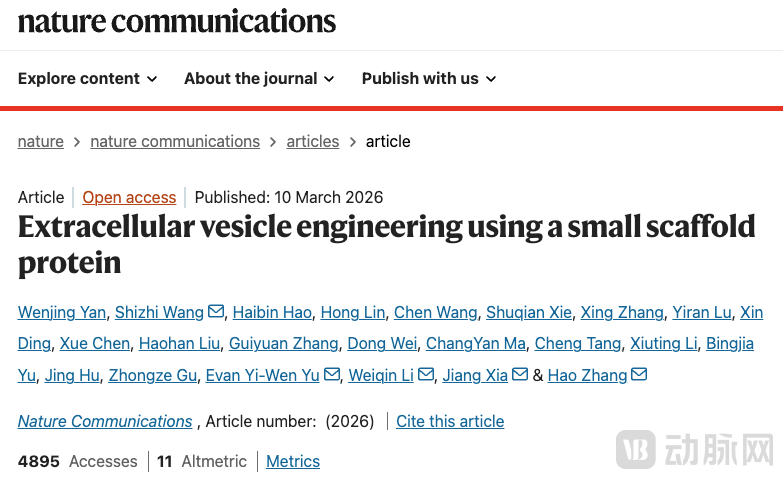
In March 2026, a paper published in Nature Communications attracted attention.Dr. Hao Zhang from Jinling Hospital, affiliated with the Medical School of Nanjing UniversityAnd its collaborative team reported in the paperA Novel Exosome-Engineered Scaffold Protein EN144.This "mini" scaffold, which has only 144 amino acids, demonstrated significantly superior loading efficiency compared to existing conventional scaffold proteins and showed therapeutic potential in two animal models: sepsis and osteoarthritis.
Dr. Zhang Hao is also a co-founder of Nanjing Ymicro Health Biotechnology Co., Ltd. In his view, EN144 is not only an academic achievement but also a technology platform with extensive scalability. This article will narrate the research findings and the story behind them.
"Delivery should be the most difficult."Dr. Zhang Hao got straight to the point in the interview.

Figure: Dr. Zhang Hao (Source: Photo provided by the interviewee)
In his understanding, whether it is lipid nanoparticles (LNP), in vivo CAR-T, or small nucleic acid drugs, most of the current delivery technologies are still limited to diseases of the liver or circulatory system. Achieving true organ-targeted delivery remains a significant challenge.
In 2013, the discovery of the cellular vesicle transport mechanism was awarded the Nobel Prize in Physiology or Medicine. As a key carrier in this mechanism, exosomes have since seen a持续攀升 in research interest. However, more than a decade later, drug delivery based on exosomes has yet to achieve milestone breakthroughs such as regulatory approval and market launch. Zhang Hao believes,The core bottleneck lies in loading capacity and delivery efficiency.。
In existing exosome engineering modification schemes, researchers typically need to rely on scaffold proteins to sort target drugs into exosomes. In the early stages of the industry, the PTGFRN used by Codiak BioSciences and the Lamp2b scaffold proteins developed by companies such as EVOX Therapeutics generally have a molecular weight of over 40 kDa.
"When this scaffold protein is particularly large, its loading capacity is limited," explained Zhang Hao. Scaffold proteins with high molecular weight show significantly reduced efficiency when loading large active proteins or antibody-based drugs, ultimately leading to low yields of effective proteins in exosomes. This not only drives up medication costs but also raises safety concerns.
Therefore, the initial intention of EN144's development is very clear:Find a scaffold protein that is small enough but has high enough sorting efficiency to meet the dual requirements of targeted modification and active drug loading.
The discovery process of EN144 is the result of an in-depth intersection between mass spectrometry technology and exosome research.
Zhang Hao's team cultivatedHEK293 Cells, using self-developed, classic scientific research, and large-scale industrial preparation methods to extract their secreted exosomes, and employing independently developed high-resolution mass spectrometry technology for in-depth proteomic analysis. In the preliminary screening,More than 1,000 proteinsIn, the team selectedApproximately 100 candidate molecules。
However, more than half of these 100 candidate proteins are already covered by existing patents. "If we want to achieve industrial transformation, we should at least develop something that hasn't been covered by others," Zhang Hao recalled the screening logic at that time. The team screened layer by layer like a "funnel" and finally locked on the ENPP1 protein.
ENPP1 is naturally enriched in exosomes with excellent sorting efficiency. Considering that the protein itself also possesses certain biological functions, the team conducted structural modifications to eliminate its biological function while further enhancing its sorting efficiency into exosomes. After repeated optimization,The team ultimately streamlined ENPP1 into a compact version with only 144 amino acids, named EN144.
According to the data in the paper, EN144 demonstrates significantly higher efficiency compared to previously reported scaffold proteins such as PTGFRN and Lamp2b when loading various therapeutic cargos. Due to its extremely small molecular weight, the size of the overall fusion protein remains manageable even when loading large molecules like gp130 (the decoy receptor protein of the IL-6 trans-signaling pathway), avoiding the upper limit of nearly 200 KDa commonly seen with traditional large scaffolds.
This means that EN144 has significantly raised the "ceiling" for drug loading, capable of not only carrying small molecule peptides and nanobodies for targeting purposes, but also accommodating gene-editing tool proteins such as CRISPR/Cas9, as well as various active therapeutic proteins.
In the paper, the team selectedSepsis and OsteoarthritisTwo distinct disease models were used to validate the therapeutic potential of EN144.
"One is acute and systemic; the other is chronic and localized."Zhang Hao explained the logic behind choosing these two indications. Sepsis has an acute onset and rapid progression, with the patient's fate potentially decided within 3 to 7 days; whereas osteoarthritis is a chronic inflammation, categorized as a localized disease. The team hopes to demonstrate the versatility of the EN144 platform by observing positive data simultaneously in two differentiated disease models.
In specific strategies, the team fused gp130 onto EN144, constructing"Decoy Exosomes" (decoy EVs)gp130 can capture the pro-inflammatory factor IL-6 trans-signaling in the body, akin to "fishing away" the inflammatory factors, thereby preventing them from triggering an inflammatory cascade amplification.
In the osteoarthritis model, the team is alsoThe exosome is loaded with a cartilage-targeting peptide at the front end.Experimental data show that, after a single injection, the engineered exosomes can accumulate in the cartilage cavity for up to a week or even longer, significantly prolonging the drug's efficacy. In contrast, traditional small nucleic acid drugs, once injected into the joint cavity, tend to quickly accumulate in the liver region via lymphatic vessels, making it difficult to maintain their efficacy.
In the sepsis model, engineered exosomes reduced systemic inflammatory responses and improved survival rates in mice.
Zhang Hao's connection with exosomes can be traced back to 2007.
That year, he entered Nanjing University to pursue his master's degree and joinedProfessor Chenyu Zhang's 3M Lab. The team isThe World's First Research Team to Discover Free miRNA in Blood"This is a counter-intuitive discovery. Normally, the abundant RNase in the blood should degrade exogenous RNA, making it difficult for them to remain stable in the blood. However, later studies found that a large amount of miRNA in the plasma is enriched in exosomes, thus avoiding degradation," recalled Zhang Hao. The paper on this discovery was subsequently quickly accepted by Cell Research and remains a landmark work in the field to this day.
After graduating with a master's degree, Zhang Hao entered the industry. Around 2010, the development of antibody drugs was at its peak, and he subsequently worked on R&D and management in the fields of antibodies and gene editing at several biotechnology companies.
In his exploration of the industry, Zhang Hao has always maintained a keen sense for cutting-edge technologies. Before CRISPR came into existence, he was already studying early gene-editing tools such as TALEN and ZFN. After Feng Zhang's team published their CRISPR paper in Science, Zhang Hao was one of the first to email Feng Zhang for an exchange of ideas, and subsequently became one of the earliest researchers in China to establish a CRISPR training course.
However, the off-target issues faced by gene-editing technology at that time made him realize that although this technology is powerful as a research tool, there are still obstacles in terms of drug development. After a brief period of career confusion, in 2019, Zhang Hao heard a speech by Professor Tao Weiguo on exosome protein research at an academic seminar held by Southeast University.
Professor Weiguo TaoConducted research on proteomics and exosomes at Purdue University in the United States, and was the first to discover a large number of phosphorylated modification proteins in exosomes, becoming a leader in this field. Zhang Hao proactively contacted Professor Tao and joined his research group at Southeast University in China to pursue a doctorate, starting from scratch to learn.Mass Spectrometry Technology。
"I didn't have a background in mass spectrometry before; my background was in antibodies and gene editing," he admitted. During his Ph.D., Zhang Hao's research focus shifted to...Exosome Proteomics Analysis, using mass spectrometry technology to screen for protein markers in exosomes from various bodily fluid samples such as blood and saliva, involving multiple disease areas including prostate cancer and Parkinson's disease.
With the EN144 platform tool, the next question naturally is:In which real clinical scenarios can it actually be useful?
The paper selected sepsis and osteoarthritis as proof of concept, but when advancing towards clinical translation, Zhang Hao made different choices. Instead of directly following the sepsis direction from the paper, he choseSevere Acute PancreatitisThis is a critical and severe condition with a mortality rate as high as 20% to 30% in ICU wards, and there is currently a lack of specific treatment drugs.
"The causes of sepsis are too complex, and any infection in any part of the body can potentially lead to sepsis," explained Zhang Hao. Acute pancreatitis can also lead to sepsis and multi-organ damage as the disease progresses, but starting from the more specific entry point of the pancreas, the research pathway and clinical endpoints are much clearer.
Another direction is Parkinson's disease.Exosomes naturally possess the ability to cross the blood-brain barrier, a unique advantage that distinguishes them from most nanodelivery systems. The team loaded exosomes with modified components targeting specific brain cells (such as neurons and glial cells), and animal experimental data showed positive results.
More interestingly, Zhang Hao attempted to connect the previous accumulation in two directions: mass spectrometry diagnostics and exosome delivery. In the field of depression, the team used mass spectrometry to simultaneously discover diagnostic markers and potential therapeutic targets from exosome protein markers, then utilized the EN144 platform to construct engineered exosomes for intervention."From discovery to detection, and then to treatment, a closed loop has actually been formed."He described his path from basic research to applied research in this way.
In 2021, to undertake these transformation tasks, Zhang Hao collaboratedDr. Xia Jiang(Professor at The Chinese University of Hong Kong, co-corresponding author of the paper) andDr. Liu JilaiEstablishedYiwei Jianhua Biotechnology Co., Ltd., Company English NameEVLIXIR, composed of EV+ELIXIR, where EV stands for extracellular vesicles (exosomes), and ELIXIR means "panacea" in English. The company's vision is to use EV as a carrier to develop more effective drugs that meet clinical needs. This is a team of over twenty people, and Zhang Hao’s positioning of it has always focused on the upstream:"Target discovery, engineering modification, quality control system, and preclinical candidate drugs. As for scale production and later clinical trials, we look forward to cooperating with more interested large companies."
To push the research results towards industrial transformation is never a one-person job, nor is it ever a smooth process.
In March 2023, it was once regarded as"First Exosome Stock"TheCodiak BioSciences Announces Bankruptcy, the entire industry's confidence was shaken. Zhang Hao admitted to the pressure during that period, but he chose to understand the matter within a longer industrial cycle.
"Look at the development path of small nucleic acids. In the early 2000s, how popular was siRNA? Around 2010, everyone realized it had no effect or was too toxic. Later, IONIS and Alnylam solved the problem of liver targeting, and you can see the rapid development in recent years." He quickly outlined the wave-like curve of small nucleic acid drugs over the past twenty years. "Not to mention the pharmaceutical industry, the IT industry is the same. The Internet also went through a bubble and then rose again, including AI now. A large amount of capital flowed in during the early stages, and there will definitely be a period of pain later on. Exosomes must follow the same logic."
In his view, Codiak's lessons have precisely helped later players clarify the direction: "It reminds us that when choosing indications, we must find a direction that maximizes the value of exosomes, rather than blindly claiming that our platform is good and can do everything." This is also the underlying logic for his choice of severe acute pancreatitis and Parkinson's disease: to address problems that existing drug modalities (antibodies, small molecules, cell therapies) fail to solve effectively, allowing the unique advantages of exosomes—safety, tissue compatibility, and the ability to cross the blood-brain barrier—to truly come into play.
And recent industry progress is also injecting confidence into this path. According to Zhang Hao, a...Mayo ClinicIncubated Exosome Project"Platelet-derived exosome-based treatment for chronic wounds"Excellent preliminary data has led to the current entry into Phase III clinical trials, with the potential to become the first approved exosome therapeutic drug. "This product addresses post-surgical wounds that have failed to heal for many years; after treatment with platelet-derived exosomes, these wounds were successfully healed, which was previously impossible," Zhang Hao mentioned this case with evident excitement. "This demonstrates the powerful tissue repair capability of exosomes themselves and also shows that the FDA has recognized its CMC process system. Having these two pathways cleared gives us tremendous confidence."
Of course, the journey of a scientific research achievement from paper to clinical application cannot be accomplished by one person alone. Looking at the list of authors of the EN144 paper, one can see researchers from Nanjing University, Southeast University, The Chinese University of Hong Kong, and multiple clinical hospitals. This extensive collaborative network was not deliberately designed but naturally formed through Zhang Hao's past experiences.
"I have stayed in Southeast University and Nanjing University, so our research team can easily collaborate with research and clinical teams from these two universities," he recalled. The Southeast University team had experience in osteoarthritis research, and the osteoarthritis experiments in the paper were completed in collaboration with them; the Nanjing University team provided clinical issues and corresponding resources in the direction of sepsis and pancreatitis; Professor Xia Jiang from the Chinese University of Hong Kong is a leader in the field of exosome engineering transformation, who has overall control of the entire research work and is also the co-corresponding author of the paper. Later, he became a partner in starting a business together."Everyone has made their professional contribution."Hao Zhang summarized the long list of authors in the paper in this way.
This"Industry-Academia-Research-Medicine" CollaborationThis model has also been extended to the stage of achievement transformation. In January this year, the team collaborated with Southeast University and the Regional Technology Transfer Center for universities approved by the Ministry of Education to build an extracellular vesicle engineering transformation platform. They will jointly train graduate students, and doctoral students can directly complete their research projects in the company's laboratory. "It is expected that there will be two doctoral positions allocated to our side this year, recruited by Nanjing University but conducting transformation research within the company," revealed Zhang Hao. In the emerging field of exosomes, there is already a scarcity of mature professionals in the industry, so "self-cultivation may actually be a more realistic path."
As the interview drew to a close, Zhang Hao mentioned an interesting coincidence: on the eighth day of the first lunar month last year, a paper from the team was accepted by Analytical Chemistry, providing methodological support for the platform of mass spectrometry analysis of plasma exosome proteomics; on the same day this year, a paper was accepted by Nature Communications, offering a core tool for exosome engineering delivery.The two papers correspond to two technical routes: from detection to diagnosis, and from discovery to delivery.
But the publication of the paper is just the beginning. Zhang Hao admitted that the biggest challenge for exosome therapy at the industrialization level currently lies inEstablishment of the CMC (Chemistry, Manufacturing, and Controls) Standards System"The country has not yet issued specific guidelines for exosome drugs. All our quality control data are designed based on our own understanding of the issues," he said. Exosomes are not a single-component substance; they contain multiple components such as proteins, small RNAs, and lipids, which bring a complexity to quality control far exceeding that of conventional biologics.
"In the next one to two years, we will have sufficient communication with the CDE to see if they recognize our solution for the entire drug quality control system," Zhang Hao said. "If they do, and this path is cleared, the future will be very promising. Because the entire platform, from initial modifications, to production, to quality control processes, has already been successfully implemented from our enterprise end."
He put"Safe, Effective, and Reliable Quality"These eight characters are repeatedly emphasized, as they represent the basic principles of pharmaceuticals. In terms of safety, the natural biocompatibility of exosomes provides an inherent advantage; regarding efficacy, the EN144 platform has demonstrated positive data across multiple animal models. The remaining aspect is "reliable quality," which requires regulatory standards for final validation to close the loop.
"The next step in my work is still to push the pipeline into clinical trials, which is the most important," he said. For a basic research achievement to truly benefit patients, there are still a series of industrialization challenges in between, such as process validation, scaled production, and regulatory communication. And this is exactly what Zhang Hao and his team are most eager to tackle at the moment.