

"First Medical Imaging Large Model Stock" Diagens Goes Public with IPO, Opening Surge of 121%
Diagens
Medical Imaging AI and High-End Medical Equipment Developer
Today, the Hong Kong stock market witnessed another milestone event in the AI large model sector. Hangzhou Diagens Biotechnology Co., Ltd. officially listed on the Hong Kong Stock Exchange, with its stock priced at HK$99 per share. The opening share price surged 121%, reaching HK$219.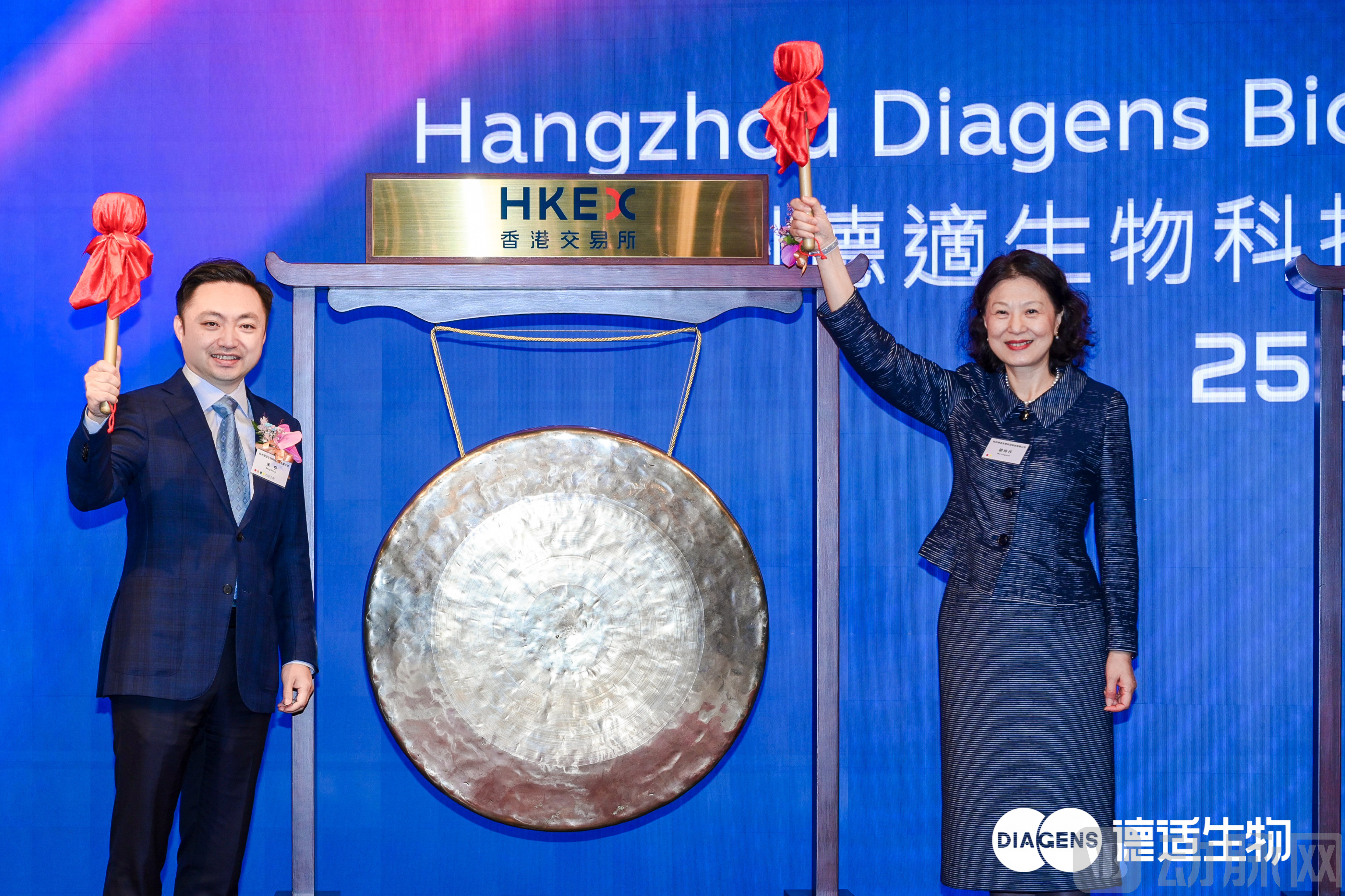
Currently, the global spotlight is undoubtedly on large AI models. Since the beginning of this year, companies in the large AI model sector, such as Zhipu and MINIMAX, have successively listed on the Hong Kong Stock Exchange, with particularly impressive stock performances. Among them, Zhipu, as a representative of the "general foundational model," is regarded by outsiders as the "water, electricity, and coal" of the AI era; MINIMAX excels in breakthroughs in C-end application scenarios and is a large model supplier natively supported by OpenClaw.Diagens, as the first AI enterprise to go public after Hangzhou proposed the concept of "the First City for Artificial Intelligence Innovative Development," fills the gap in the current vertical field of large-scale AI models applied to the B-end (H-end).
At the same time, the listing of Hangzhou Diagens Biotechnology Co., Ltd. also signifies that the large foundational models of AI healthcare are gradually moving away from "technological concept hype" and progressing towards a genuine phase of commercialization.
Hangzhou Diagens Biotechnology Co., Ltd.'s IPO performance this time was nothing short of impressive.
Officially disclosed, this Diagens plans to issue 7.992 million H shares, with 10% for public offering and 90% for international placement. In the first half day of the international placement phase, it attracted over 1.6 billion Hong Kong dollars, with the subscription scale oversubscribed by more than 2 times. Ultimately, the public offering portion received subscriptions from 115,017 valid applicants, with the number of shares applied for in the Hong Kong public offering reaching 858,643,350. Based on the public offering fundraising amount, the oversubscription multiple reached an astonishing 1,073 times.
Notably, unlike some previous companies that arranged cornerstone investors for their IPOs as a "trust endorsement," Hangzhou Diagens Biotechnology Co., Ltd. (De Shi) chose not to rely on cornerstone investors in its recent listing. The reason is that to attract cornerstone investors, companies often need to offer discounts on the issue price and impose share lock-up periods, which would cause more secondary market investors to miss out on the company's growth dividends. De Shi has chosen to leave this growth dividend for secondary market investors.
Without the backing of cornerstone investors, Hangzhou Diagens Biotechnology Co., Ltd. still received oversubscription, which is closely related to the certainty of track development and its leading position in the industry.
From the perspective of track development certainty, the rigid demand attributes of intelligent medical imaging and policy dividends have led to a rapid release of market demand, showcasing a bright future for the track.Last October, the "Implementation Opinions on Promoting and Regulating the Application Development of 'Artificial Intelligence + Healthcare'" clearly stated that by 2030, efforts should be made to promote the widespread adoption of intelligent medical imaging-assisted diagnosis in hospitals at level two and above. According to the "2024 Statistical Bulletin on the Development of China’s Health and Wellness Industry," the number of hospitals at level two and above reached 16,405 in 2024, and this figure continues to grow. Policies have opened up imaginative space for future development. Market opportunities have also attracted numerous enterprises to enter the field, including leading imaging equipment companies like United Imaging Healthcare, tech giants such as Tencent Healthcare, AI medical imaging firms like Infervision and Deepwise & League, and even international manufacturers like Siemens Healthineers and GE Healthcare, all of which have investments in intelligent medical imaging. According to Frost & Sullivan data, China's medical imaging testing market is expected to reach a scale of 159 billion yuan by 2030.
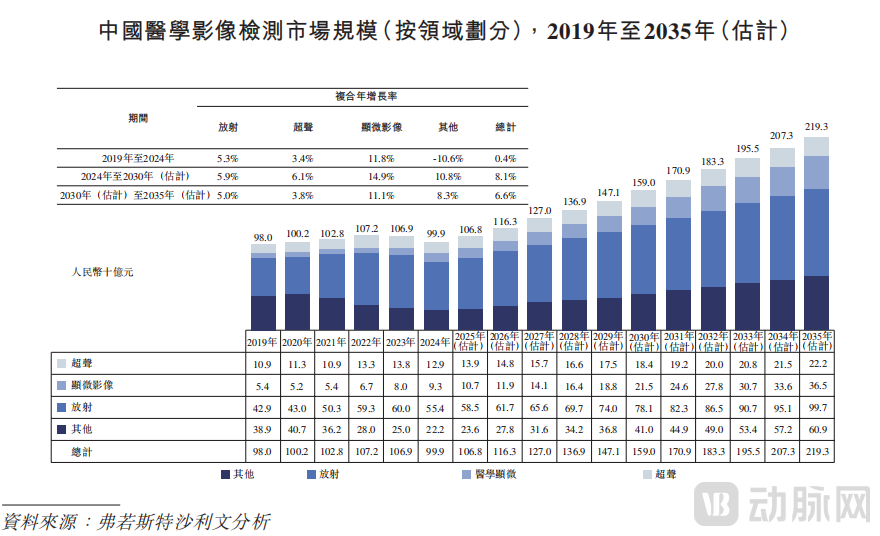
Source: Diagens Prospectus
Among them, Diagens, as the leading enterprise in the industry, is one of the few medical companies in China that possesses the technical capability of foundational large models, has achieved clinical implementation, and realized scaled revenue.As a core target in this track, it naturally attracts widespread attention from investors.
From the financial data, Diagens is entering a phase of improved profitability and rapid commercial growth.Financial report data shows that in the first three quarters of 2025, Diagens Biotechnology's revenue reached 112 million yuan, a year-on-year surge of 470%. At the same time, due to the optimization of the profit structure, Diagens' overall gross margin showed significant growth, increasing substantially from 42.9% in September 2024 to 75.9% in September 2025. This further strengthens the company's future development resilience.
The growth in revenue was driven by the rapid market expansion of the core business.
In the core business dimension, Hangzhou Diagens Biotechnology Co., Ltd. (Diagens), based on a large foundational model for medical imaging, has taken the lead in achieving commercial breakthroughs in the high-growth track of microscopic imaging, gaining market success with its chromosome karyotype analysis solution. In the future, leveraging the generalization capability of the large medical imaging model, Diagens can expand applications into other medical imaging fields such as CT, MRI, ultrasound, and endoscopy. Meanwhile, Diagens' large medical imaging model is enabling medical institutions to develop their proprietary models through technology licensing, cloud platform delivery, and other models, accelerating development and implementation.
In the field of chromosome karyotype analysis, Diagens provides an efficient and innovative solution.Traditional chromosome karyotype analysis heavily relies on manual operations by physicians, is time-consuming, labor-intensive, and faces issues like physician subjectivity in report interpretation. The average reporting cycle usually takes 30 days. By introducing automated equipment and intelligent algorithms, Hangzhou Diagens Biotechnology Co., Ltd. has improved detection efficiency as well as the consistency and standardization of results. Moreover, the company’s core product, AI AutoVision,®Supports case-level karyotype abnormality detection in chromosomal karyotyping—achieving 100% sensitivity and 100% specificity in detecting numerical abnormalities, and 94.05% sensitivity and 100% specificity in detecting structural abnormalities. The outstanding solution has led to Diagens' impressive market performance. According to the prospectus, Diagens has captured 30.6% of China's chromosome karyotype analysis market, ranking first and breaking the market monopoly previously held by overseas companies Zeiss and Leica.
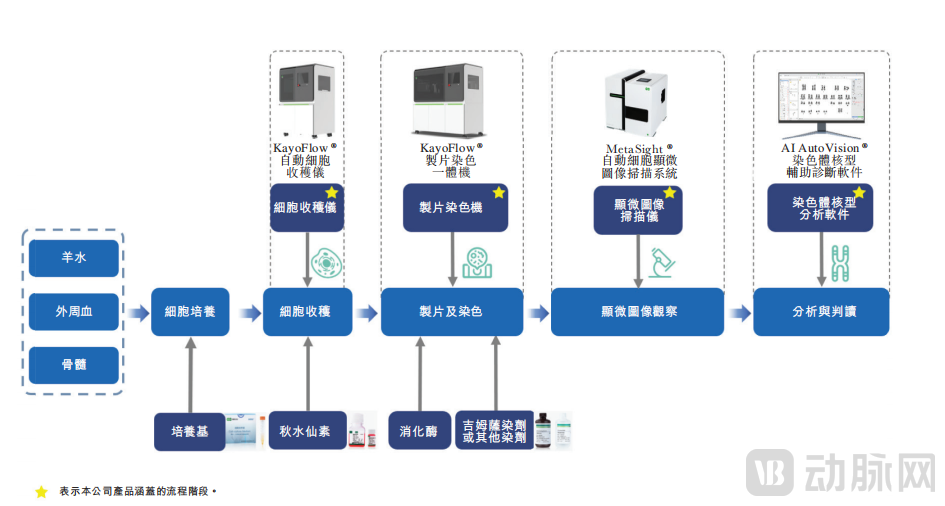
Source: Diagens Prospectus
In terms of base large model technology licensing, Diagens' base large model offers advantages such as "high speed," "low cost," and "wide adaptability," which can greatly assist developers in creating intelligent medical imaging products.Traditional dedicated model development and application typically require tens of millions of yuan in funding, tens of thousands of annotated imaging data for training, and a research and development cycle of more than two years. In contrast, Hangzhou Diagens Biotechnology Co., Ltd.'s iMedImage reaches a parameter scale of hundreds of billions, adopting a modular design.®The base model supports 19 clinical imaging modalities, including CT, MRI, ultrasound, karyotype analysis, and endoscopy, covering over 90% of medical imaging scenarios. It can reduce the development cycle and R&D costs of specialized disease models by 90%. Currently, the revenue share of this business has surpassed that of karyotype analysis, becoming the core driver of Hangzhou Diagens Biotechnology Co., Ltd.'s growth. This also indirectly demonstrates the industry's high recognition of the capabilities of its base model.
In the market aspect, while Diagens has achieved business implementation nationwide in China, it is further increasing the proportion of direct sales, which is expected to further solidify Diagens' commercial closed loop.Based on clinical recognition, Diagens products have covered top-tier tertiary hospitals such as Peking Union Medical College Hospital and Zhongshan Hospital Affiliated to Fudan University, with an adoption rate of 40% among the top ten hospitals in China; up to 400 clinical medical institutions have implemented related product applications. In terms of channels, while expanding market coverage through cooperation with physical examination centers, medical institutions, and internet healthcare companies across China, Diagens is also increasing the proportion of direct sales: from January to September 2025, its direct sales revenue accounted for 68.6% of total revenue.
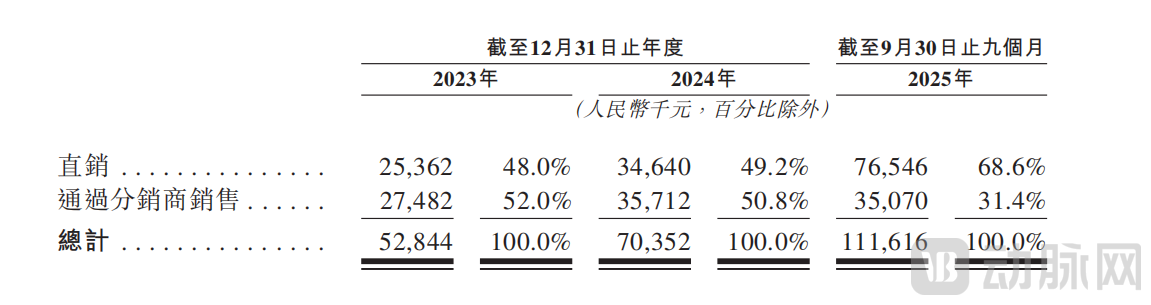
Source: Diagens Prospectus
In recognition of the technical strength of Hangzhou Diagens Biotechnology Co., Ltd.'s medical imaging foundation large model, leading companies in the industry have chosen to enter into strategic partnerships with it. The publicly disclosed strategic partners of Diagens already include Tencent, H3C, Inspur, ZTE, and Wutongshu, among others. This list of collaborators continues to grow.
For Diagens, by jointly building a new intelligent medical imaging infrastructure and collaborating with partners in areas such as computing power infrastructure, digital transformation, and scenario-based applications, it can greatly achieve resource integration and complementary advantages. This collaboration will further drive the deep development of large-scale model technology across the medical industry chain, pushing AI healthcare from technological breakthroughs toward systematic value creation. Additionally, this ecosystem cooperation无形中为德适构建了一道厚实的“安全墙”,进一步构筑起其护城河。
And the cooperation itself is also aimed at better solving the problems currently faced by the medical imaging industry.
For example, the strategic cooperation between Diagens and Tencent aims to build a multi-modal intelligent central system, promoting the下沉 of imaging diagnostic capabilities through a "cloud + terminal" architecture, and accelerating the extension of tertiary hospital-level diagnostic capabilities to tens of thousands of grassroots medical institutions.Tencent itself has the advantage of cloud computing service capabilities. The goal of Diagens' cooperation with Tencent is to provide a comprehensive solution that integrates AI and cloud computing technology. As the cooperation progresses, Diagens and Tencent plan to build an "equipment + service + data" innovative business model through digital connection platforms such as WeChat and Tencent Health, and jointly promote the standardization of AI training for medical imaging and data security standards. Currently, based on iMed MaaS®The intelligent pre-annotation function of the platform has officially gone online, which can significantly improve the efficiency of medical image data processing and lower the threshold for clinical and research applications.
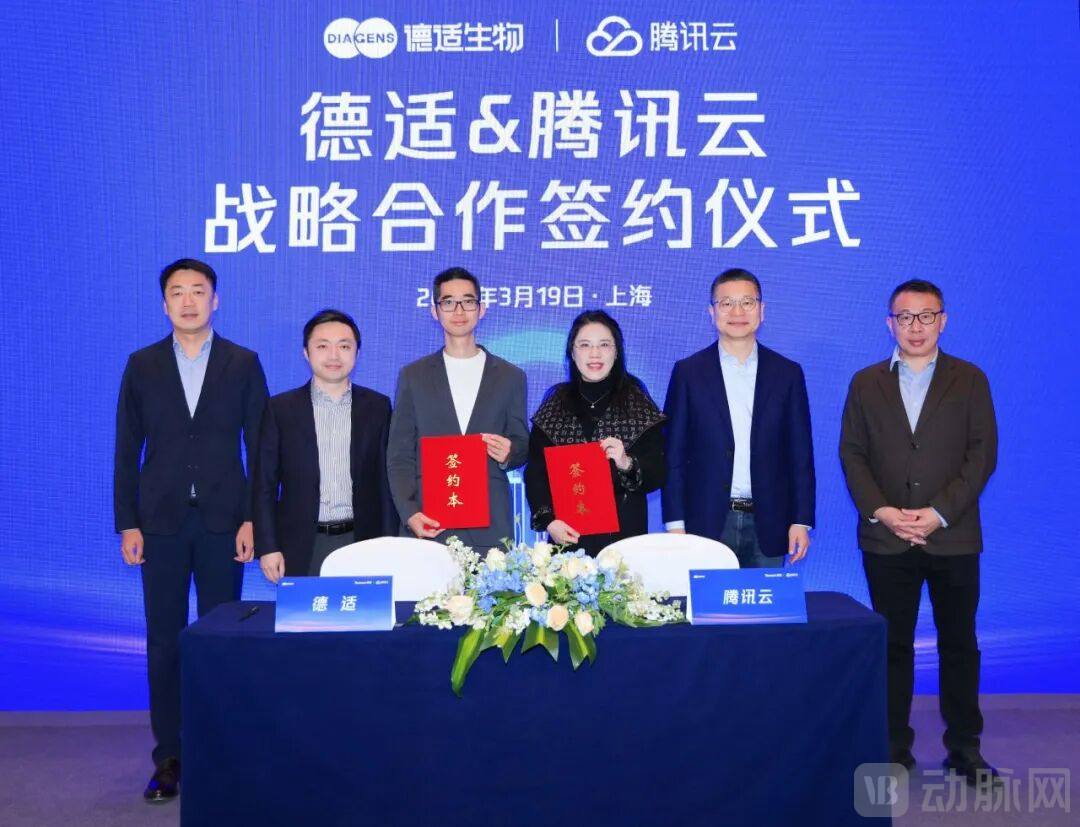
Source: Diagens WeChat Official Account
Hangzhou Diagens Biotechnology Co., Ltd. and H3C have jointly built an "Integrated Storage, Computing, Training, and Inference" AI medical imaging solution, addressing the challenge of "local deployment" faced by some healthcare practitioners.Based on an integrated solution for storage, computing, training, and inference, customers can leverage fully localized multi-disease, multi-modal, and multi-task analysis capabilities to develop and configure medical imaging AI models customized for research projects. This enables relevant hospitals and clinicians to utilize their real-world data to independently develop, optimize, and deploy tailored AI imaging models, truly achieving "training their own AI with their own data." This significantly lowers the technical barriers for AI applications in medical institutions, providing stronger support for precise clinical diagnosis and treatment.
Through ecological cooperation, Hangzhou Diagens Biotechnology Co., Ltd. gains not only scenarios, data, and computing power support but also directly embeds its medical imaging foundational model capabilities into the core links of the current intelligent healthcare industry chain, ultimately forming a positive cycle of technology-product-scenario-data. This will also transform Hangzhou Diagens from a single product provider to a company whose business model shifts from "equipment supply" to "digital new infrastructure provision," further solidifying its leading position in the industry.
To further consolidate the leading position in the industry, financial support will undoubtedly provide better assistance.
Hangzhou Diagens Biotechnology Co., Ltd.'s funds raised this time are expected to be about 49% for AI AutoVision.®The research and development and commercialization to consolidate the leading position, approximately 20% for the iteration of iMedImage.®The model expands the technology licensing business, with approximately 13% used to strengthen commercialization and globalization efforts both in China and overseas, while the remaining funds are allocated for product development.
As Diagens goes public and funding is in place, its commercial value will become increasingly prominent.With the叠加of多重红利such as policies, market, and capital, Hangzhou Diagens Biotechnology Co., Ltd. is expected to maintain its leading position, unleash greater value in the billion-dollar medical imaging market, and become a core benchmark in the AI healthcare field.
At the same time, the commercial expansion across China will not only increase the coverage of Diagens solutions in tertiary hospitals but also accelerate their penetration into primary healthcare. By leveraging AI technology to enhance diagnostic efficiency and reduce medical costs, it will ultimately promote the widespread availability of quality medical resources, contributing to the achievement of the 2030 policy goals and realizing the integration of commercial value and social value.