

Tencent as the shareholder, ByteDance as the boss

Tencent
Internet Comprehensive Service Provider
When Traffic Giants Choose the Heavy-Asset Healthcare Path.
In the spring of 2020, as the world was shrouded in the shadow of the pandemic, ByteDance quietly completed the acquisition of Baike Mingyi Network. This transaction, valued at only 500 million yuan, did not attract much attention at the time but marked the beginning of the internet giant's entry into the healthcare sector, known for its algorithmic recommendations and short videos.
Five Years Later: ByteDance's Cumulative Investment in the Medical Field Exceeds 20 Billion Yuan, Controlling Over 20 Enterprises, Forming a Full-Chain Closed Loop Covering Medical-Care-Diagnosis-Treatment-Pharmaceuticals. In stark contrast to Tencent's widespread, non-controlling VC-style investment approach in the medical field, ByteDance has chosen a more aggressive and burdensome path: controlling acquisitions, deep integration, and self-built ecosystems.
Behind this strategic choice lies ByteDance's insight into the essence of the healthcare industry, as well as its ambition to replicate the success of consumer internet in the medical and health sector. If Tencent plays the role of a connector in the healthcare field, then ByteDance is striving to become an integrator—not by connecting existing medical resources but by personally stepping into the arena to carve out a unique path of building an ecosystem through holding.
From Content Gap to Strategic Gateway.
ByteDance's medical layout began in 2020. In May of that year, ByteDance acquired Baike Mingyi Wang for 500 million yuan, renaming it "Xiaohe Medical Canon" as the underlying database for medical science content. In September of the same year, ByteDance acquired YoLinErSi Technology, founded by former Baidu executive Wu Haifeng, established the Aurora department, and launched the Xiaohe Health brand, officially entering the internet healthcare sector.
This series of actions seemingly follows the conventional path of internet healthcare, which is to create content first and then build a platform. However, ByteDance's ambition clearly goes beyond that. After completing the construction of its online healthcare matrix, ByteDance quickly extended its reach to offline medical institutions.
In 2021, ByteDance fully acquired Songguo Clinic through Xiaohuo Health, renaming it Xiaohuo Clinic, positioning it as a high-end comprehensive medical institution with large specialties and small general practice. In June 2022, ByteDance completed full control of Amcare, a deal worth approximately 10 billion yuan, which included 6 women and children hospitals, 1 reproductive specialty hospital, 4 confinement centers, and 2 outpatient centers. In 2024, ByteDance achieved over 90% control of Macro Love through capital increase, gaining control of Amcare Cancer Hospital, a tertiary cancer specialty hospital in Beijing.
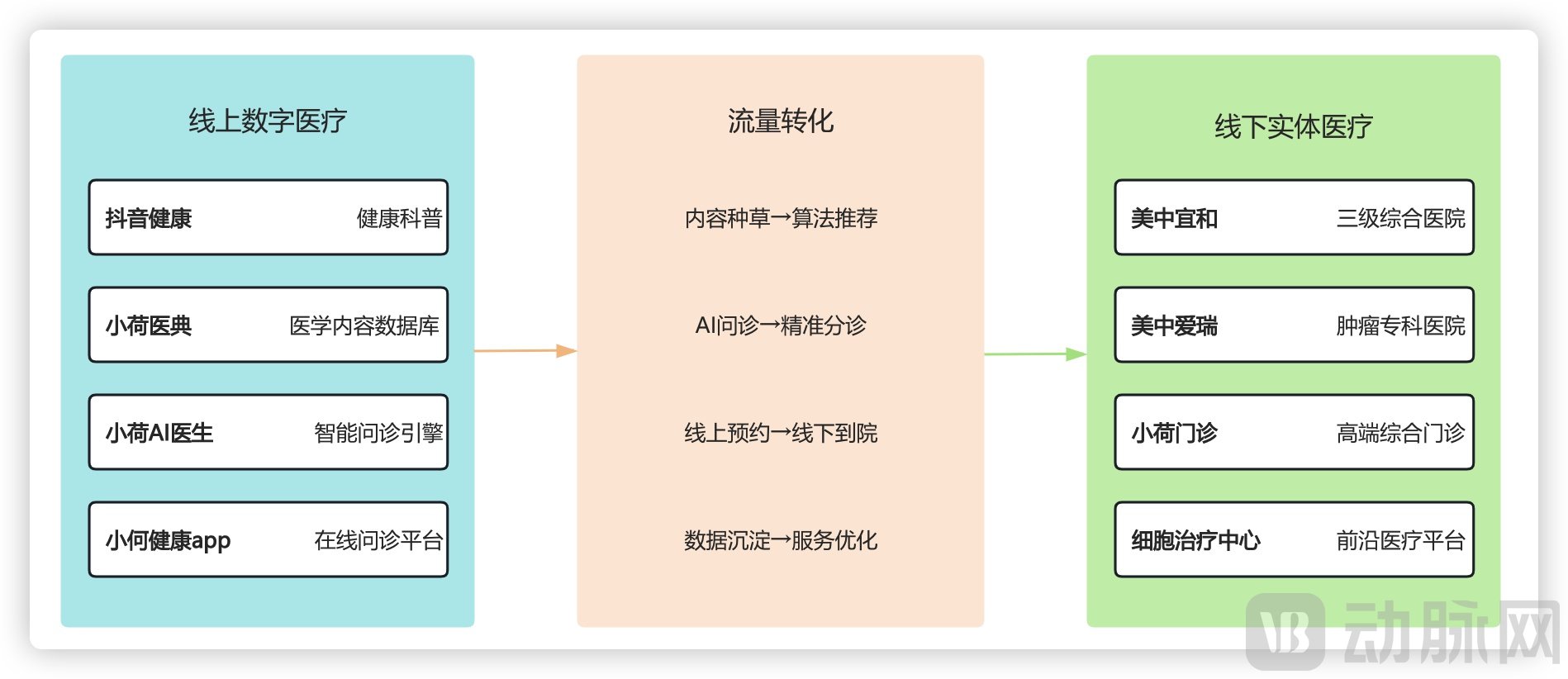
From online to offline medical service chain, according to public information mapping
This controlling acquisition contrasts sharply with Tencent's investment style.
Tencent's investments in the medical field span numerous companies such as WeDoctor, DXY, Haodf.com, and Penguin Doctor. However, it has consistently maintained a stance of holding minority stakes without seeking control, primarily acting as a financial investor and traffic enabler. On the other hand, ByteDance follows the logic of industrial capital by acquiring and immediately integrating. After fully acquiring Amcare, although ByteDance claims it will not interfere in daily operations, it quickly pushed for its transformation from a women and children's specialty hospital to a comprehensive medical platform and integrated Little Lotus Clinic into the Amcare system.
More symbolically, the move in early 2025 saw ByteDance invest 734 million yuan to establish Beijing Ninghe Kangrui Medical Management Co., Ltd., dedicated to operating cell therapy businesses; simultaneously, the construction of the third phase of the Amcare hospital campus was initiated, with plans to upgrade it into a general hospital.
These investments are not simple financial maneuvers, but substantial industrial infrastructure constructions. The heavy asset input reveals a clear fact: ByteDance is building a physical healthcare industry group, rather than a virtual internet-based medical platform.
The integration of cutting-edge technology is ByteDance's most prominent feature.
ByteDance's healthcare layout places significant emphasis on the deep integration of cutting-edge technologies, particularly artificial intelligence. This is not merely a simple combination of Internet + healthcare but an attempt to use AI to reconstruct the production methods and delivery models of medical services.
At the online end, ByteDance has launched Xiaohes AI Doctor, a medical AI product that strictly adheres to the clinical thinking of seeking evidence first and then providing recommendations. Xiaohes AI Doctor employs a mandatory follow-up mechanism where, after users input symptoms, the system actively inquires about medical history, imaging data, and medication information. Through multi-round interactions, it reduces the risk of misdiagnosis. This design essentially simulates the diagnostic thinking of clinical doctors, attempting to strike a balance between user experience and medical rigor.
More importantly, Xiaohe AI Doctor is not an isolated product but a traffic conversion hub within ByteDance's healthcare ecosystem. Data shows that Douyin platform has 200 million users watching health education content every day. Xiaohe AI Doctor achieves the transformation from content consumption to medical services through the chain of educational videos → pop-up consultation entry → AI consultation → online pharmacy purchases. According to the data funnel model, 12.3% of users who watch medical videos will click on the consultation entry, of which 58.7% complete the consultation, and 17.9% ultimately make drug purchases. This seamless transition between content scenarios and medical scenarios epitomizes ByteDance's traffic advantage.
However, ByteDance's technological ambition goes far beyond this. In more cutting-edge fields, ByteDance is laying out tracks in hard technologies such as AI-driven drug design (AIDD), cell therapy, and non-invasive early screening, and has already achieved phased results.
In the field of AI-driven drug design, ByteDance released the SeedFold model in January 2026, directly challenging Google's AlphaFold 3. The model, trained on 26.5 million protein structures, outperformed AlphaFold 3 in multiple benchmark tests, achieving industry-leading prediction accuracy. Of even greater practical value is the PXDesign platform, introduced in October 2025. In experimental validations across six different protein targets, the system achieved nanomolar hit rates ranging from 20% to 73% for five targets, demonstrating a 2- to 6-fold performance improvement over DeepMind’s AlphaProteo. Currently, ByteDance's AIDD team has identified several promising preclinical candidate compounds in areas such as oncology and neurological diseases and is moving forward with preparations for IND filings.
In the field of cell therapy, the Beijing Airui International Medical Complex, with a total investment of 6 billion yuan, is under construction. It plans to have 800 beds and focuses on the innovative transformation of cell therapy, with full-process capabilities from research and development to clinical transformation. In January 2025, the US-China Amcare Cancer Hospital and Singapore's BioGenetics will jointly establish the "Sino-Singapore Cancer Prevention and Treatment Technology Innovation and Clinical Transformation Medical Center," focusing on cutting-edge therapies such as CAR-T and TIL. Additionally, Zhang Yiming, the founder of ByteDance, has strategically controlled BioGenetics through his Cool River Venture fund. This provides a solid foundation for creating an integrated internal circulation system encompassing clinical discovery, basic research, industrial transformation, and clinical application.
In the field of non-invasive early screening, Micro-Hay Medical Laboratory, which focuses on the research and industrialization of non-invasive multi-cancer early screening technology, has completed the construction of a complete technical chain including cfDNA extraction, methylation enzyme conversion, and targeted sequencing. It has established a clinical research network with more than 40 top-tier tertiary hospitals in China and completed multi-cancer early screening studies involving over 5,000 participants. Currently, it is undergoing clinical validation with a cohort of 10,000 people. Micro-Hay Medical is committed to deeply integrating artificial intelligence with high-throughput sequencing technology to promote the large-scale application of cancer early screening. In addition, ByteDance has also released talent recruitment in the chemiluminescence field, and the exploration of the IVD track continues to deepen.
These moves reveal a clear strategic logic: ByteDance aims not only to be a provider of medical services but also an innovator in medical technology. By deeply embedding AI technology into core areas such as drug research and development, disease diagnosis, and treatment plan design, the goal is to establish a base for clinical data feedback and technical iteration validation, thereby building a fusion ecosystem of clinical + technology + transformation to achieve a true closed loop.
Despite both making significant bets on the AI track, ByteDance and Tencent have chosen two completely different paths. Tencent aims to become a provider of AI infrastructure for the healthcare industry, while ByteDance hopes to directly produce medical services, using AI to empower the entire chain from research and development to delivery.
The $10 Billion Acquisition of Amcare is the Pinnacle of ByteDance's Controlling Investment in Healthcare.
In ByteDance's healthcare landscape, Amcare is undoubtedly the most critical piece. This is not only because of the 10 billion yuan acquisition amount, but also because Amcare carries ByteDance's strategic mission of transitioning from a women and children's specialty service to a comprehensive healthcare platform.
In April 2024, Hu Lan, founder and CEO of Amcare, announced that the group has completed its transformation from specialized gynecology and pediatrics healthcare to a comprehensive medical platform. The brand-new tertiary general hospital zone will be operational by the end of the year. This transformation is driven by the continuous decline in China's newborn population, which has led to a contraction in the traditional business of specialized gynecology and pediatrics hospitals. However, ByteDance values another aspect of Amcare's potential: its influence as it commands nearly 60% of Beijing's private hospital childbirth market, as well as the possibility of upgrading to a high-end comprehensive medical platform.
The core of the transformation is the introduction of the MDT (Multidisciplinary Team) model. This is a patient-centered medical treatment method that breaks down departmental barriers, pioneered by Mayo Clinic and considered the top model of modern healthcare. Amcare hopes to establish multiple disciplines in its new tertiary comprehensive hospital zone, including oncology, assisted reproduction, orthopedics/sports medicine, obstetrics and gynecology, pediatrics, medical aesthetics, internal medicine, ophthalmology, otolaryngology, and stomatology.
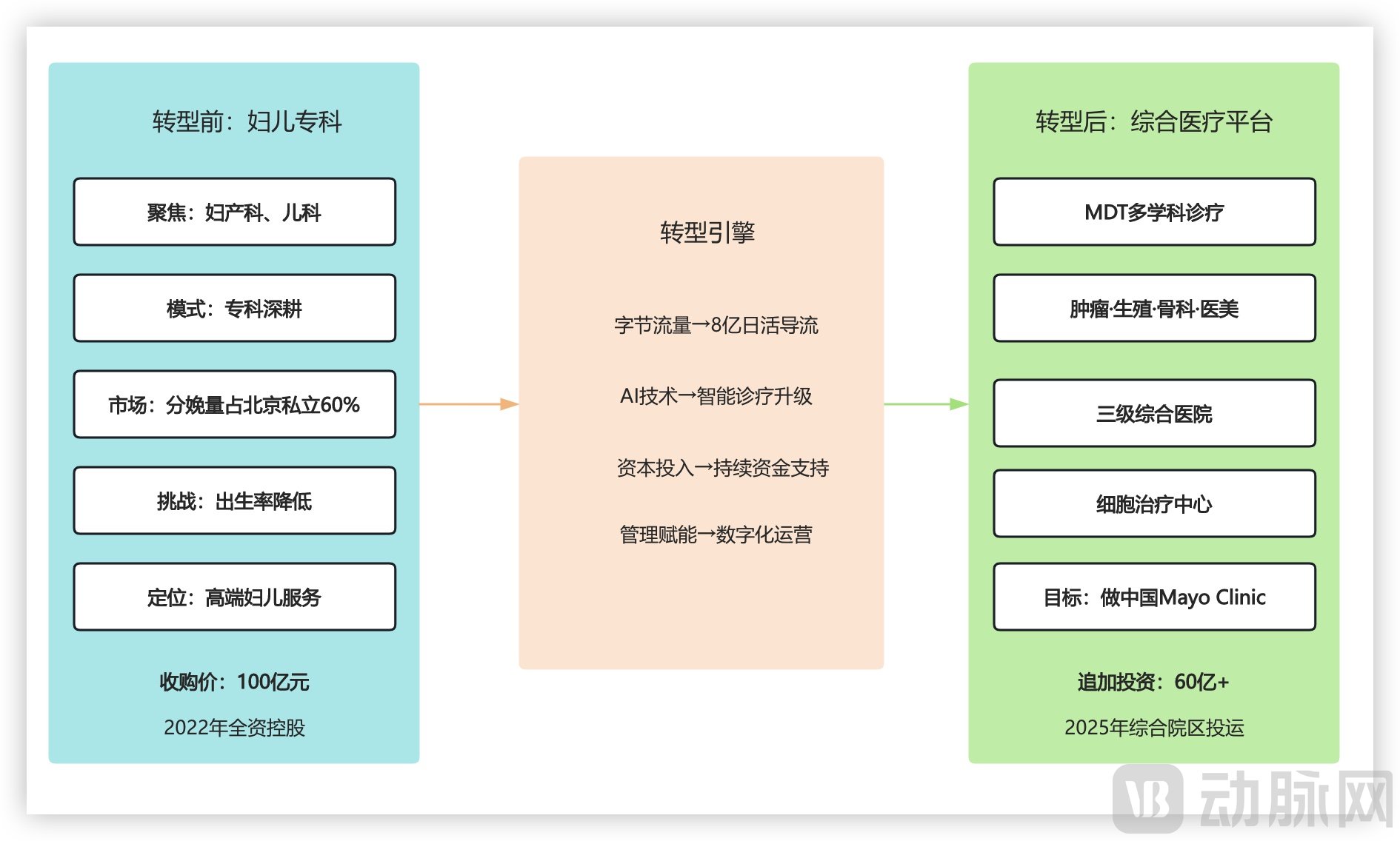
ByteDance's Exploration of Medical Industrialization, Chart Based on Public Information
This transformation holds multiple strategic significances for ByteDance. First, it addresses the long-standing challenge of monetizing traffic in internet healthcare. Simply providing online consultations and selling medicines does not constitute an exceptionally strong business model. However, with an offline physical hospital in place, ByteDance can achieve a closed-loop system of online screening and diagnosis combined with offline services, converting Douyin's massive traffic into tangible medical treatments. Second, the general hospital platform offers a clinical validation base for ByteDance’s AI medical technologies. Whether it is the algorithms of Xiaohu AI Doctor or cutting-edge technologies like cell therapy, they can all undergo implementation verification and clinical transformation at Amcare.
More importantly, this transformation represents ByteDance's respect for the rules of the medical industry. Early failures in internet healthcare have proven that a simple "internet + healthcare" model is difficult to succeed; the core of medical services still lies in high-quality medical resources and clinical capabilities. By acquiring a controlling stake in Amcare, ByteDance is essentially purchasing a medical license and a professional medical team, using this as a foundation to build genuine medical service capabilities.
Only by getting the server side up and running can we build a triangular cycle ecosystem of traffic-data-service. The server side not only provides diagnostic and treatment services but, more importantly, generates clinical data, including patients' medical records, imaging, treatment plans, rehabilitation outcomes, and other data. After desensitization, this data can be fed back into the training and optimization of AI algorithms. This cycle of clinical data → algorithm optimization → diagnostic improvement → more data is the core competitiveness of the ByteDance ecosystem.
This forms an interesting contrast with Tencent's investment logic. Tencent’s investments in the healthcare sector focus more on connectivity—connecting doctors with patients, hospitals with patients, and medicines with patients. The advantage of this model is that it requires fewer assets and can expand rapidly, but its downside lies in the difficulty of controlling service quality and the low efficiency of traffic monetization. On the other hand, ByteDance’s model is based on self-building—self-built hospitals, self-assembled teams, and self-constructed service systems. This model involves heavy assets and a long cycle, but once successful, it creates competitive barriers that are difficult to replicate.
Despite ByteDance's ambitious healthcare layout, the challenges are equally daunting.
First, the particularity of the healthcare industry determines the limitations of traffic logic. Healthcare is a low-frequency, high-trust-threshold service; users won't choose a hospital simply because of algorithmic recommendations, nor will they accept a treatment just because of short-video promotions. ByteDance's expertise in content distribution + algorithmic recommendation faces significant obstacles in the healthcare sector when it comes to shifting user mindset.
Secondly, the heavy asset model poses a huge test for both the capital chain and management capabilities. The transformation of Amcare requires continuous investment; the construction cycle of cell therapy centers lasts for several years, and AI drug research and development is a long-term project that takes ten years to complete. Against the backdrop of slowing growth in internet advertising, whether ByteDance will continue to support large-scale investment in the healthcare sector remains uncertain.
Finally, policy risks cannot be ignored. The medical industry is strictly regulated, and policy changes—from the qualification approval of internet hospitals to the clinical norms for cell therapy—may directly impact the feasibility of business models. ByteDance needs to strike a balance between innovation and compliance, which is no easy task for an internet company known for rapid iteration.
However, ByteDance's medical experiments also have unique strategic significance. ByteDance's layout in the medical field is essentially a large-scale experiment on whether Internet companies can become industrial conglomerates. Therefore, it has chosen a path completely different from Tencent: instead of becoming an open platform that connects everything, it aims to be an industry giant that controls the entire chain; instead of being a VC seeking financial returns, it strives to be an industry capital that achieves strategic synergy.
Behind this choice lies ByteDance's confidence in its own capabilities, believing that its algorithmic advantages can optimize the allocation of medical resources, its traffic advantages can reduce customer acquisition costs, and its technological strengths can break through efficiency bottlenecks in medical services. At the same time, this is also a strategic bet, wagering on the feasibility of the heavy asset model in the healthcare industry, on AI technology’s ability to reconstruct medical services, and on ByteDance's organizational capabilities to manage a vast medical group spanning online and offline operations.
In five years, with 20 billion yuan invested and over 20 controlled enterprises, ByteDance is using the speed of the internet and the power of capital to deeply penetrate the landscape of China's healthcare industry. Regardless of the final outcome, this experiment itself has already proven that when an internet company decides to "go heavy," its potential far exceeds external imagination.
In this sense, ByteDance indeed doesn't resemble a VC, nor does it look like a traditional internet healthcare platform. It is evolving into an entirely new species—a healthcare conglomerate with AI as its technological foundation, data as its core asset, and a closed-loop ecosystem as its business model. This might just be the exploration of "breaking through business inertia" that ByteDance founder Zhang Yiming referred to when he stepped down as CEO, and also the critical leap for ByteDance's transformation from an app factory to a technology industry giant.