

Mindray's Entrepreneurial Roots, Overseas Market Holds Up Half the Sky: MEDCAPTAIN's Journey to Conquer the Hong Kong Stock Market

MEDCAPTAIN
R&D and Manufacturer of In Vitro Diagnostic Reagents and Equipment

Mindray
Medical Device R&D Manufacturer
In the medical device industry, there is no myth of getting rich overnight. What matters is the quality of the product, the stability of the channels, and the intensity of research and development. In March 2026, Shenzhen MEDCAPTAIN MEDICAL TECHNOLOGY CO., LTD. officially submitted its listing application to the Hong Kong Stock Exchange, with Morgan Stanley and Huatai International as joint sponsors. This low-profile company, which many outsiders may not have heard of, has already made its way into 90% of China's top tertiary hospitals, selling its products in 140 countries worldwide. Holding three key strengths—life support, minimally invasive intervention, and in vitro diagnostics—it turned losses into profits within three years, becoming a typical example of breakthrough success for domestically produced medical devices.
Many people, upon hearing about MEDCAPTAIN for the first time, assume it’s a newly emerged startup. In reality, it has long become an "invisible standard" in hospitals. From infusion pumps in the ICU, endoscopes in operating rooms, to thromboelastography analyzers in the laboratory department, MEDCAPTAIN's products are embedded in every critical step of the medical treatment process, quietly occupying a core position in advanced medical devices. By the end of 2025, MEDCAPTAIN will have covered over 6,000 hospitals in China, with tertiary hospitals accounting for up to 90%. This means that many of China’s top hospitals have been using its equipment and consumables for a long time.
Not content with merely securing its home base in China, MEDCAPTAIN has long expanded its business globally. Leveraging a mature distribution network, its products are sold across the Asia-Pacific, Europe, the Middle East, Africa, and the Americas, covering 140 countries and regions. In a global market dominated by giants like Philips, Mindray, and Johnson & Johnson, MEDCAPTAIN has carved out its own niche. As a full-scenario medical device service provider, MEDCAPTAIN hasn’t staked everything on a single sector; instead, it has built three core business matrices: life support, minimally invasive intervention, and in vitro diagnostics. With over 60 life support products, more than 110 minimally invasive intervention products, and over 160 in vitro diagnostic products, the company boasts a portfolio of more than 300 products that create synergies, diversify risks, and share channel resources. This approach has enabled MEDCAPTAIN to forge a solid path of independent research and development alongside global commercialization.
How far can a medical device company go? The core factor lies in whether the leader truly understands the industry. MEDCAPTAIN's team can be called the "golden veteran group" of the medical circle. Founder Liu Jie, aged 56 this year, is an undisputed Mindray veteran who has served as International Sales Vice President, Executive Vice President, Chief Operating Officer, and Chief Financial Officer, fully participating in Mindray's entire journey from being a domestic leader to becoming a global powerhouse. In his early years, he also honed his skills at HP Medical and Johnson & Johnson Medical, gaining comprehensive expertise in R&D, production, sales, and the entire chain of globalization.
Zhong Yaoqi, also from Mindray, is the partner who focuses on international marketing and strategic mergers and acquisitions. The two of them, one internal and one external, meticulously plan with a deep respect for the industry. From product development to hospital access, from building domestic channels to exploring overseas markets, every step aligns with industry patterns, avoiding the common pitfalls of startups. Among the seven senior executives disclosed, five have experience working at Mindray. It is this seasoned team that has enabled MEDCAPTAIN MEDICAL TECHNOLOGY CO., LTD. to lay a solid foundation from the start, targeting the high-end market without engaging in low-end competition or cheap contract manufacturing. By focusing relentlessly on technology and quality, they are gradually establishing themselves in a field dominated by foreign companies.
Since 2016, MEDCAPTAIN has completed 10 rounds of financing totaling 2.259 billion yuan, with Hillhouse Capital being the largest institutional shareholder, holding over 20%. In its early stages, MEDCAPTAIN rapidly built up three core business segments—life support, minimally invasive intervention, and in vitro diagnostics—through a series of acquisitions.
The Rise of MEDCAPTAIN: Not by Luck, but by Capitalizing on the Most Certain Trends in the Medical Device Industry. The three key areas it has ventured into are all essential, high-growth sectors with immense potential for domestic substitution. Life-support equipment is a critical need in ICUs and operating rooms, characterized by high technological barriers and strict regulations, and has long been dominated by foreign companies. The global market is projected to reach $109.7 billion by 2030, while the Chinese market will exceed 93.2 billion yuan. With the advancement of tiered medical treatment and equipment upgrades, the demand for domestically produced alternatives is becoming increasingly urgent.
Minimally Invasive Intervention: The Fastest-Growing Sector in Recent YearsThe widespread adoption of minimally invasive surgeries and the soaring penetration rate of single-use endoscopes are driving growth. By 2030, the global market is projected to reach $48.8 billion, with China’s market valued at 53.2 billion yuan. With strong repeat purchases of consumables and stable cash flow, this sector represents a premium business for medical device companies.In Vitro Diagnostics (IVD): The Largest Sub-Segment in the Global Medical Device MarketBy 2030, the global IVD market will scale to $167.3 billion, while China’s market will approach 191.2 billion yuan. Applications such as coagulation testing, blood typing, and thromboelastography are essential needs in hospitals. High technical barriers ensure that once a company secures its market share, it is difficult to be replaced.
The rules of this industry are simple: three thresholds — regulation, technology, and channels — all indispensable. Without a decade of R&D accumulation, you won't get approval; without core technology, you can't compete with foreign companies; without a hospital-recognized reputation, you can't expand your channels. However, MEDCAPTAIN, relying on the experience of its veteran team, continuous R&D investment, and solid product strength, has successfully crossed all three thresholds.
Medical devices ultimately rely on the strength of their products. According to the prospectus data, the company's total revenue reached 1.619 billion yuan in 2025, with its three major businesses each playing a distinct role and contributing to a stable income structure.
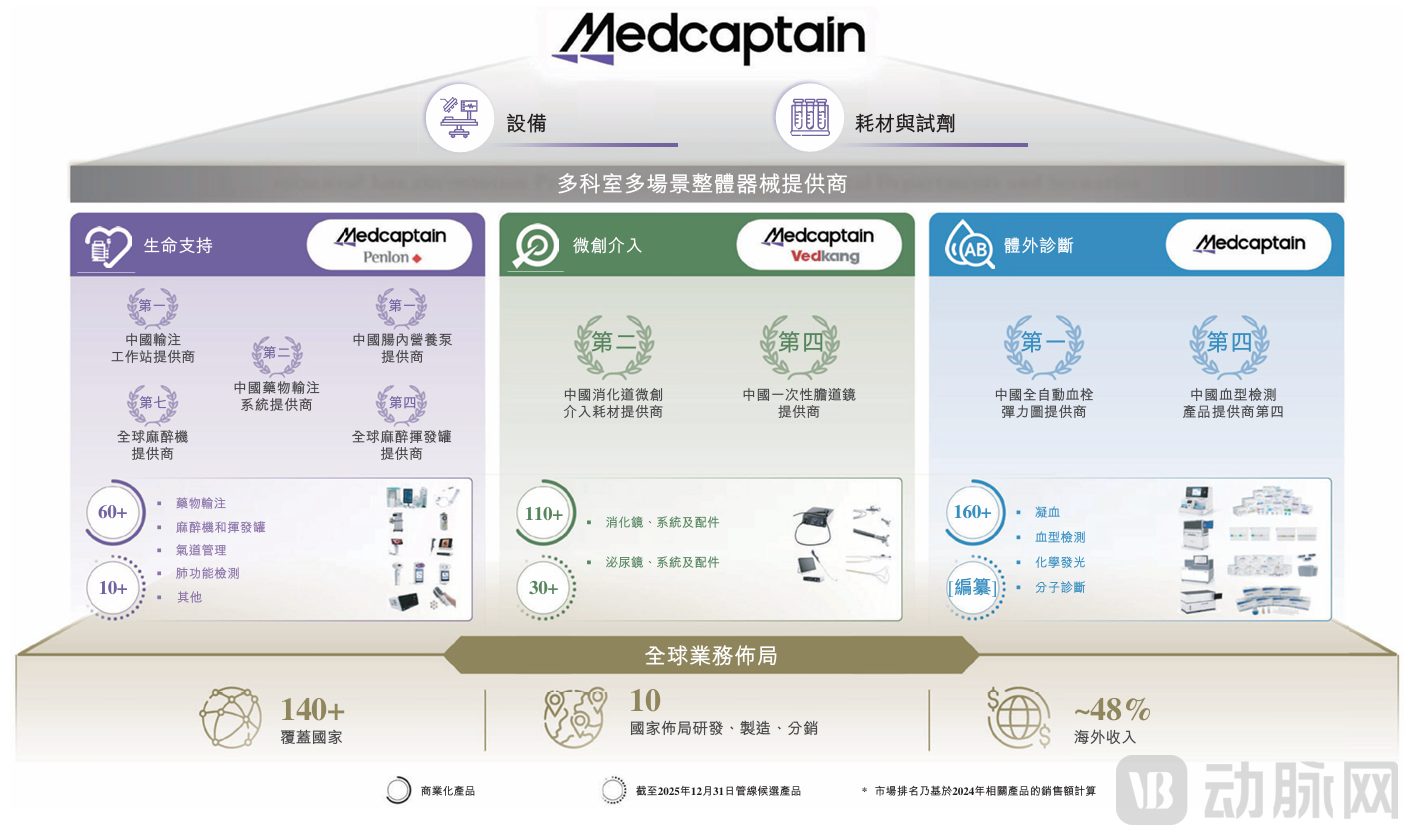
Life support is the foundation of MEDCAPTAIN's business, focusing on products such as infusion pumps, injection pumps, infusion workstations, enteral nutrition pumps, and anesthesia machines. Targeting ICU and operating rooms, MEDCAPTAIN has consistently ranked first in market sales for infusion workstations and enteral nutrition pumps over multiple years, thanks to the world’s first remote infusion control system and China’s first independently developed multi-channel infusion workstation.
In 2025, the revenue from the life support business reached 613 million yuan, accounting for 37.9% of the total revenue, with a gross profit margin of 46.4%. This is the company's core business, characterized by stable income and high customer loyalty. Despite fierce market competition, it continues to make steady contributions.
Minimally Invasive Interventions: The Growth Engine and Largest Revenue Source
In Vitro Diagnostics (IVD) is a promising sector for the company, focusing on fully automatic thromboelastography analyzers, blood type detection equipment, and test kits. In 2021, the company launched the world's first fully automatic thromboelastograph, directly setting industry standards, and has ranked first in this niche market for several consecutive years. By 2025, the revenue from the IVD business is projected to reach 194 million yuan, accounting for 12.0% of total revenue. Although its proportion is not high, it features high technical barriers and steady growth, making it an important growth driver for the future.
These three business segments each have their own advantages: life support stabilizes the core business, minimally invasive interventions generate high profits, and in vitro diagnostics aim for long-term growth. According to the prospectus, in the life support sector, measured by sales revenue, it ranked first in China’s infusion workstation market and enteral nutrition pump market from 2018 to 2024 annually. In the minimally invasive intervention sector, it ranked second in China’s digestive system minimally invasive intervention consumables market and among the top five in China’s disposable choledochoscope market from 2022 to 2024 annually. In the in vitro diagnostics sector, it ranked first in China’s fully automatic thromboelastography market from 2021 to 2024 annually.
The financial data in the prospectus is filled with MEDCAPTAIN's growing pains and trajectory of逆袭. In the medical device industry, it is necessary to invest heavily in research and development and channel expansion in the early stages, and losses are the norm. MEDCAPTAIN is no exception, but it completed the crucial turnaround from loss to profit within three years. In 2023, revenue was 1.313 billion yuan, with a net loss of 64.51 million yuan; in 2024, revenue reached 1.399 billion yuan, with a net loss of 96.62 million yuan; in 2025, revenue increased to 1.619 billion yuan, with a profit of 50.74 million yuan, entering the harvest period completely.
Behind the profitability is a continuous increase in gross margin, rising from 49.6% in 2023 to 53.7% in 2025. The core reason is the growing share of high-margin minimally invasive interventional business, driven by economies of scale and optimized product mix. More remarkably, even during the two years of losses, MEDCAPTAIN did not cut back on R&D investment. Over three years, it poured in a total of 846 million yuan, building a 525-person R&D team that accounts for 24% of its workforce. It established five major R&D centers in Shenzhen, Changzhou, Nanjing, Shanghai, and the UK, focusing relentlessly on core technologies to prevent being constrained by foreign entities.
In terms of business model, MEDCAPTAIN relies primarily on distributors, supplemented by ODM, with direct sales as a complement. By 2025, distributor revenue will account for 83.1%, representing a lightweight asset model with extensive coverage. Without the need for heavy asset investment in channel building, it can quickly penetrate the nationwide and global markets, achieving low cost and high efficiency, which aligns with the optimal strategy in the medical device industry. However, over-reliance on channel outsourcing may harbor certain risks in the long term.
MEDCAPTAIN is not just a domestic company in China, but a truly globalized medical device enterprise that has expanded internationally. Overseas markets have become an indispensable pillar of growth for the company. The prospectus clearly breaks down revenue by region: in 2025, revenue from mainland China accounted for 51.7%, while overseas revenue reached 48.3%, nearly supporting half of the business. This proportion has steadily increased from 38.4% in 2023, indicating that the company’s globalization strategy is entering a fruitful phase.
Looking further into the overseas markets, the EMEA region—Europe, Middle East, and Africa—is the largest overseas market. The company has established local representative offices in key markets such as the UK, Netherlands, Turkey, India, and Brazil to provide nearby services and responses. It no longer simply sells products but focuses on localized operations, which is the key to its ability to gain a strong foothold overseas.
At the channel level, overseas markets are deeply cultivated through a professional dealer system, while acquisitions of overseas companies such as Penlon in the UK in earlier years have enabled rapid access to local market entry qualifications and mature channels, significantly shortening the global expansion cycle. To date, the products have entered 140 countries and regions worldwide, covering hospitals in developed countries as well as grassroots medical institutions in emerging markets, truly realizing the pattern of "China-developed, global sales."
Medical device is a slow and long-term business that requires persistent dedication. MEDCAPTAIN proved the viability of its model by turning losses into profits within three years, and demonstrated its product strength through successful international expansion. From a startup in Shenzhen to covering 90% of Class III hospitals in China, from losses to profitability, and from domestic markets to reaching 140 countries, MEDCAPTAIN’s story epitomizes the localization of China's medical device industry. Now, as MEDCAPTAIN prepares for a Hong Kong stock listing, the funds raised will be used for R&D upgrades, capacity expansion, and global strategic planning. Clearly, MEDCAPTAIN’s ambition goes beyond leading its niche—it aims to become a globally recognized Chinese brand on the world medical device stage.