

Series B Financing of $50 Million: Biobeat Reinvents 24-Hour Blood Pressure Monitoring with Cuffless Patch
On January 13, Biobeat Technologies announced a strategic partnership with Kestra Medical Technologies, a leading wearable medical device company in the cardiac rehabilitation field, to integrate Biobeat's cuffless blood pressure monitoring technology into Kestra’s cardiac rehabilitation wearable defibrillator system.
One month before this collaboration, Biobeat completed a $50 million Series B financing round, injecting strong momentum into the commercialization of its technology and ecosystem expansion.
Biobeat's core product is the world's first FDA-approved cuffless, patch-based 24-hour ambulatory blood pressure monitoring system, designed to address misdiagnosis issues in traditional blood pressure measurements through continuous medical-grade monitoring.
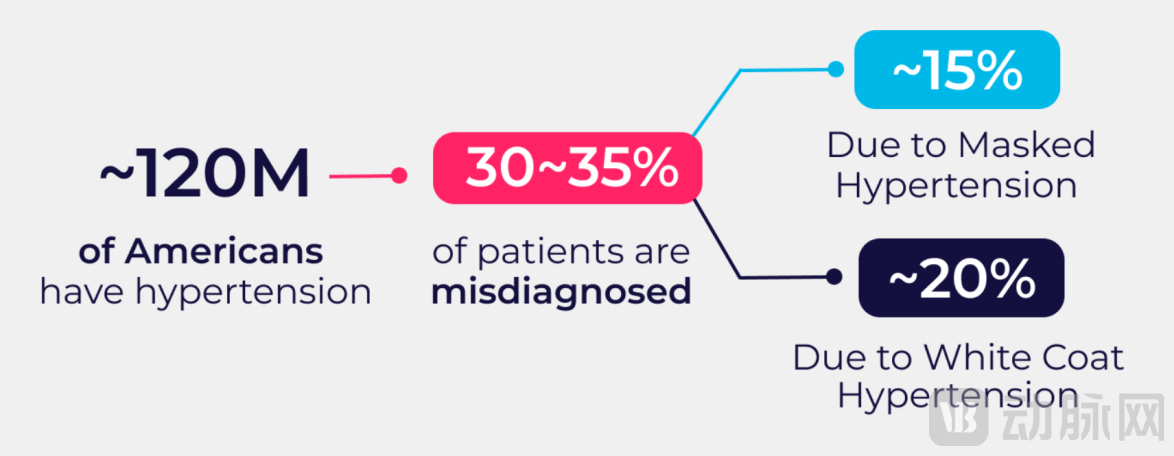
According to statistics from the American Heart Association, about 120 million adults in the United States have hypertension. Due to reliance on a single measurement taken in the clinic, the diagnosis may deviate from the true blood pressure status. Among patients diagnosed with hypertension in the clinic, approximately 20% can be attributed to "white coat hypertension" — a phenomenon where blood pressure increases due to anxiety in medical settings but remains normal in daily life.
Source: Biobeat official website
To address this clinical reality, Biobeat was founded in 2016, with its headquarters located in Boca Raton, Florida, USA. From its inception, the company has focused on providing monitoring solutions that more accurately and continuously reflect patients' daily blood pressure conditions through technological innovation.
This exploration is driven by a core team with diverse backgrounds and cross-disciplinary integration.
Founder and CEO Arik Ben Ishay has extensive experience in advanced technology project management. From 2005 to 2011, he served as the executive of a startup and director of a technology incubator. From 2012 to 2016, he was the head of the hardware and software department at Symcotech LTD, responsible for developing and managing the department's information system requirements and leading the company’s innovation and development team.
Chairman Raymond W. Cohen has over four decades of leadership experience in the life sciences and medical technology industries. He served as the co-founder and CEO of Axonics, Inc. for a decade, a publicly traded company that is a global leader in the field of implantable neurostimulation devices. Under his leadership, Axonics successfully completed its initial public offering, achieved revenue exceeding one billion dollars within four years of commercial launch, and was named the fastest-growing technology company in North America.
Founder, Senior Vice President, and Chief Technology Officer Johanan May has extensive experience in multiple technical fields such as hardware and software development and quality assurance, and previously served as the Director of the IoT division at a high-tech company; Founder and Senior Vice President of R&D Israel Sarussi has over 40 years of experience in developing advanced high-tech devices, with particular expertise in medical technology and the ability to bring products from the concept stage to the regulatory approval stage.
Moreover, a scientific advisory board composed of cardiology experts from leading medical institutions such as Mayo Clinic and Duke University provides cutting-edge guidance for product development and clinical validation.
This team, which combines experience in the medical technology industry with clinical insights, shares a common goal: to empower doctors to make more informed decisions by providing continuous, accurate, and convenient medical-grade monitoring, ensuring effective management for every hypertension patient.
Biobeat's core competitiveness lies in its FDA-approved cuffless monitoring chest patch. The product is designed for "Ambulatory Blood Pressure Monitoring (ABPM)" and "clinical settings," directly addressing professional diagnostic challenges such as "white coat hypertension" misdiagnosis. This positioning determines that its initial application scenarios mainly revolve around medical institutions.
Traditional cuff devices rely on intermittent inflation to compress blood vessels, a process that is abrupt and disruptive to sleep. Biobeat's patch utilizes a patented PPG optical sensor, which, through a wireless and non-invasive method, can continuously measure blood pressure for 24 hours and simultaneously monitor over ten vital signs such as blood oxygen saturation, respiratory rate, heart rate, and body temperature. Data is automatically uploaded to the cloud platform, supporting remote monitoring, allowing patients to receive medical-grade continuous care during daily activities.
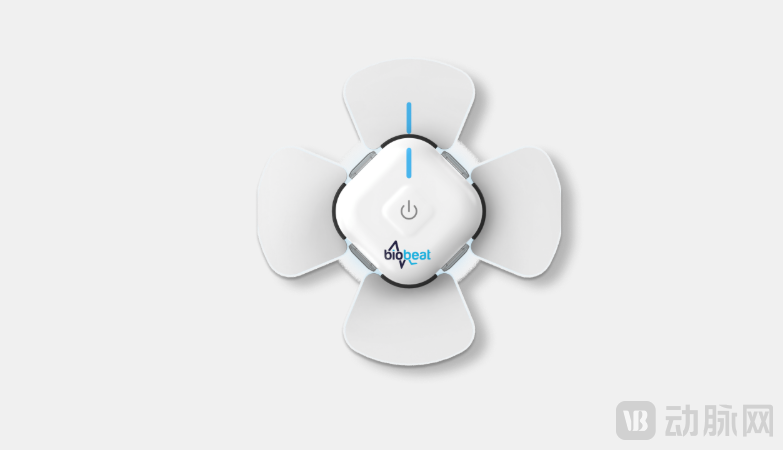
Chest Monitor (Source: Biobeat Official Website)
The patch is comfortable and unnoticeable to wear, especially solving the core pain point of nighttime measurement interfering with sleep, improving patient compliance. The complete data stream brought by high compliance is key to overcoming the challenges of clinical diagnosis. The system can seamlessly integrate patient-recorded symptom diaries with continuous sensor data, generating comprehensive reports that reflect real blood pressure fluctuation patterns throughout the day. This not only helps doctors accurately identify and distinguish between "white-coat hypertension" and masked hypertension, avoiding misdiagnosis, but also provides precise basis for developing personalized treatment plans and evaluating efficacy.
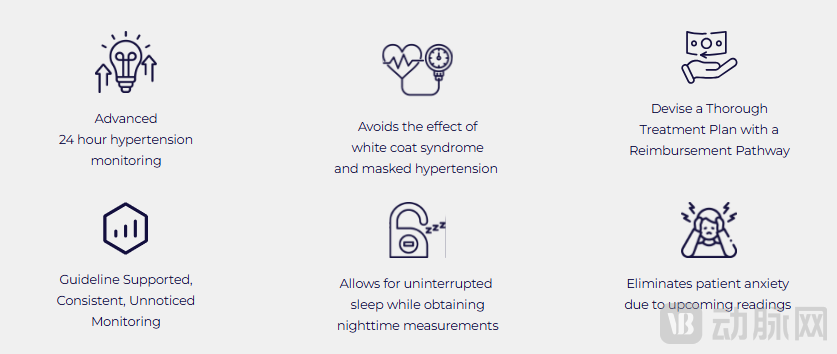
Function of the Chest Detector (Image Source: Biobeat Official Website)
From the clinical pathway perspective, Biobeat optimizes the entire process from initial diagnosis, monitoring to evaluation. From suspecting hypertension at the clinic's first visit, to the patient wearing a patch for 24-hour real-life monitoring, and then to the automatic generation of reports and quick delivery to the doctor. The whole process simplifies operations, upgrading diagnosis from a single instantaneous measurement in the consulting room to a comprehensive assessment based on real-life scenarios.
Since gaining FDA approval for blood pressure monitoring in 2018, the extensibility of its technology platform has become evident across multiple dimensions. On one hand, in terms of application scenarios, it has expanded from simple hypertension diagnosis to more complex continuous monitoring situations such as cardiac rehabilitation, showing potential for earlier disease warning. On the other hand, in terms of commercialization pathways, the company is exploring diverse approaches: aside from its core medical chest patch, its monitoring technology has also received FDA approval for smartwatch-form devices, paving the way for everyday use. Meanwhile, the company’s official website once directly sold a disposable monitoring kit called “24BP” to consumers, indicating an initial exploration into the direct-to-consumer (DTC) model. These efforts collectively demonstrate that while solidifying its medical-grade core positioning, Biobeat is actively seeking broader market possibilities.
In December 2025, Biobeat completed a $50 million Series B financing round, which will be used to accelerate the commercial expansion of its products in the U.S. market.
This round of financing was jointly led by Ally Bridge Group, OrbiMed Advisors, and Elevage Medical Technologies. In addition, Steven Plachtyna from Ally Bridge, Dina Chaya from OrbiMed, and Evan Melrose from Elevage have joined the company's board of directors to support its next phase of development.
The institutions leading this investment round are heavyweight participants in the global healthcare investment field. Ally Bridge Group focuses on high-impact life science innovations and has led or co-led over $6 billion in healthcare transactions since its establishment. OrbiMed manages assets exceeding $19 billion, offering financing solutions and access to extensive global team resources. Elevage Medical Technologies, established by the renowned investment firm Patient Square Capital, provides funding and deep post-investment operational support to companies ranging from advanced clinical development to commercial acceleration stages.
Biobeat, which has received strong capital support, is standing at the starting point of large-scale promotion. Founder and CEO Arik Ben Ishay stated that the company has assembled a professional sales team to expand the commercialization of its new dynamic blood pressure monitoring system. He said, "Based on our successful clinical validation, dynamic blood pressure monitoring has finally reached the point of becoming a true diagnostic standard, which will help diagnose and titrate antihypertensive drugs for over 100 million hypertensive patients in the United States." This round of financing has undoubtedly accelerated this ambition.
Capital's empowerment rapidly catalyzed the extension of strategy. In January 2026, Biobeat and Kestra Medical Technologies, a leader in wearable cardiac devices, announced an in-depth collaboration involving exclusive licensing, co-development, and equity investment. The aim is to integrate Biobeat’s cuff-less blood pressure monitoring technology into Kestra’s ASSURE Wearable Cardioverter Defibrillator (WCD) system, providing patients with continuous, non-invasive blood pressure diagnostic insights.
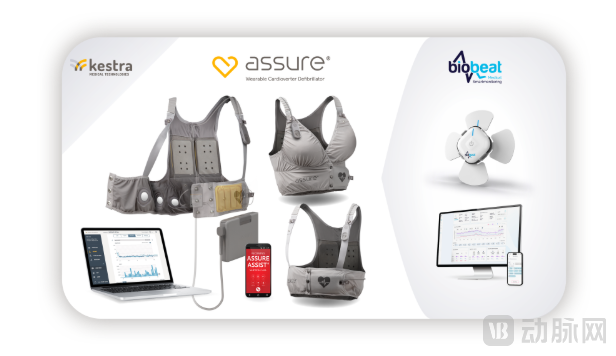
This collaboration addresses an urgent clinical need. According to data from Kestra's largest prospective real-world study on wearable defibrillators to date—the ASSURE Wearable Cardioverter Defibrillator Post-Market Clinical Evaluation (ACE-PAS)—72% of users have hypertension. During the critical phase of cardiac rehabilitation, precise, continuous, and non-disruptive blood pressure management is essential for optimizing medication therapy and improving patient outcomes.
For Biobeat, this collaboration represents far more than just a commercial agreement; it marks a pivotal leap in its technology: evolving from standalone diagnostic devices to being embeddable within more complex disease management ecosystems, such as cardiac rehabilitation. This not only validates the scalability of the solution but also outlines the company’s future direction—transitioning from a device company providing precise data to a technology platform empowering remote monitoring and chronic disease management.
Under this pathway, the company's core strategy has become increasingly clear: by continuously enhancing the intelligent analysis capabilities of its data platform, and using this collaboration with Kestra as a benchmark, it aims to expand more ecosystem partnerships to build a digital solution platform that can assist in clinical decision-making and optimize the management of various chronic diseases, from hypertension to cardiac rehabilitation.
This strategic transformation caters to the vast wave of market development. According to Persistence Market Research, the global market size for wearable blood pressure monitoring devices is projected to reach $8.1 billion by 2031, with a compound annual growth rate (CAGR) of 15.7%. Meanwhile, the AI-integrated remote patient monitoring market is experiencing rapid growth. DataM Intelligence reports that the AI remote patient monitoring market is expected to reach $1.035 billion by 2033, with a CAGR of 6.7%, and blood pressure monitoring is one of the fastest-growing categories. Biobeat is positioned precisely at the intersection of these two high-growth sectors.
However, beneath the similar technological trends, companies follow different growth paths. Biobeat has chosen a "deep" path that starts from addressing serious medical pain points, heavily relying on clinical validation and professional channels. In China, the robust consumer electronics supply chain and vast user base have given rise to different product forms and commercial logic. Some companies have moved towards a "consumer-grade hardware carrying professional-grade functions" path, represented by wrist-worn and arm-worn devices, directly reaching users through mature consumer electronics products. Others focus on the medical-grade market, with products mostly being handheld cuff-less blood pressure monitors or continuous monitoring systems for intensive care, significantly differing in form and use cases from Biobeat's chest patch.
This also highlights the uniqueness of Biobeat's model: rather than pursuing rapid explosions in the consumer market, it seeks deep integration within professional medical systems. Starting from addressing the clinical pain points of blood pressure monitoring, Biobeat provides an innovative solution for medical-grade continuous monitoring with its cuffless monitoring patch. Today, driven by capital and strategic cooperation, it is expanding its technological core to broader health management scenarios. This development path clearly points to the future it aims to achieve: making health monitoring more seamless and clinical data more intelligent.