

Distinct HealthCare, a Benchmark for High-End Medical Services in China, Surges on Debut; Tencent is the Largest Shareholder

Distinct HealthCare
High-Quality, Digital Medical Service Provider
Today, Distinct HealthCare, a chain clinic group positioned in the mid-to-high-end medical services market, went public on the Hong Kong Stock Exchange (HKEX).
Distinct HealthCare's issuance price is HK$59.9 per share, with an opening price of HK$81 today. As of 9:41 AM, the stock price reached HK$88.2, representing a 47.25% increase, with a total market value of HK$5.022 billion.
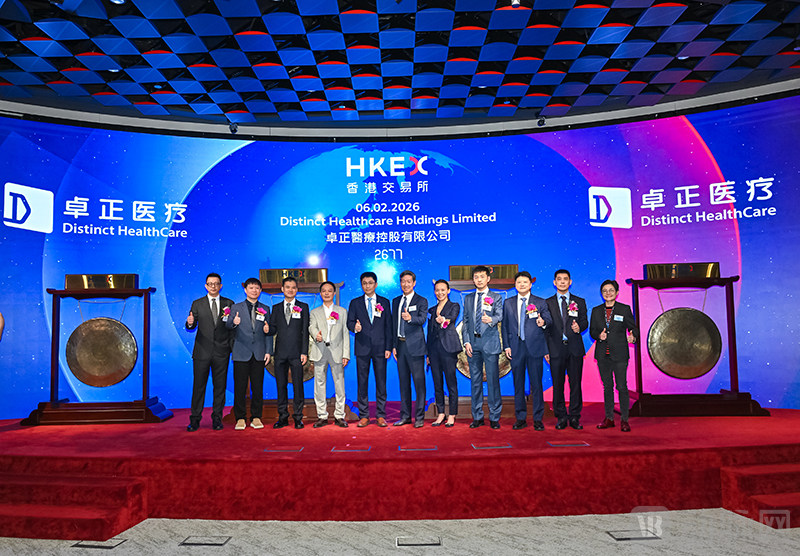
Starting from a 50-square-meter clinic in 2012, Distinct HealthCare has grown to encompass 24 medical institutions, including 17 clinics and 2 hospitals in China, as well as 5 general practice clinics established in Singapore and Malaysia. The physical medical institutions under Distinct HealthCare mainly cover pediatrics, dentistry, ophthalmology, dermatology, otolaryngology and surgery, gynecology, internal medicine, health checkups, and other specialties. Additionally, it provides internet-based consultation services through its online platform.
When Distinct HealthCare first submitted its prospectus in May 2024, VCBeat provided an analysis of its key business elements such as the family healthcare model, membership system, and commercial insurance payments.(Click here to view the interpretation details).To date, the core business structure of Distinct HealthCare has not changed from the aforementioned model. The most noteworthy change on the occasion of its successful IPO is that, with rapid revenue growth in recent years, improved operational efficiency, and economies of scale taking effect, Distinct HealthCare has turned losses into profits, preliminarily solving the profitability challenge of mid-to-high-end medical services.
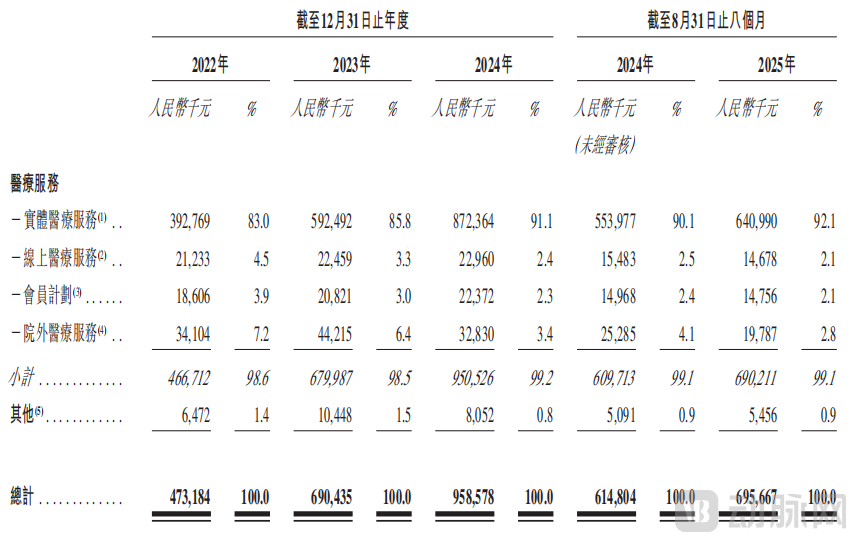
Revenue Structure and Revenue Changes of Distinct HealthCare, Source: Prospectus
Specifically, Distinct HealthCare's total revenue increased from 473 million yuan in 2022 to 959 million yuan in 2024, with a compound annual growth rate of 42.3%. The total revenue from January to August 2025 was 696 million yuan, representing a year-on-year increase of 13.2%. In terms of profitability, the company achieved a net profit of 80.227 million yuan in 2024, and the net profit further increased to 83.211 million yuan from January to August 2025.
It is worth mentioning that the average cost per visit at Distinct HealthCare's physical medical institutions reached around 1,100 yuan. Nevertheless, its patient return rate increased from 75.7% in 2022 to 82.7% from January to August 2025.Against the backdrop of China's long-term focus on inclusive healthcare, mid-to-high-end medical services are gradually gaining market recognition.
In the medical service industry, labor costs have long been a major component of business operating costs, a characteristic that is particularly evident in the mid-to-high-end medical services sector.
On the one hand, the recruitment and retention of highly skilled doctors and other medical professionals are directly related to the service capacity and reputation of the institution. However, the industry generally faces challenges such as a scarcity of high-quality medical talent and long training cycles, thus,High salaries for talent acquisition and continuous investment in talent development resources are essential for the growth of institutions. On the other hand, to ensure a high-quality service experience for patients, mid-to-high-end medical institutions must allocate more support-oriented human resources, further driving up labor costs.
Taking Distinct HealthCare as an example, its medical team is divided into full-time and part-time categories, with full-time doctors being the main force. As of August 2025, Distinct HealthCare has a total of 387 full-time doctors, with an average of 15 years of practice experience. Among them, 79% come from top-tier tertiary hospitals in China, and 21% have overseas study or work experience. The full-time doctor team has made significant contributions to the company's performance. Data from the prospectus shows that since 2022, full-time doctors have contributed approximately 93% to 97% of the revenue from physical medical services.
At the same time, other medical professionals at Distinct HealthCare, such as nurses, pharmacists, and various types of technicians, are also continuously expanding to support the growth of the business scale.
Overall, labor costs also account for a high proportion of Distinct HealthCare's total costs.
The prospectus disclosed that employee salaries and benefits expenses constituted the largest component of cost of revenue, selling expenses, and administrative expenses.However, the proportion of the aforementioned expenditures in total revenue has been gradually decreasing in recent years, dropping from 80.2% in 2022 to 54.2% from January to August 2025.
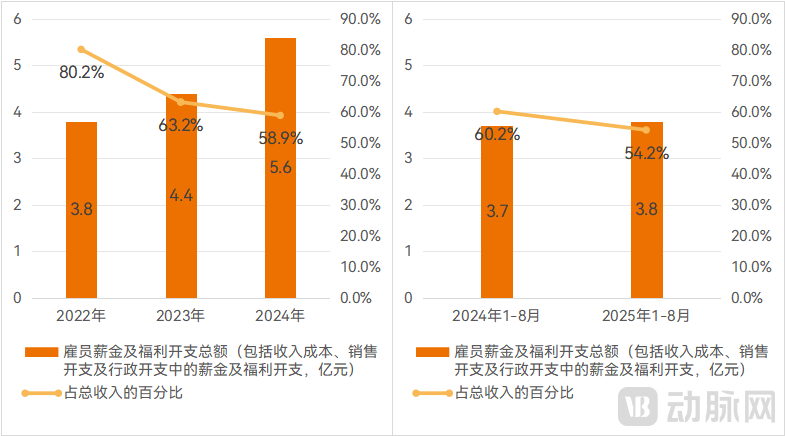
Distinct HealthCare Human Resources Related Expenditures, Data Source: Prospectus
In other words, as shown in the figure above, as the business scale expands and total revenue grows, although the total amount of labor costs has increased, its proportion in total revenue has significantly decreased (even excluding the special circumstances of the COVID-19 pandemic in 2022, there was still a notable decline during normal periods).
The effect of core cost control has become apparent, laying the foundation for Distinct HealthCare's profitability improvement and enabling the scale effect of mid-to-high-end medical services to begin to be released.
Cost control centered on human resources requires an efficient and feasible management system as support. For mid-to-high-end medical service institutions that need to expand in a chain, digitalization is the key to ensuring the effective operation of the management system.
In terms of management systems, Distinct HealthCare has established a three-level centralized management structure of "Headquarters-Region-Specialty Service Unit."
Specifically, the headquarters assumes core functions such as overall strategic planning, setting business standards, and supervising policy implementation. Regional and specialty units retain operational flexibility and can dynamically adjust service strategies based on local healthcare needs and market conditions. This structure not only reduces the group's overall operational risks but also achieves a balance between efficiency and flexibility through centralized core management functions, promoting the release of economies of scale.
At the same time, Distinct HealthCare's digital system covers the entire chain from patient services to internal operation management, forming an efficient and collaborative management closed loop.
To support the implementation of a three-level management structure, Distinct HealthCare has built three core digital platforms. The Distinct Management System (DMS) integrates online channels such as mobile applications, WeChat Official Accounts, and mini-programs, standardizing the entire process of patient outreach, medical services, health education, membership billing, and long-term health management. The cloud-based Hospital Management System (HMS) covers the medical service network within the group, ensuring the accuracy, continuity, and completeness of patient treatment information, providing support for follow-up consultations and long-term medical management. The Distinct Data Platform aggregates multi-dimensional data from users, clinical operations, activities, and finance, uncovering cross-department referral opportunities through in-depth analysis while enabling personalized services like health education and appointment reminders for patients.
Building on this, artificial intelligence technology has been integrated into key aspects of medical services. During the appointment stage, AI assistants can match departments and doctors based on patient needs, automatically confirming eligible appointments while flagging complex requests for manual review, ensuring efficient and accurate triage. In the diagnosis and treatment process, AI can automatically consolidate core information from medical records and physical examination reports, extracting concise medical summaries to help doctors quickly grasp a patient’s medical history, significantly reducing consultation preparation time. For prepaid package users, AI can automatically verify package benefits by cross-referencing diagnostic codes with service items, enhancing operational efficiency and patient experience.
The efficient linkage between online and offline medical services further amplifies the value of digital management. Distinct HealthCare expands its cross-regional service coverage by integrating resources from online platforms and offline institutions. Meanwhile, relying on the activity levels of doctors and patients online, Distinct HealthCare can more accurately identify target markets for offline expansion, helping newly established medical service institutions achieve scale operations quickly.
A highly standardized digital system is becoming the core driving force for Distinct HealthCare's business expansion, propelling its high-quality, large-scale development in the medical service field.
Typically, large general hospitals and internet healthcare platforms are not only key participants in the development of medical AI but also ideal scenarios for its implementation. As a chain clinic group, Distinct HealthCare has placed significant emphasis on AI research and application in its future business strategy.
Given the industry landscape, Distinct HealthCare's strategic choices mentioned above may be the result of various internal and external factors.
From the perspective of internal factors, Distinct HealthCare clearly stated in the prospectus,Looking ahead to the medium and long term, AI will bring disruptive changes to the way medical services are delivered and also offer significant opportunities for reshaping medical service standards. In other words,The company firmly believes that AI can become one of its endogenous growth drivers.
From the external environment,Since 2025, "Internet giants" have continued to increase their investment in AI medical health applications.These applications either cover different virtual medical care roles or help doctors create digital avatars, and with the continuous upgrading and iteration of large models, they can provide users with a higher-quality interactive experience. For internet companies, these AI applications are expected to become new traffic entry points, quietly reshaping the landscape of online healthcare services through user demand distribution.In the future, these AI applications are highly likely to create a suction effect on online user resources.
In fact, the aforementioned changes have been gradually occurring. According to the prospectus data of Distinct HealthCare, from January to August 2025, the number of patient visits for its online medical services decreased. The main reason is that for common and minor conditions, more patients are opting for third-party AI-assisted health consultation services rather than the health consultation services provided by Distinct HealthCare.
Therefore, Distinct HealthCare's focus on investing in AI technology is not only an internal driving force for the company’s development but also a key strategy to address external competition and industry transformation.
In its future business plans, Distinct HealthCare’s AI strategy for operational management will focus on four key scenarios: administrative process automation, quality management analysis, patient flow prediction and staffing optimization, and AI-assisted health consultation services. For instance, further enhancing the automation of appointment scheduling, billing, and insurance claims processing to significantly reduce manual administrative workload; utilizing AI to classify and analyze patient complaints and safety incidents to improve the responsiveness and productivity of quality control teams; launching a patient flow prediction system that forecasts patient needs based on historical data analysis and optimizes human resource allocation; and employing AI to assist medical staff in writing medical records and other documents, allowing healthcare professionals to focus more on patient interaction and improve service quality.
Patient-oriented services: AI technology will reshape Distinct HealthCare's service model. The platform provides free AI-assisted online follow-up services for all offline patients, ensuring the continuity and timeliness of care. Meanwhile, the AI system analyzes communication records between doctors and patients both online and offline, identifies the core needs of patients, and assists staff in optimizing communication skills and health education plans. In addition, clinical decision support AI applications are also being continuously advanced to help doctors improve diagnostic accuracy and treatment quality.
Building on this, Distinct HealthCare also plans to empower cross-disciplinary collaboration with AI, upgrading health management services for both children and adults. In the pediatric field, the team of subspecialty physicians and therapists will be expanded to provide one-stop holistic care for conditions such as developmental disorders, allergies, and asthma. Adult health management will integrate diverse services including health assessments, chronic disease management, mental health support, and sports rehabilitation, with plans to establish over 10 health management centers. Meanwhile, AI-assisted health consultation services covering both children and adults are also in preparation. These services will rely on dynamic health information from sources such as in-hospital medical records, external healthcare data, and wearable devices, combined with real-time health scores and care reminders via mobile applications, to offer users personalized medical guidance around the clock.
Distinct HealthCare's emphasis on its AI strategy is intuitively reflected in the company's allocation of future funds.The prospectus disclosed,35% of the IPO proceeds will be used for the application of AI and other digital technologies, which is the largest proportion of the fundraising purposes.
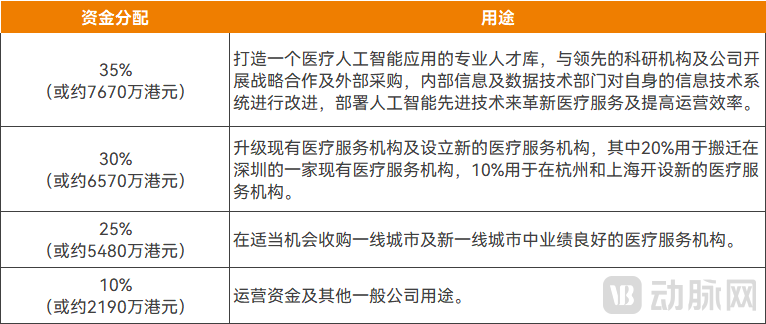
Distinct HealthCare IPO Fundraising Purposes, Source: Prospectus
According to the plan, Distinct HealthCare will build a professional talent pool for medical AI applications, engage in strategic cooperation and external procurement with leading research institutions and companies, improve and upgrade existing systems through internal information and data technology departments, and deploy AI to revolutionize medical services and enhance operational efficiency.
For example, the company will further enhance the automation level of appointment scheduling, billing, and insurance claims processing to significantly reduce manual administrative workload, with an expected reduction of approximately 50% in average manual processing time. In terms of health consultation services, AI-assisted healthcare professionals in compiling medical records and other documents are expected to reduce the time healthcare professionals spend on clinical documentation during each visit by about 15%.
Market data predicts that, with stable economic growth and the continuous increase in per capita disposable income, the mid-to-high-end medical services market has experienced rapid expansion in recent years and shows broad prospects. However,In China, where普惠医疗 has long been the mainstay, developing中高端医疗服务 is no easy task.
From 2012 to 2016 was a period when high-end medical service institutions in China were established intensively, with a large number of entrepreneurs and investment institutions flooding in. As a representative enterprise, Distinct HealthCare has received investments from several well-known institutions such as Tencent, Tiantu Capital, CICC, Qianhai Mother Fund, and Shuimu Fund during its development. VCBeat mentioned in the "2018 China New Clinic Operation Report" that it conducted research interviews with a large number of new clinics positioned in the high-end services. However, some star clinics...NowadaysHave disappeared or been merged and acquired. Overall, the cultivation of the mid-to-high-end medical services market is a long process, and its operational sustainability and profitability are long-term challenges.
At the medical technology level, even if private institutions hire expert doctors, their overall level is still difficult to compete with public hospitals; at the service level, even with an excellent service experience, it is hard to make it a core competitiveness. Looking at the current listed medical service groups with better performance, most of them are supplements to the public healthcare system, such as specialized services in ophthalmology or dentistry, or comprehensive hospitals adding to the total resources.
Now, the listing of Distinct HealthCare has shown the industry the possibilities of mid-to-high-end medical services in the Chinese market.In the future, with the deep integration of technology and medical scenarios, it is expected that more mid-to-high-end medical service enterprises will enter the secondary market with outstanding performance.