

ASCO 2026: Chinese ADCs make a powerful statement with first-line breakthroughs, bispecific iteration, and multi-target advancements
Kelun-Biotech
Innovative Drug Developer

Hengrui Pharma
Innovative and High-Quality Pharmaceutical Developer

Biokin Pharmaceutical
Pharmaceutical R&D Developer

Mabwell
Innovative Biopharmaceutical Company

LEPU BIOPHARMA
Innovative Oncology Treatment Product Developer
Held annually from late May to early June, the American Society of Clinical Oncology (ASCO) Annual Meeting serves as the premier bellwether for the presentation of breakthroughs in global oncology therapeutics and the assessment of industry trends. At the 2026 ASCO Annual Meeting, antibody-drug conjugates (ADCs) emerged as one of the most pivotal tracks in global oncology innovation, comprehensively showcasing cutting-edge research and development advancements worldwide.
Focusing on China's ADC industry, this year's ASCO meeting marks the sector's collective advancement across three dimensions, completely breaking away from the early development model of single-point breakthroughs: first, the upgrading of treatment scenarios, advancing from traditional late-line salvage therapy to directly competing with first-line standard of care; second, molecular structure iteration, advancing from established monoclonal antibody ADCs to the world's first novel bispecific ADC format; third, expansion of the target portfolio, with targets such as TROP2, HER3, Nectin-4, and GPC3 being advanced concurrently, comprehensively covering solid tumors including lung cancer, breast cancer, urothelial carcinoma, liver cancer, and cervical cancer.
These three interconnected threads mutually reinforce one another, collectively delineating the industry positioning of China's ADC sector as of 2026.
Kelun-Biotech's ADC+IO Combination Outperforms Keytruda Monotherapy in Phase III Head-to-Head Trial
Among the most highly anticipated ADC readouts at ASCO 2026, Kelun-Biotech's OptiTROP-Lung05 study on Sacituzumab Tirumotecan (sac-TMT) undoubtedly secures a prominent place. This randomized, controlled phase III clinical trial evaluates sac-TMT in combination with pembrolizumab (Keytruda) versus pembrolizumab monotherapy. Enrolling patients with first-line PD-L1-positive non-small cell lung cancer (NSCLC), the study's core clinical data demonstrate impressive results:
· Median progression-free survival (PFS): Not reached for the combination arm at a median follow-up of 10.5 months (95% CI: 13.6–NE), compared to 5.7 months for the pembrolizumab monotherapy arm. "Not reached" indicates that at the time of data cutoff, more than half of the patients in the combination arm had not yet experienced disease progression or death, and the efficacy curve continues to extend upward;
· A 65% reduction in the risk of disease progression or death: HR 0.35 (95% CI 0.26–0.47, P < .0001). HR stands for hazard ratio; an HR of 1 indicates no difference between the two groups, while an HR below 1 indicates superiority of the experimental group; an HR of 0.35 means that "at any given time point, the instantaneous risk of progression or death in the combination group is only 35% of that in the monotherapy group";
· 12-month progression-free survival rate: 62.4% in the combination group vs. 29.0% in the monotherapy group; objective response rate (ORR): 70.2% in the combination group vs. 42% in the monotherapy group. ORR refers to the proportion of patients with significant tumor shrinkage (partial or complete response), serving as the most direct indicator of "how potent the drug's efficacy is."
As the classic standard-of-care regimen for first-line treatment of PD-L1-positive non-small cell lung cancer, Keytruda monotherapy has long dominated clinical practice. This phase III study is the first globally to demonstrate that an antibody-drug conjugate combined with immunotherapy can directly outperform Keytruda monotherapy, delivering authoritative validation of the new-generation "ADC plus IO" treatment paradigm.
The first-line breakthrough of sac-TMT is no accident; it has long established a robust commercial and clinical foundation. In 2024, sac-TMT received National Medical Products Administration approval for market launch based on the OptiTROP-Breast01 study for the treatment of advanced triple-negative breast cancer in the second-line and later settings. In the pivotal phase III trial, its objective response rate exceeded 40%, demonstrating significant superiority over chemotherapy. From mature commercial application in later-line settings to a successful breakthrough as a first-line standard of care, sac-TMT has emerged as a benchmark for domestic antibody-drug conjugates transitioning from later-line complementary roles to first-line leadership.
This study holds three core industrial values: first, it validates the feasibility and superior efficacy of "ADC plus IO" in first-line lung cancer treatment at the highest level of evidence-based medicine, expanding the clinical application boundaries of combination therapy; second, it confirms that the TROP2 target is not only applicable to later-line salvage therapy but can also meet the stringent efficacy requirements for first-line treatment; third, it marks the official transition of Chinese-produced antibody-drug conjugates from fast-follow innovation to a new stage of participating in defining global oncology treatment standards.
In terms of industry value, the global potential of sac-TMT has long been recognized by international pharmaceutical giants. In 2022, Kelun-Biotech licensed the overseas rights to MSD for a total deal value of USD 1.41 billion. The landmark positive phase III data presented at ASCO fully validates the in-licensing value and strategic foresight of the multinational pharmaceutical company.
Biokin's Bispecific ADC Sets a World-First Technological Benchmark
If sac-TMT represents the mature commercialization capabilities of domestic single-target antibody-drug conjugates, then Biokin's BL-B01D1 (iza-bren) represents the next-generation innovative direction in global antibody-drug conjugate molecular design—the bispecific antibody-drug conjugate.
Unlike traditional monoclonal antibody-drug conjugates, bispecific antibody-drug conjugates utilize bispecific antibodies as carriers to simultaneously target two key tumor antigens. BL-B01D1 precisely targets EGFR and HER3, two highly prevalent targets in solid tumors, and offers multiple technical and clinical advantages: it covers tumor cells with diverse receptor expression patterns, thereby broadening the indicated patient population; its dual-receptor binding mechanism enhances endocytosis efficiency in tumor cells, amplifying the cytotoxic killing effect; and leveraging the widespread expression of EGFR and HER3 across multiple cancer types, it holds strong potential for cross-cancer indication expansion.
As the world's first and currently only EGFR×HER3 bispecific antibody-drug conjugate to enter phase III clinical trials, the clinical value of BL-B01D1 has been authoritatively validated. In February 2026, the interim analysis of its phase III study in triple-negative breast cancer, BL-B01D1-307, simultaneously met both primary endpoints of progression-free survival and overall survival. Given that overall survival is a core hard endpoint for anti-tumor therapies, the achievement of dual primary endpoints in the interim analysis robustly demonstrates the product's compelling clinical efficacy.
At the ASCO 2026 Annual Meeting, the core highlight for BL-B01D1 lies in esophageal squamous cell carcinoma. Its phase III study in esophageal squamous cell carcinoma following progression on first-line PD-(L)1 inhibitor and platinum-based therapy was presented as an oral report. Interim analysis demonstrated that compared with chemotherapy, iza-bren achieved a median overall survival of 9.8 vs. 7.2 months (hazard ratio of 0.64), a median progression-free survival of 4.2 vs. 2.0 months (hazard ratio of 0.50), and an objective response rate of 35.3% vs. 13.1%, with both overall survival and progression-free survival dual endpoints meeting statistical significance. This represents a milestone breakthrough for bispecific antibody-drug conjugates in the field of gastrointestinal malignancies.
Behind its remarkable clinical potential lies top-tier commercial value. In 2023, Biokin out-licensed the overseas rights to BL-B01D1 to Bristol Myers Squibb, with a potential total transaction value of up to USD 8.4 billion, setting a new record for out-licensing deals of Chinese domestic innovative drugs that year. The core rationale behind this deal is that BL-B01D1 is not a single-indication pipeline product, but a platform asset with pan-cancer expansion capabilities, aligning seamlessly with the long-term innovation pipeline strategies of multinational pharmaceutical companies.
Multi-Target Breakthroughs Across All Domains: Domestic ADC Companies Establish Differentiated Pipeline Strategies
Beyond the two cutting-edge tracks of TROP2 and EGFR×HER3, data presented at the 2026 ASCO Annual Meeting and recent clinical disclosures indicate that Chinese-developed ADCs have formed a comprehensive pipeline across core targets including HER3, Nectin-4, and GPC3. Clear pipeline specialization and differentiated strategic positioning among companies have collectively established a systematic competitive advantage.
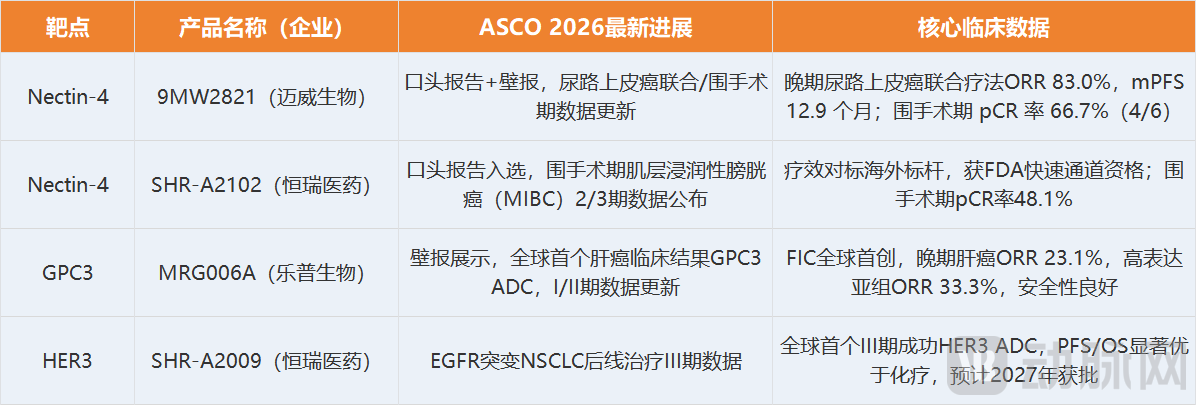
Data Source: Corporate announcements, ASCO 2026 abstracts, and publicly available information
Nectin-4 has emerged in recent years as a highly promising target for urothelial carcinoma, with Mabwell's 9MW2821 achieving multiple breakthroughs across various indications in this therapeutic area. Its phase I/II clinical objective response rate and disease control rate data for urothelial carcinoma rank among the highest globally. The drug is currently advancing into a first-line phase III study, directly challenging the current standard of care. It is also the world's first Nectin-4 antibody-drug conjugate to enter phase III clinical trials for cervical cancer. Furthermore, its indication for triple-negative breast cancer has been granted Fast Track designation by the U.S. Food and Drug Administration, and its international development strategy is progressing steadily.
Hengrui Pharma's SHR-A2102 previously disclosed clinical trial data for advanced urothelial carcinoma, with efficacy benchmarking against leading overseas products in the same class; at this year's American Society of Clinical Oncology Annual Meeting, its phase 2/3 data in perioperative muscle-invasive bladder cancer were presented. The parallel development of these two Chinese-produced products targeting the same antigen has significantly elevated the overall competitiveness and industry ceiling of China's Nectin-4 antibody-drug conjugate sector.
Hepatocellular carcinoma (HCC) is a malignancy with a high incidence in China that has long lacked ideal targeted therapies. GPC3, which is highly expressed in the majority of hepatocellular carcinomas but minimally expressed in normal liver tissues, has emerged as a rare, high-quality target exclusive to liver cancer. Lepu Biopharma's MRG006A, China's first and the global first-in-class (FIC) GPC3 ADC, was developed leveraging the Hi-TOPi platform. Featuring a drug-to-antibody ratio (DAR) of 8 and a high toxin payload capacity, it concurrently imposes more stringent technical requirements on linker stability and the controlled in vivo release of the payload. Overall, while this first-in-class HCC ADC entails higher R&D risks, it boasts significant differentiated advantages. Upon commercialization, it will face a favorable competitive landscape and demonstrates outstanding long-term development potential.
As the world's first HER3 ADC to achieve success in a Phase III clinical trial, Hengrui Pharma's SHR-A2009 demonstrated significantly superior progression-free survival (PFS) and overall survival (OS) compared to chemotherapy in the later-line treatment of EGFR-mutated NSCLC, positioning it to fill the global gap in approved HER3-targeted therapies, with potential regulatory approval expected in 2027.
In summary, China's ADC sector has established a relatively comprehensive target landscape. In terms of clinical depth, industry R&D has achieved successive breakthroughs, advancing from early Phase I data exploration to Phase III first-line clinical trials, and from later-line salvage therapy to frontline head-to-head competition. Meanwhile, the pipelines of major domestic companies have formed a clear and differentiated strategic focus: Mabwell's 9MW2821 is positioned to compete head-to-head against the standard of care in urothelial carcinoma; Hengrui's diversified pipelines target multiple indications, including gastrointestinal tumors, later-line lung cancer, and urothelial carcinoma; while Lepu's MRG006A precisely addresses the unmet therapeutic need in liver cancer. With clearly defined positioning and distinct roles across all pipelines, a healthy and well-structured industrial ecosystem has been established.
The Next 12 to 24 Months Will be the Critical Realization Period
The clinical advancement of Chinese ADCs is closely intertwined with their popularity in the global licensing market. This is evidenced by two quantifiable facts: First, over the past three years, Chinese ADCs have consistently accounted for over 15% of license-out projects. Second, from 2021 to the end of November 2024, the total value of licensing transactions in the China-produced ADC sector has exceeded $40 billion.
Linking clinical breakthroughs with the momentum of overseas expansion reveals a relatively clear virtuous cycle in the industry: proprietary targets/technologies → hard endpoint data presented at top academic conferences such as ASCO → high-value licensing deals with multinational pharmaceutical companies → accelerated global development → delivery of further clinical data. The achievements of pipelines such as sac-TMT and BL-B01D1 stand as a prime demonstration of this cycle. Chinese ADCs have evolved from competition focused on single pipelines to a collective leap encompassing multiple companies, diverse targets, and various cancer indications.
Over the next 12–24 months, several key industry developments warrant close monitoring: the regulatory progress and overseas development pace of sac-TMT in first-line NSCLC; sequential data readouts from multiple Phase III trials by Hengrui and Mabwell; the further maturation of early-stage data for Lepu's GPC3 ADC and similar candidates; and the expansion of "ADC + IO" combinations into additional cancer indications. The industrial depth of this therapeutic track merits sustained long-term attention.