

Abbott's Patent Siege Intensifies, Chinese-produced CGM Faces Continuous Obstruction

Abbott
Provider of Health Diagnostic Products and Health Diagnostic Management Solutions

Sibionics
Medical Device R&D and Manufacturing Company

MicroTech Medical
Developer of Medical Device Products for Diabetes Management

Sinocare
Rapid Detection of Chronic Disease: Product R&D, Production, and Sales
Abbott's Persistent Patent Enforcement Puts Domestic CGM in Strategic Dilemma.
China's CGM Industry Is Caught in a Dual Dilemma of "Internal and External Troubles". In the domestic market, price wars are intensifying, with some product unit prices dropping to the hundred-yuan level. Homogeneous competition continues to squeeze the industry's profit margins. When these companies venture into Europe, they are met not with a vast market but with the formidable patent barriers meticulously erected by Abbott.
Following Sibionics and Sinocare, another Chinese CGM company, MicroTech Medical, has also been sued by Abbott for patent infringement in Europe. Leading companies in the industry have successively become embroiled in patent disputes in the European market, with some products forced to suspend sales in Europe due to preliminary injunctions. On one side is the fierce competition in the domestic market, and on the other side is the high patent barrier in the European market. Chinese CGM companies are struggling to advance amidst the challenges of technological breakthroughs, market expansion, and patent layout.
Against the backdrop of increasingly fierce global competition and intellectual property games, how to break internal and external shackles and find a sustainable development path has become a core issue that urgently needs to be addressed by China's CGM industry.
Abbott's Patent Blockade Upgrade Extends to Some Key Technologies.
If Abbott's patent litigation against domestically produced CGMs starting in 2024 initially only revolved around trademarks, then from the September 3, 2025 trial at the Hague division of the Unified Patent Court (UPC) in Europe, both parties entered a real knock-down, drag-out phase.
After Sinocare submitted relevant evidence to the UPC denying any infringement and raised defenses of non-infringement and invalidity of Abbott's two patents, on October 17, 2025, the Hague branch of the UPC granted Abbott’s application for a preliminary injunction regarding the EP4344633 patent. However, on October 22, the Hague branch of the UPC rejected Abbott’s application for a preliminary injunction concerning the EP3988471 patent. With one win and one loss, the two parties are temporarily even.
By November, Sinocare had suspended the sale of its first-generation CGM products in the UPC member states as required by the UPC injunction. However, this ruling did not affect markets in non-UPC member states such as the UK. Meanwhile, Sinocare publicly stated that patent litigation is a challenge that Chinese medical device manufacturers must face when expanding overseas, and it will address future challenges through innovation and R&D.
In December, Sinocare disclosed on the investor interaction platform that it had filed an appeal with the UPC to revoke the preliminary injunction related to patent EP4344633. The appeal can already be found on the UPC's official website. Meanwhile, Sinocare has also submitted a request to the European Patent Office (EPO) for the invalidation of Abbott's EP4344633 patent.
In other words, the focus of the competition between the two parties in the near future will be on the coverage scope of the EP4344633 patent.
From the previous judgment of the UPC, the core of the patent protection for "Analyte Sensor Assemblies" lies in the physical structure of CGM sensors, including electrode lamination, circuit connections, and waterproof encapsulation. Although Sinocare claimed that certain features of the patent were not used, the UPC determined that the overall architecture still fell within the scope of the patent.
The patent EP3988471, whose injunction request was rejected by the UPC, is a patent that protects the timeline graph interface technology for medical device displays. Its core lies in safeguarding specific details of the app interface layout. According to the disclosed UPC documents, the reason for this rejection is mainly based on the fact that the display interface of Sinocare's CGM product's accompanying app does not fall within the scope of protection claimed by Abbott’s patent, and therefore does not constitute infringement. This ruling reflects the UPC's approach of determining the scope of patent protection through a strict interpretation of the claims and assessing whether a product falls within that scope accordingly.
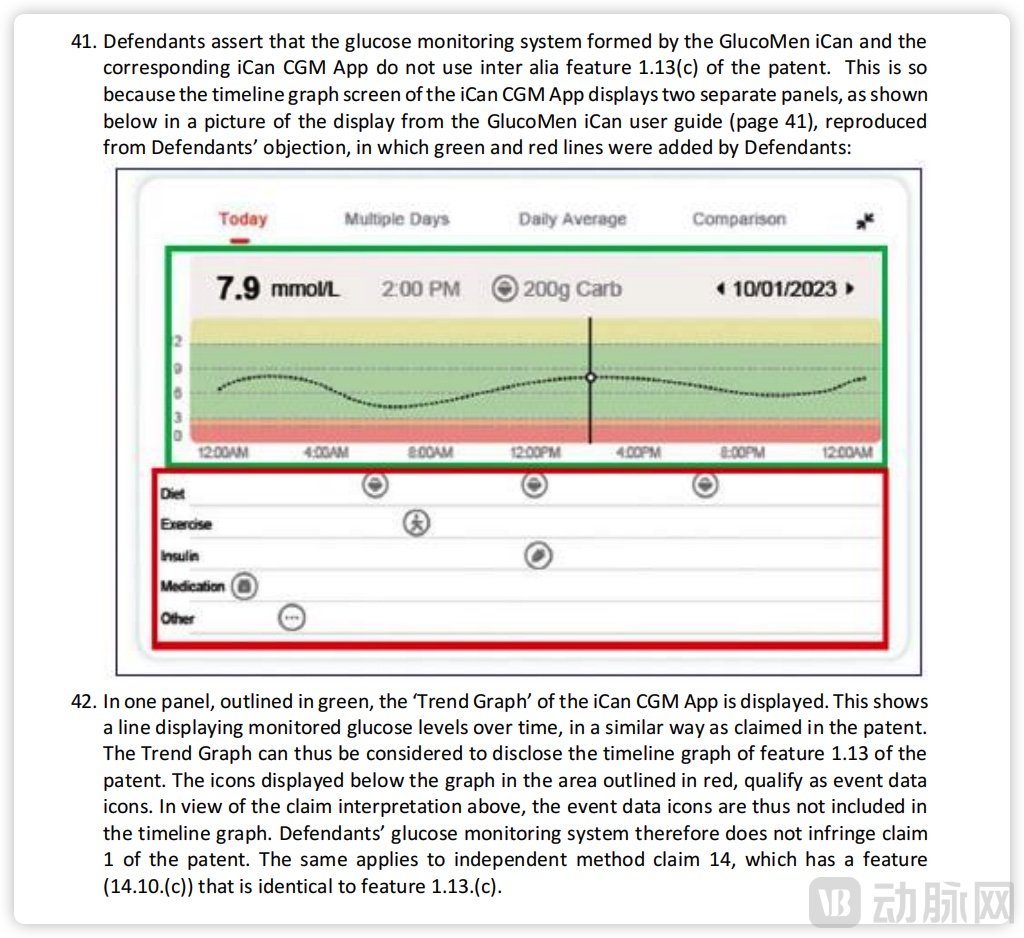
Regarding the Core Judgment Basis of EP3988471 Patent, Image Source: UPC
Through this round of confrontation, it can be seen that Abbott's patent layout in the CGM field is not simply technical protection, but a systematically designed competitive weapon that has been developed over many years, covering the entire industrial chain and integrating legal and commercial means. Its strategic approach reflects top-level thinking in technology patenting, patent standardization, and standard commercialization.
"Technological innovation alone is not enough to ensure commercial success and patient accessibility. Abbott's success stems not only from its technological innovation but also relies on a sophisticated, multi-layered, defensive and offensive patent strategy. The core objective of this strategy is to maximize the period of market exclusivity, build insurmountable patent barriers for competitors, and closely align patent deployment with the regulatory approval timelines of various countries," a CGM practitioner told VCBeat.
In simple terms, Abbott has applied for a large number of patents covering the entire lifecycle and all components of CGM, forming a dense network of patent protection. From the detection methods of the most critical analytes (such as glucose) in bodily fluids to hardware and structure, from core chemistry and materials to user interaction and software, a broad protection net has been established. It is very difficult for competitors to develop similar products without bypassing all these patents. Based on the logic of the UPC ruling, once the likelihood of infringement is deemed greater than the likelihood of non-infringement, there is a high probability that sales will be prohibited.
Moreover, Abbott continues to deeply explore core components. Taking the biosensor membrane as an example, since filing its first related patent in 2002, Abbott has continuously received patent approvals over the subsequent nearly 20 years. This ongoing patent protection ensures that competitors cannot easily replicate its best-performing versions. Meanwhile, by applying for patents covering different material formulations, structures, or manufacturing methods, Abbott has effectively "claimed" a large number of feasible R&D pathways in this technological field, successfully limiting the innovation space of its competitors.
Of course, Sinocare, as the leading domestic CGM company, has already taken action.
Firstly, at the product level, the second-generation CGM product, upgraded to an integrated structural design with a smaller diameter and thickness, has successfully obtained the EU CE MDR certification, meeting the requirements of the latest EU medical device regulations and can be sold in countries that recognize EU MDR qualifications.
At the market level, although Abbott is currently only pursuing patent litigation for the first-generation CGM, given Abbott's current patent-blocking strategy, Sinocare, along with its European partner Menarini and relevant professional teams, continues to conduct in-depth discussions and assessments on the feasibility of implementing a second-generation CGM product’s health insurance access plan in the European region, aiming to further reduce related patent risks. For instance, they are focusing initial efforts on markets outside the jurisdiction of the UPC, such as the UK, Switzerland, Spain, and Poland.
Finally, it is crucial to persist in countering Abbott. Facing Abbott's professional patent offensives, if we cannot directly invalidate their patents, then the Sword of Damocles will hang over the heads of domestically-produced CGMs attempting to expand overseas. Once "struck," the progress of commercialization abroad could come to an abrupt halt.
As the "top player" in China's blood glucose meter industry, Sinocare has invested substantial resources in the CGM field. Its third-generation sensor, centered on a "silver-carbon electrode + biocompatible membrane," successfully bypasses the electrochemical electrode structure technology route dominated by Abbott. At the same time, it has applied for over 100 invention patents across multiple niche areas, demonstrating both the resources and confidence to engage in a prolonged patent battle with Abbott.
According to the UPC process, the subsequent appeal process will last 6 to 12 months, which is destined to be a protracted battle impacting the development of China's CGM industry.
The rapid development of China's CGM products has eroded the market share of traditional giants.
Since 2021, the successive approvals and market launches of domestically produced CGM products represented by Shenzhen Sibionics Co., Ltd., MicroTech Medical, and Yuyue Medical (after acquiring CareLink) have marked the beginning of the commercialization era for Chinese-made CGM. As Sinocare, the leader in blood glucose meters, joined the competition in 2023, the CGM market in China has gradually heated up.
Particularly from 2024, China-produced CGM triggered a price war. When Abbott's Freestyle Libre 2 was launched in China at the price of 475 yuan, a group of China-produced CGM had already entered the 100-yuan price range. In addition to the iteration of the products themselves, Chinese CGM companies have been continuously optimizing services around their products, providing diabetes patients with better blood glucose monitoring and blood glucose management experiences.
Like Shenzhen Sibionics Co., Ltd., which continues to expand the indications of its CGM product, Sibionics Dynamic. MicroTech Medical, based on products such as AiDEX X, Equil Patch Smart Insulin Pump, and Jiantang Doctor Blood Glucose Management System, provides full-course, all-scenario closed-loop management services for diabetes patients. Sinocare has also launched a "four-in-one diabetes management system" based on its products, covering comprehensive blood glucose management from in-hospital to out-of-hospital settings. At the same time, multiple companies have developed functions that directly connect to smartwatches, making it convenient for diabetes patients to control their blood sugar levels across various scenarios.
According to industry insiders' estimates, Abbott's CGM products' market share in China has dropped from a peak of about 80% to less than 50%, and all of this is due to the rise of domestically produced CGMs.
On the other hand, the U.S. market has changed, and Abbott's backyard is on fire.
According to Abbott's financial report released in October, the sales of Abbott's CGM in the third quarter exceeded 2 billion US dollars, increasing by 20.5% year-on-year. The estimated annual sales will reach 8 billion US dollars. Everything seems to be moving in a positive direction.
However, at the end of November, Abbott issued a medical device correction notice for certain FreeStyle Libre 3 and Libre 3 Plus sensors due to a potential defect in products from a specific production line, which could lead to incorrect hypoglycemia data. If patients adjust medication or insulin doses based on erroneous readings, it may result in severe hypoglycemic events, including coma, organ damage, or even death. This action was based on 736 global reports of serious adverse events, including seven deaths.
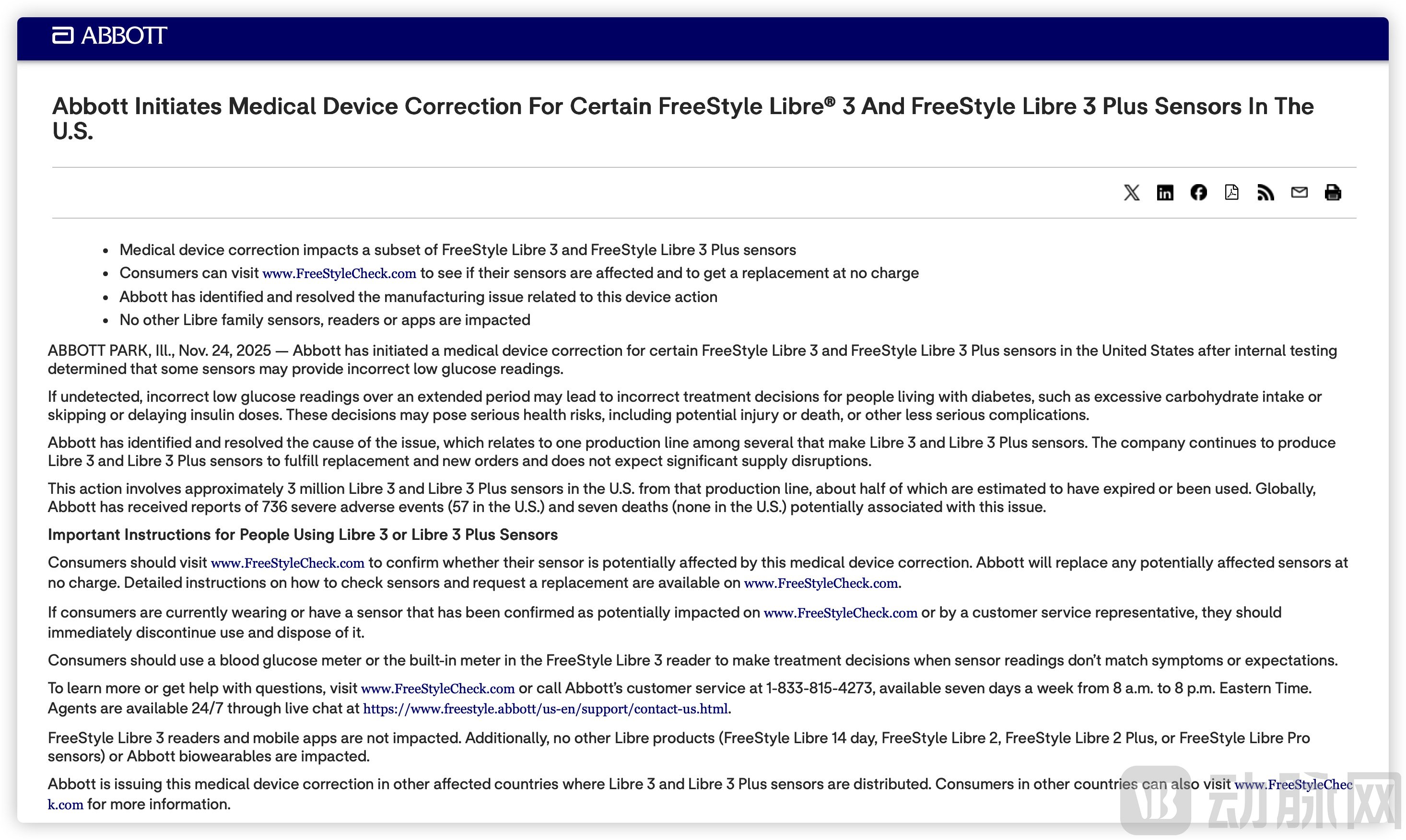
Abbott's Announcement on the Incident, Image Source: Corporate Official Website
According to Abbott, approximately 3 million sensors are affected this time, and the subsequently produced Libre 3 and Libre 3 Plus sensors have been corrected. Although Abbott has not disclosed the impact of this incident on the CGM products in the U.S. market, it cannot afford any setbacks in the European market among the traditionally major markets of China, the U.S., and Europe. Once a competitor gains momentum, they will inevitably become a target.
The next target chosen by Abbott is MicroTech Medical.
The patent litigation initiated by Abbott against MicroTech Medical is a continuation of its patent strategy. From the background perspective, MicroTech Medical’s first-generation CGM product obtained CE certification and entered the European market as early as 2021. Its second-generation product, LinX, achieved a year-over-year overseas revenue growth of 218.0% in H1 2025, covering 118 countries and regions worldwide and successfully entering the national health insurance systems of multiple European countries. Clearly, for Abbott, allowing such a competitor to continue growing could potentially undermine its fundamental position in the European market.
Choosing such an opponent for patent litigation is essentially the same as the previous lawsuits against Sibionics and Sinocare, aiming to use patent tools to curb a rapidly rising competitor. According to the investor call at the end of November, MicroTech Medical has actively responded to the lawsuit at the UPC and submitted a defense. The related hearing is scheduled for the end of December 2025, with an expected outcome by the end of January 2026.
This patent litigation mainly involves EP3960072, the protected "automatic retraction bias mechanism" of which belongs to conventional mechanical design and is widely used in medical devices (such as syringes and implantation devices). The stability of this patent’s validity remains debatable. Currently, three companies, including MicroTech Medical, have filed an opposition with the European Patent Office (EPO) for invalidation of this patent. If the patent is ultimately invalidated, it will remove a key obstacle for the overseas expansion of CGM products made in China.
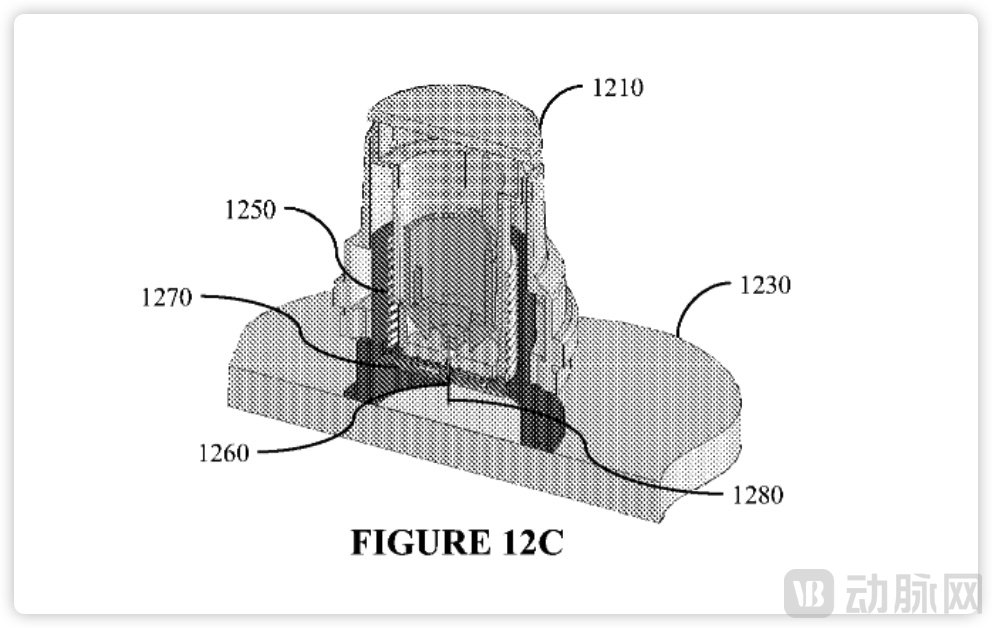
Structural diagram of EP3960072 patent insertion device, source: EPO
From Market Layout to Technological Breakthroughs: MicroTech Medical Proactively Addresses Industry Competition and Risks
Being hit by the patent stick does not mean there is no way out.
In October 2025, Omron Healthcare released its new Continuous Glucose Monitoring (CGM) system product GS1, which began its first presale on the JD Health platform, successfully expanding its product portfolio in the blood glucose management sector. Notably, this product is the result of a collaboration between Omron and Shenzhen Sibionics Co., Ltd.
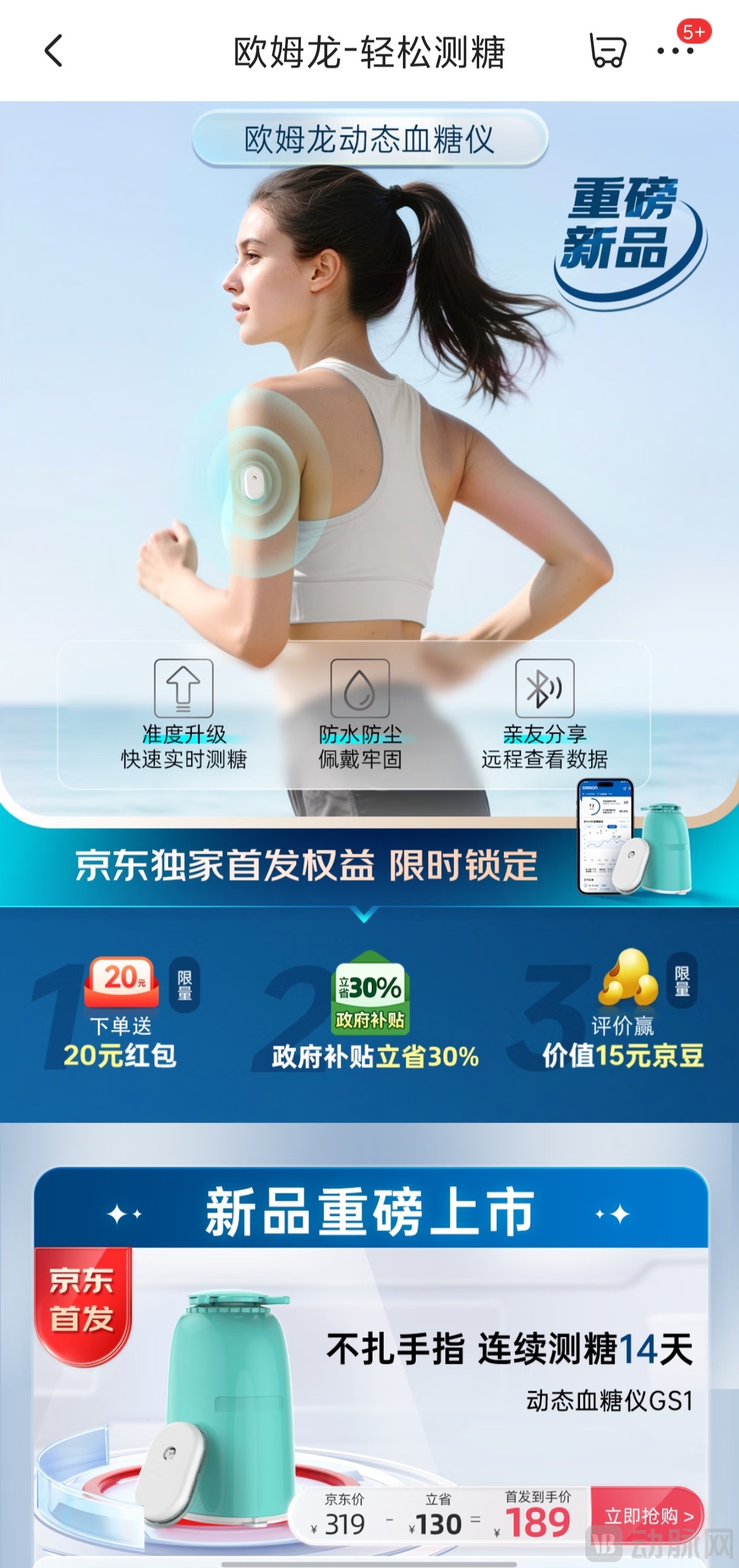
Omron CGM Product, Image Source: Screenshot from JD App
As the leading enterprise in the global home medical device industry, Omron boasts strong brand influence and channel capabilities. However, its products have mainly focused on electronic blood pressure and glucose meters in the past, without venturing into the CGM field. On the other hand, Shenzhen Sibionics Co., Ltd. is a pioneering Chinese company in the CGM sector, but it currently lacks brand recognition and global channel capabilities.
This cooperation is not only a simple product OEM, but also can be regarded as a strategic complementarity between the two parties.
For Omron, such cooperation allows it to bypass massive R&D costs and time, quickly completing a closed-loop product matrix for chronic disease management—from blood pressure monitoring to blood glucose monitoring. The emergence of CGM products also enables its blood glucose management business to make a critical leap from single-point detection to all-time precise protection. At the 2025 CIIE, Omron also showcased health management solutions covering multiple fields, including cardiovascular and metabolic diseases, featuring CGM products.
For Shenzhen Sibionics Co., Ltd., the previous expansion into Europe faced patent challenges from Abbott, which forced the company to slow down its pace in the European market. However, through collaboration with Omron, leveraging Omron's brand influence to expand into overseas markets could be considered another way of "sailing overseas by borrowing a boat."
Omron has built up its own niche over the years through its brand influence and channel advantages, and will not have much direct competition with domestically produced CGMs. This kind of cooperation, where one party provides the brand and the other provides the production capacity, is a win-win situation.
In addition to such collaborations, China-produced CGM companies have also put significant efforts into traditional "non-mainstream" markets outside Europe and America by 2025.
For instance, Sinocare exports 40,000 blood glucose monitoring devices (including CGM and BGM) to Africa every month, covering over 40 countries such as Egypt, Nigeria, and Kenya. MicroTech Medical has also gained market access in multiple countries across the Middle East, Asia-Pacific, and South America, especially receiving approval for marketing in markets with large diabetic populations like India and Brazil. Yuyue Medical mentioned during investor activities that it achieved rapid growth in Southeast Asia, and CGM will be a key focus for future overseas expansion, actively targeting potential markets in the Middle East and South America.
A major characteristic of these markets is the emphasis on price over brand; products that are functional, affordable, and accessible are more appealing.
For domestically produced CGMs, although their brands may not yet be able to rival leading enterprises, they hold a significant advantage in cost control due to supply chain strengths and large-scale production capabilities at the price level. If successful in these markets, it essentially means trading space for time—accumulating scale, data, and brand to iterate and upgrade products, ultimately challenging core markets in Europe and America.
From the development of the CGM industry, as upstream companies in the industrial chain exert more effort—such as China-produced CGM AFE chips achieving lower power consumption, higher accuracy, greater integration, and flexible configurability—the most important outcome is the ability to reduce the overall solution cost by approximately 50%. This also lays the foundation for the mass shipment of China-produced CGM in these markets.
Overall, the patent competition faced by domestically produced CGMs is a long-term challenge involving time, money, and strategy. For Chinese CGM companies to find a breakthrough in such competition, they must first ensure their survival by shipping large volumes to support product iteration. Then, they need to break out of Abbott's patent framework at the technical level and innovate at the application scenario level by shifting towards AI empowerment, chronic disease management ecosystems, and other service layers where Abbott has yet to establish a strong presence. Finally, investment in upstream industries like enzyme engineering, biomaterials, and chip design will be necessary to transition the industry from following to defining.
For domestically produced CGMs to break through, the fantasy of quick success must be abandoned. Sufficient competitiveness needs to be built simultaneously in three dimensions: underlying technology, global patents, and ecosystem construction.