

BCI Flex completes 300 million Series A+ financing round led by Casstar, with full follow-on investment from existing shareholders

CASSTAR
Venture Capital Institution

Legend Capital
Early-stage venture capital and growth-stage private equity investment institutions

IDG Capital
Venture Capital Institution

BCIFlex
Invasive High-Throughput Ultra-Thin Flexible Brain-Computer Interface System Developer

Shunwei Capital
Venture Capital Institution

LCIG
Tech Industry Investment Firm

YuanBio Venture Capital
Venture Capital Institution

HongShan
Business Consulting, Enterprise Management Consulting Investment Institutions

Baidu Ventures
AI Investment Firm

Apricot capital
Venture Capital Institution
Recently, China's leading invasive brain-computer interface (BCI) company, BCI Flex, announced the completion of a 300 million Series A+ financing round. This round was led by Casstar, with continued investment from existing shareholders including Legend Capital, Beijing Medical and Health Care Industry Investment Fund, IDG Capital, Shunwei Capital, Lenovo Capital, Yuanbio Venture Capital, HSG (formerly known as Sequoia Capital China), Long-Z Investment, Baidu Ventures, Apricot Capital, and Jiayin Capital.
Notably, this marks the second financing round completed by BCI Flex within six months. The rapid and consecutive capital injections strongly affirm market confidence in BCI Flex's technological capabilities and growth potential within the invasive BCI sector. It is reported that the funds raised in this round will primarily be used to advance large-scale clinical trials, enhance the development of high-throughput flexible BCI products, and accelerate the translation of the technology into clinical applications.
Since its inception, BCI Flex has firmly committed to the invasive BCI technological path. On one hand, the team possesses profound expertise in the underlying technologies of invasive BCI. On the other hand, this decision is rooted in a deep understanding of the industry's ultimate direction. The future of BCI lies in enabling high-bandwidth information exchange between the human brain and external devices, transforming BCI from an assistive tool for "compensating impairments" into a fundamental technology for efficient human-machine symbiosis. Only the invasive BCI pathway can achieve this leap.
Currently, implantable BCI has evolved into two technological pathways: semi-invasive BCI and invasive BCI. The fundamental distinction lies in the physical positioning of the electrodes relative to brain tissue, which directly determines the quality of neural signals and the upper limit of application. Semi-invasive BCI places electrodes either epidurally or subdurally to capture neural signals from the brain. Since neural signals attenuate rapidly with transmission distance, semi-invasive BCI captures signals with relatively low temporal and spatial resolution, making it difficult to extract fine-grained neural coding information. In contrast, invasive BCI directly implants flexible electrodes into brain tissue, enabling precise capture of single-neuron action potentials (spikes) with high temporal and spatial resolution. As a result, invasive BCI not only allows real-time, high-precision decoding of fine movements but also holds an order-of-magnitude advantage in information transmission rate (bit rate) for human-machine interaction. In the global competition for invasive BCI technology, the overseas market is led by Neuralink, founded by Elon Musk, while in China, BCI Flex has emerged as the domestic leader in invasive BCI, driven by breakthroughs in core technologies and comprehensive independent innovation.
To date, BCI Flex has established a systematic layout across the upstream and midstream of the invasive BCI industry chain, constructing a complete industrial closed loop from core technology R&D to large-scale manufacturing. BCI Flex has not only overcome four core foundational technologies—flexible electrodes, neural chips, decoding algorithms, and electrode implantation robots—but has also built a nearly 2,000 m² clinical-grade micro-nano processing workshop and a GMP-standard assembly workshop, achieving full-chain autonomy and control over clinical-grade products.
Among these, BCI Flex's high-throughput flexible electrodes recently achieved a major technological breakthrough. A research team led by the company's founder and Chief Scientist, Ying Fang, successfully developed a "stretchable high-throughput flexible electrode" that combines high-throughput signal acquisition with biomechanical compliance. This achievement effectively addresses the industry-wide challenges of displacement and detachment associated with traditional linear flexible electrodes. The related findings were published on February 5th in the international academic journal Nature Electronics and have garnered widespread attention from authoritative media outlets such as People's Daily and Science and Technology Daily.
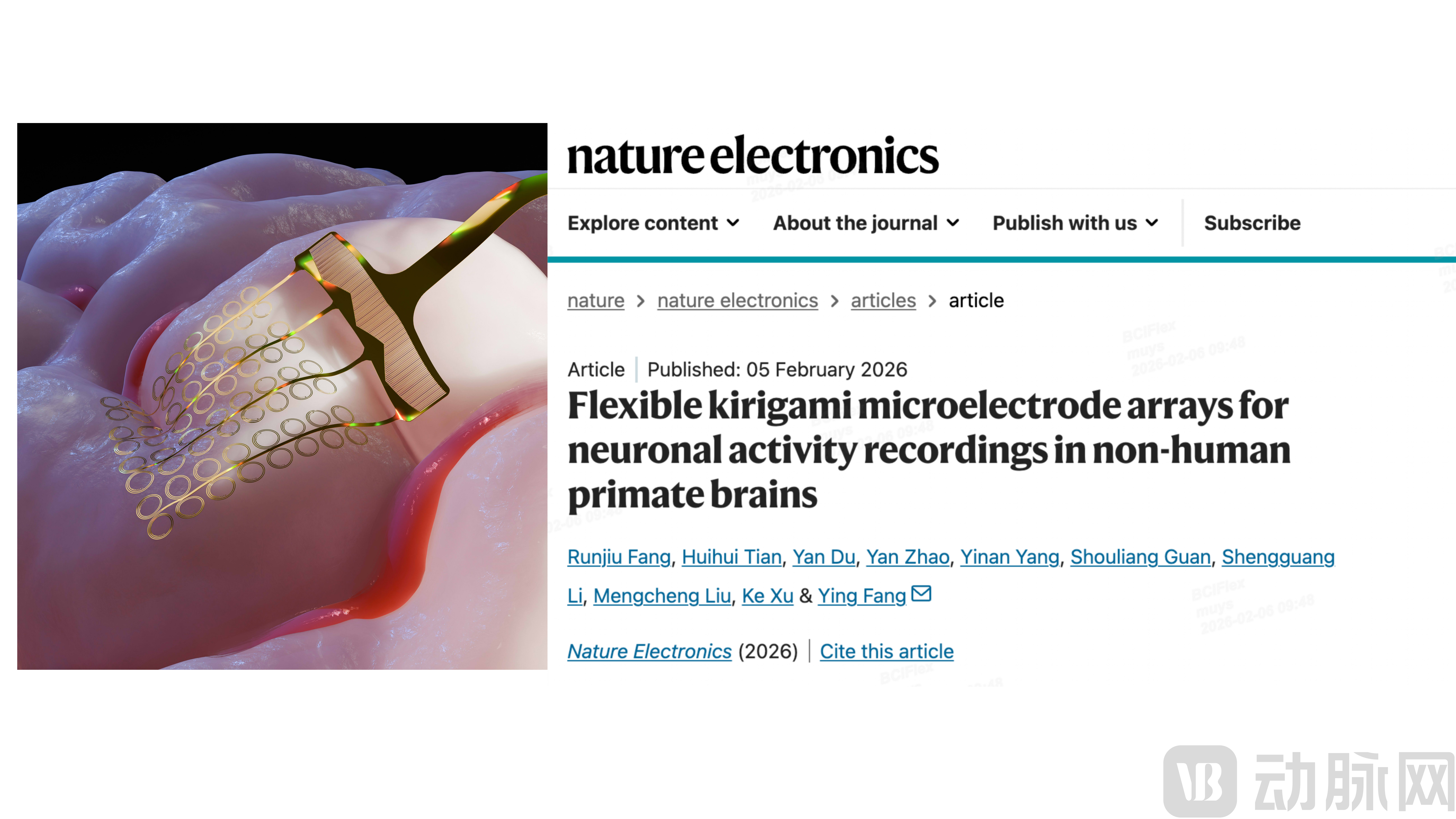
(Left: High-throughput Stretchable Flexible Electrode; Right: Screenshot of Publication on the Nature Electronics Website)
In addition, BCI Flex has achieved comprehensive breakthroughs in other critical foundational technologies: its domestically developed neural signal acquisition chip, roughly the size of a coin, reduces power consumption by 75% compared to traditional chips; its deep neural network decoding algorithm, trained on massive volumes of neural data, enables highly accurate real-time decoding; and its supporting high-efficiency, high-precision intelligent electrode implantation robot addresses the "last mile" challenge in the large-scale clinical application of high-throughput invasive brain-computer interface technology.
Currently, the BCI Flex team has successfully developed a high-throughput wireless invasive brain-computer interface system based on stretchable flexible electrodes. By optimizing the biocompatibility of the BCI system and the bandwidth of signal transmission, this system effectively enhances long-term signal stability and decoding accuracy, laying a technical foundation for the large-scale clinical application of invasive BCI products.
In 2025, BCI Flex completed China's first clinical implantation of an invasive BCI product with over one hundred channels, preliminarily validating the product's safety and efficacy. According to Qi Song, founder and CEO of BCI Flex, BCI Flex plans to initiate a large-scale registration clinical trial for its over-one-hundred-channel invasive BCI product this year (2026), accelerating its path to clinical application.