

Interim Analysis of KEYNOTE-091 Trial: Pembrolizumab Achieves First Positive Result in Adjuvant NSCLC Therapy

MSD
Pharmaceutical R&D and Manufacturer
On the evening of March 17, 2022, Central European Time, during the ESMO Virtual Plenary: March 2022, MSD announced the interim analysis of the KEYNOTE-091 study (also known as EORTC-1416-LCG/ETOP-8-15-PEARLS; NCT02504372).
Data Show That the Study Met One of Two Primary Endpoints: Regardless of PD-L1 Expression Levels, Pembrolizumab, With or Without Adjuvant Chemotherapy, as Adjuvant Treatment for Patients with Stage IB-IIIA Non-Small Cell Lung Cancer After Surgical Resection (Lobectomy or Pneumonectomy), Significantly Improved Disease-Free Survival (DFS) Compared to Placebo, with Safety Results Consistent with Previous Studies. The Study Data Also Suggest That Pembrolizumab May Become a New Option for Adjuvant Treatment in These Early-Stage Lung Cancer Patients Post-Surgery.
Study Design
KEYNOTE-091 is a randomized, triple-blind, Phase III clinical trial designed to evaluate the efficacy and safety differences of pembrolizumab versus placebo, with or without adjuvant chemotherapy, as adjuvant treatment following surgical resection (lobectomy or pneumonectomy) in patients with IB (≥4 cm) to IIIA stage (AJCC 7th edition TNM staging criteria) non-small cell lung cancer. The primary endpoint of the study is disease-free survival (DFS*) in the overall population and in the PD-L1 high expression population (TPS ≥50%). Secondary endpoints include overall survival (OS) and lung cancer-specific survival (LCSS*). The study enrolled 1,177 patients with IB-IIIA stage non-small cell lung cancer who achieved R0 resection, randomly assigned in a 1:1 ratio to receive either pembrolizumab (200 mg intravenously every 3 weeks for 1 year or up to 18 doses) or placebo.
* DFS is defined as the time from randomization to disease recurrence and distant metastasis (including second primary non-small cell lung cancer or other malignant tumors) or death from any cause, whichever occurs first.
*LCSS is defined as the time from randomization to death due to lung cancer.
Research Results
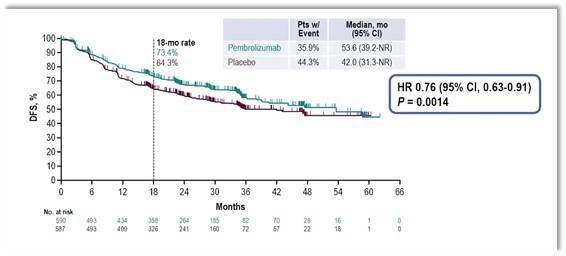
The interim analysis data of KEYNOTE-091 released this time showed that KEYNOTE-091 reached one of the dual primary endpoints, which means pembrolizumab as an adjuvant therapy for patients with stage IB-IIIA non-small cell lung cancer after surgery significantly improved DFS in the overall population (regardless of PD-L1 expression level) compared with placebo control, showing statistical and clinical significance.
The median DFS for patients receiving pembrolizumab as adjuvant therapy was 53.6 months, representing an improvement of nearly one year compared to the placebo control group (median DFS 42.0 months).
At the same time, the risk of disease recurrence or death after surgery was reduced by 24% (HR=0.76 [95% CI, 0.63-0.91]; p=0.0014).
The data presented at the online plenary session also suggests that pembrolizumab (Keytruda) may become a new option for adjuvant treatment post-surgery in early-stage lung cancer patients, regardless of PD-L1 expression levels.
The goal of adjuvant therapy is to reduce the risk of cancer recurrence after surgery. Data still show that among patients with early-stage non-small cell lung cancer who undergo surgery, 43% will experience recurrence and may even die due to disease progression. The KEYNOTE-091 study data demonstrate that immunotherapy can provide a new option for these patients.
The immunotherapy represented by Pembrolizumab has made significant progress in the treatment of advanced lung cancer. In less than a year in 2019, Pembrolizumab was approved in China for three indications, including monotherapy and combination with chemotherapy, establishing its cornerstone position in the treatment of lung cancer in China.
How will immunotherapy meet the treatment needs of early-stage postoperative lung cancer patients in the future? Will the success of pembrolizumab in adjuvant therapy strengthen the position of immunotherapy drugs in the comprehensive treatment of non-small cell lung cancer patients, and rewrite the standard perioperative treatment protocols? Let us wait and see.