

Increased competition as another China-developed semaglutide product files for market approval

Fosun Wanbang Pharma Group
Drug Developer
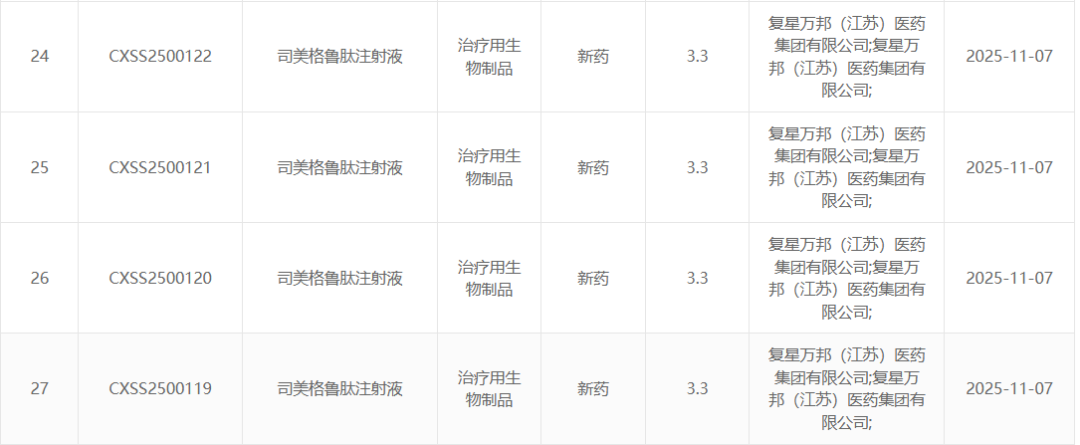
On November 7, the CDE (Center for Drug Evaluation) website indicated that the marketing application for Fosun Wanbang Parma Group's Semaglutide Injection has been accepted. Based on the drug's clinical progress, it is speculated that the intended indication for this application is likely type 2 diabetes. According to the Insight database, this is the ninth China-developed semaglutide product to have a marketing application submitted.
In China, Fosun Wanbang's semaglutide has completed a Phase III clinical trial. This study aimed to evaluate the efficacy and safety of semaglutide injection compared with Novo Nordisk's Ozempic® in treating patients with Type 2 diabetes whose blood glucose levels were not well controlled by metformin. The trial was completed in April this year.
Semaglutide was originally developed by Novo Nordisk. According to Novo Nordisk's financial report, the sales of semaglutide in the first three quarters of this year were 169.296 billion Danish kroner (approximately USD 25.428 billion), accounting for 81.44% of Novo Nordisk's total revenue. Specifically:
Ozempic, the injectable glucose-lowering version, recorded sales of 95.264 billion Danish kroner (USD 14.309 billion), marking a 13% year-on-year increase. Its sales in China reached 4.288 billion Danish kroner (USD 644 million), representing a 7% decline.
Rybelsus, the oral glucose-lowering version, recorded sales of 16.79 billion Danish kroner (USD 2.522 billion), marking a 5% year-on-year increase. Its sales in China reached 551 million Danish kroner (USD 83 million), representing a surge of 281%.
Wegovy, the weight-loss version, recorded sales of 57.242 billion Danish kroner (USD 8.598 billion), marking a 54% year-on-year increase. Its sales in China reached 950 million Danish kroner (USD 143 million), representing a surge of 481%.
However, the core patent for Semaglutide will expire in March 2026, and it will face fierce competition in the future. According to the Insight Database, marketing applications have been submitted for nine China-developed semaglutide products, respectively from Jiuyuan Gene, Livzon Pharmaceutical Group, Qilu Pharmaceutical, United Laboratories, Huadong Medicine, CSPC Pharma, Huisen Pharma, Brilliant Pharmaceuticals, and Fosun Wanbang. The initial approved indication for all these products is type 2 diabetes.
Regarding registration classification, Qilu Pharmaceutical and CSPC Pharma's semaglutide products were submitted under the category of Chemical Drug Modified New Drug 2.2, while all other products were filed as Biosimilar 3.3.
Furthermore, eight additional semaglutide products from Chinese pharmaceutical companies — including Chiatai Tianqing, CR Double-Crane, and Shandong New Time Pharmaceutical — have advanced to Phase III clinical trials. It is evident that the semaglutide market in China is poised to enter an era of intense competition.