

Novartis files for new Pluvicto indication in China

Novartis
Drug Development and Manufacturing
On November 4, China's Center for Drug Evaluation (CDE) accepted a new drug application from Novartis for an additional indication of Pluvicto (177Lu-PSMA-617), classified as a 2.4 regulatory submission.
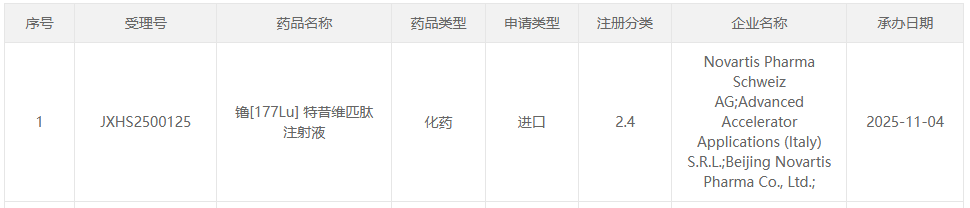
Based on available information and clinical trial progress, the proposed indication is likely for the treatment of adult men with metastatic hormone-sensitive prostate cancer (mHSPC). It would combine Pluvicto with standard therapy, which includes androgen deprivation therapy (ADT) and androgen receptor pathway inhibitors (ARPI).
Pluvicto is a PSMA-targeted radioligand therapy. It works by linking a targeting molecule (PSMA-617) to a therapeutic radioactive isotope (Lutetium-177). Upon binding to PSMA-expressing prostate cancer cells, the radiation emitted by the isotope damages and destroys the tumor cells.
Pluvicto was the first targeted radioligand therapy approved by the U.S. FDA for patients with castration-resistant prostate cancer. It received initial approval in 2022 for the treatment of PSMA-positive mCRPC in patients who had received prior androgen receptor pathway inhibitor (ARPI) and taxane-based chemotherapy, positioning it as a third-line therapy. In March 2025, the FDA further expanded its approved indication to include mCRPC patients who have progressed after one ARPI and have not received chemotherapy, establishing its use as a second-line treatment.
According to reports, in its second year on the market (2023), Pluvicto achieved sales of $980 million, representing a remarkable year-on-year growth of 261.62%. Novartis's 2024 financial report showed global sales of the drug reached $1.392 billion.
In China, Pluvicto had previously submitted two marketing applications, both of which were included in the priority review process. The current submission represents its third marketing application in the country.
In recent years, Novartis has completed several significant transactions in the nuclear medicine field. As early as 2017, the company acquired Advanced Accelerator Applications (AAA) for approximately $3.9 billion, gaining access to Lutathera and establishing a strategic foothold in radiopharmaceuticals. In 2018, Novartis further expanded its nuclear medicine pipeline through the $2.1 billion acquisition of Endocyte.
Collectively, Novartis has invested over $10 billion in nuclear medicine through these strategic acquisitions and has begun extending its platform to develop cyclic peptide-based radioligand therapies.