

Sales Surge by 100%+, How About the Utilization Rate of China-Made Endoscopic Surgical Robots?
In 2025, the sales performance of domestically produced surgical robot companies in China was impressive, showing explosive growth.
Two listed companies have achieved triple-digit growth in performance. MedBot recorded revenues of 550 million yuan, representing a year-on-year increase of 114%, with its flagship product, the Tumie laparoscopic surgical robot, having received cumulative global orders exceeding 220 units; Edge Medical reported revenues of 456 million yuan, marking a year-on-year surge of 185%, with cumulative global installations surpassing 100 units. Such performance even exceeded MedBot's internal expectations.
China-produced endoscopic surgical robots have surpassed expectations in scaling up installations, but greater challenges have also emerged. The business of endoscopic surgical robots is not merely about selling equipment; the fact that consumables account for over 60% of Intuitive Surgical's revenue in their financial reports already demonstrates this. The high-retention profit model of "Equipment+Consumables+Services" is the key to the sustainable success of surgical robots. Can China-produced endoscopic surgical robots win this long-term battle?
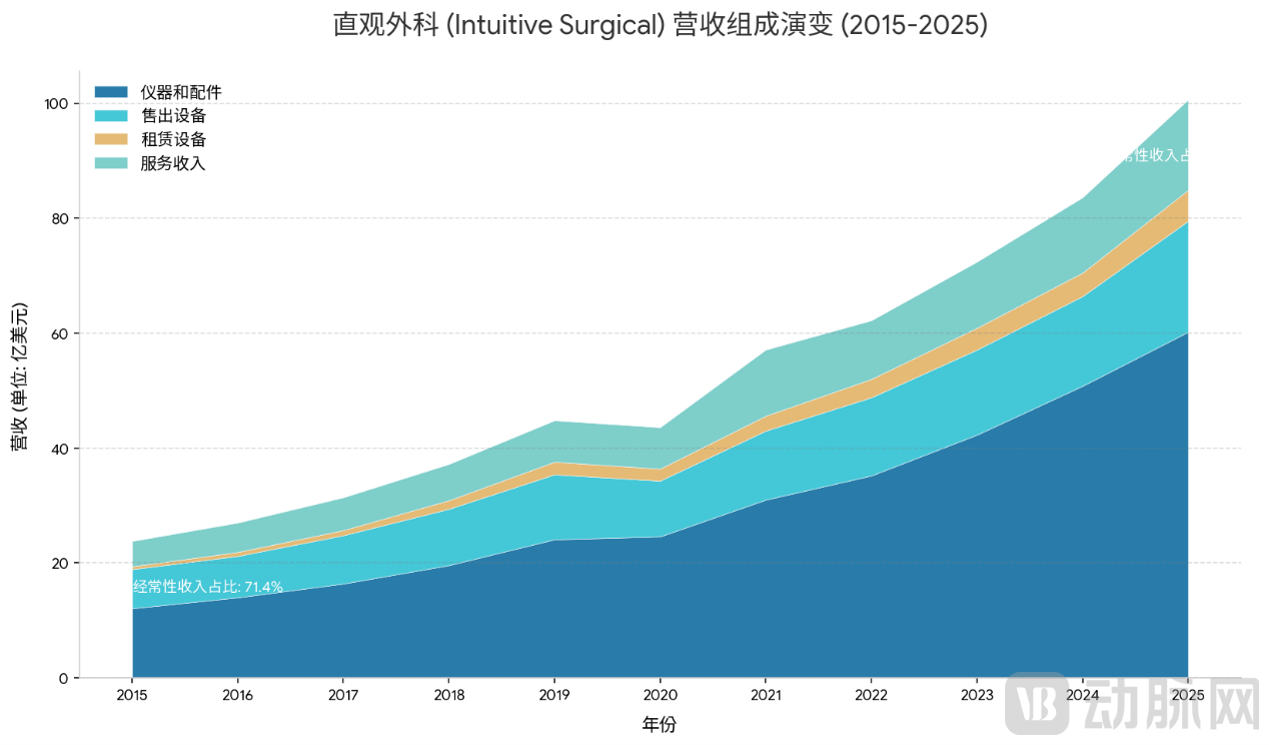
Data source: Intuitive Surgical Annual Report
Intuitive Surgical's increasing revenue from consumables is inseparable from the continuous growth in system utilization rates. The CEO of Intuitive Surgical stated: System utilization rate is the most direct validation of a product’s core value.
Globally, an average of about one surgery per day is performed by a single da Vinci system. Intuitive Surgical disclosed that the utilization rate of the da Vinci multi-port system increased by 3% year-on-year in 2025, with an average of over 300 surgeries per system annually; the single-port system reached an average of 180 surgeries per system annually in 2025.
Each surgical procedure performed will generate revenue for Intuitive Surgical in terms of accessories, consumables, and services. The cost of consumables per da Vinci procedure ranges from $900 to $3,700; in terms of service revenue, the annual maintenance cost per da Vinci surgical system is $95,000 to $225,000. Recurring revenue from consumables, services and leasing accounts for up to 84% of annual revenue, with strong customer retention ensuring the high stability of this business model.
In China, the da Vinci surgical robot is used more frequently. In 2025, the average number of surgeries performed by a single da Vinci Surgical Robot has exceeded 400 procedures per unit annually, with over 500 units implemented in China, serving more than 810,000 Chinese patients cumulatively.
In China, the annual surgical volume of a single high-capacity medical center can even reach 1,000 procedures annually. The annual average of around 400 surgeries per da Vinci system in China is also pulled down by lower volumes at newly installed units. In some high-capacity medical centers, the annual average number of surgeries performed by a single da Vinci system exceeds 1,000 per year, meaning that one da Vinci system completes about three surgeries per day. The utilization rate of da Vinci systems in China surpasses the global average, reflecting strong demand and significant untapped potential in the Chinese market.
How about the current utilization rate of da Vinci systems in Chinese hospitals after the large-scale deployment of domestic products?
Listed companies have relatively complete information disclosure. According to the data from listed companies, utilization rates for domestically produced endoscopic surgical robots in China are rising rapidly.
The single-unit average surgical volume of the Toumai system, a laparoscopic surgical robot under MedBot-B (02252), has reached 230 cases. Toumai’s global commercial orders exceed 220 units, covering more than 50 countries and regions. Over 140 units have been commercially installed, with those in stable operation averaging over 230 cases per year. In 2025, Toumai’s independently reorderable consumables sales increased sixfold year-on-year, with the consumables revenue share rising from 5% to 12%. Based on Toumai’s leading position and the company’s total revenue (551 million yuan), the independently reorderable consumables revenue in 2025 is estimated at approximately 66 million yuan, signaling strong growth momentum.
Edge Medical does not directly disclose consumables revenue or average per-unit surgical volumes. As of December 31, 2025, Edge Medical has installed or delivered 100 surgical robots globally, with 46 units installed or delivered to end users in China and 54 overseas. The latest data shows that the total global clinical procedures of Edge Medical® robots have exceeded 20,000 cases, while cumulative Edge Medical® single-port laparoscopic surgical robots procedures have surpassed 3,000 cases. Edge Medical has disclosed that the average monthly surgical volume at multiple hospitals exceeds 30 cases, and the unit-level operational efficiency of its robots is steadily improving.
In terms of utilization rates, while domestic endoscopic surgical robots still lag behind the da Vinci system, their utilization rates are rising rapidly, which is expected to drive growth in consumables revenue.
The rapid growth in the utilization rate reflects the market's recognition of domestically produced equipment, but to further increase the number of surgeries, domestic systems still require improvements in their supporting surgical instruments.
Being equipped with advanced surgical instruments is the key to improving surgical efficiency and enabling high utilization rates.
Previously, in terms of the precision and flexibility of surgical operations, the robotic arms of most companies could only manipulate simple tools such as scalpels, scissors, forceps, and tweezers. They were still lacking in the operation of advanced minimally invasive surgical instruments and required assistants to help complete tasks such as vascular closure and gastrointestinal anastomosis.
To address this challenge, the da Vinci system launched two advanced surgical instrument products in 2018: the SureForm stapler and the VSE large vessel sealer, which were introduced to the Chinese market in 2022. Cutting and anastomosis are extremely critical surgical steps. These two advanced surgical instruments can save at least half an hour of operation time and are key to improving the surgical experience.
SureForm Stapler is a highly competitive tool for the da Vinci system in surgeries requiring tissue resection and reconstruction, such as colorectal, gastrointestinal, and thoracic procedures. The SureForm stapler allows the chief surgeon to operate completely independently, with the system automatically monitoring the tissue thickness within the jaws and adjusting the pressure. There is no need for an assistant to operate the stapler through the auxiliary hole, which enhances surgical safety while also providing better control over the operation time, especially in complex reconstructive surgeries.
The advantage of the VSE large vessel sealer is mainly reflected in the coagulation and closure of blood vessels. Surgical robots not equipped with the VSE large vessel sealer originally paired with instruments such as monopolar curved scissors, bipolar forceps, Cardiere forceps, and needle holders. These instruments can meet the vast majority of clinical needs but also present certain clinical pain points.
The VSE large vessel sealer integrates four functions: coagulation, cutting, grasping, and dissection. It can coagulate and seal blood vessels and tissue bundles with a diameter of up to 7mm. In certain clinical scenarios, VSE can replace the functions of monopolar/bipolar devices, scissors, grasping forceps, and dissecting forceps, reducing instrument switching during surgery and improving surgical efficiency. In terms of safety, lateral thermal damage from VSE is controlled within 1-2mm, which is significantly less than that of conventional monopolar/bipolar devices. The da Vinci VSE Large Vessel Sealer features a 60° fully articulating wrist and 540° instrument shaft rotation. Its 60° fully articulating wrist allows access to blood vessels and target tissues from any angle, enabling 90-degree vessel closure. Compared to instruments used in the traditional laparoscopic era, it offers superior angular adjustment capabilities.
SureForm and VSE, as flagship high-end products in da Vinci’s consumables revenue, have seen increasing penetration across multiple departments, and average consumables revenue per procedure continues to rise.
The maturity of advanced surgical instrument sets is one of the main shortcomings of most laparoscopic surgical robots compared to the da Vinci system, and it is also a direction that multiple surgical robot companies have been continuously improving recently.
Medtronic announced in July 2025 that its robotic version of the large vessel sealer, the LigaSure RAS, received CE approval for market launch. LigaSure RAS can be used in Conjunction with the Hugo Surgical Robot. In traditional laparoscopic surgery, Medtronic's LigaSure large vessel sealer is a globally leading product. LigaSure holds 78% of the U.S. large vessel sealer market and maintains a leadership position in Europe (accounting for approximately 50% of the market), with widespread use in overseas clinical settings. The approval of LigaSure RAS will help Medtronic expand the market for its Hugo surgical robot.
Johnson & Johnson's new generation of staplers, the ETHICON™4000 Stapler, is also exclusively compatible with the OTTAVA robotic surgical system in its design.
MedBot also announced that the self-developed large vessel sealer and stapler have been successfully applied to the multi-port surgical robot system, breaking through the technical bottleneck of long-term dependence on imported high-end instruments in complex minimally invasive surgeries.
The Edge Medical Multi-Port Robot has also updated its supporting surgical instruments, with various new instruments receiving NMPA approval, enhancing the fine operation capabilities of surgical robots. For example, the new hook clamp and rat-toothed grasper provide better solutions for common challenges in traditional surgeries, such as insufficient gripping force and tissue slippage when handling large or fibrotic tissues, making traction and positioning more stable and reliable.
In the field of advanced surgical instruments, Edge Medical has further developed the Edge Medical® Robotic Ultrasonic Scalpel, which achieves simultaneous cutting and hemostasis. This supporting surgical instrument does not follow the design of the da Vinci system's large vessel sealer, possibly because doctors in China prefer using ultrasonic scalpels in traditional endoscopic surgeries, with less use of large vessel sealers. The complementary ultrasonic scalpel better meets the needs of doctors in China.
SHURUI is also continuously improving its advanced single-port instrument system. It has launched the S-Energy composite coagulation and cutting knife, which integrates monopolar and bipolar capabilities into a single instrument, as well as enhanced needle holders and tissue graspers, further improving the instrument's load capacity, stable control ability, and complex suturing and reconstruction capabilities.
The supporting instruments for surgical robots are evolving toward higher safety and greater intelligence. Having a complete and reliable set of supporting surgical instruments has become a key competitive advantage for laparoscopic surgical robots.
The delivery of medical devices has never been the endpoint of a commercial closed loop. The penetration rate of endoscopic surgical robots is still less than 5%. At this stage, the core competitor for surgical robot companies is not their peers but the traditional laparoscopic solutions that have established mature clinical pathways and cost systems. This means that robots must deliver quantifiable clinical advantages in terms of precision, efficiency, learning curve, and total cost to drive substantial increases in penetration rates.