

Fastest approval in history! Diagens' AI AutoVision® secures world's first Class III certificate for a medical imaging foundation model
On May 20, Diagens' independently developed AI AutoVision® Chromosome Karyotype Image-Assisted Diagnostic Software was officially approved for market launch. As a product approved through the Innovation Green Channel, this is the world's first Class III AI medical device product based on a medical imaging foundation model, and it is also the fastest-approved global first-in-class product in the history of medical imaging AI.
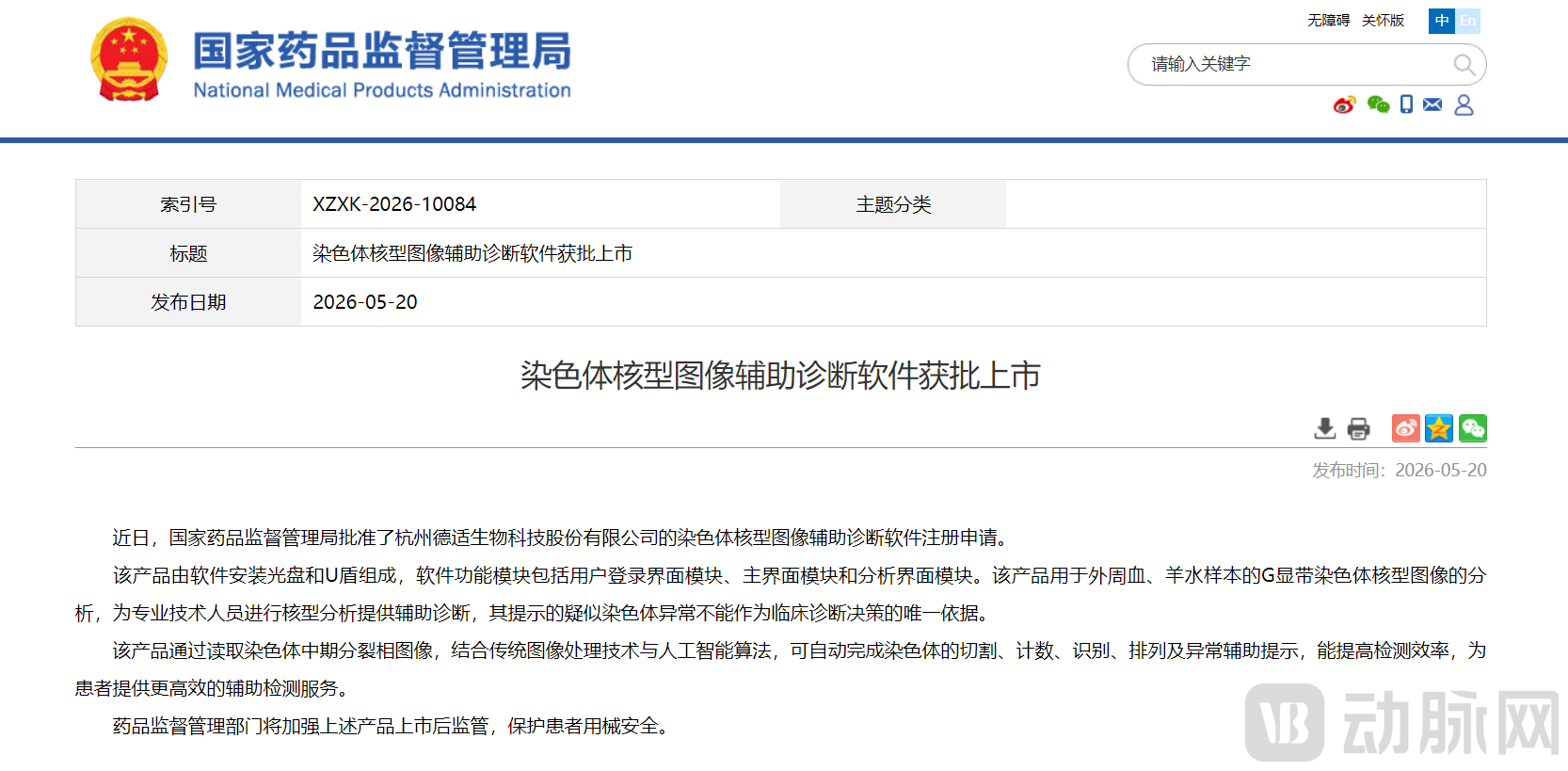
This approval not only signifies that AI AutoVision® has formally entered a new phase of large-scale clinical application, but more importantly, marks the transition of AI healthcare from the "specialized disease model era" to the era of compliant clinical use of foundational large models. It is driving a transformative change in the supply model across the entire medical imaging industry through breakthrough innovation, setting a new benchmark for industry development.
In the clinical practice of medical imaging, chromosome karyotype analysis is an essential foundation for birth defect prevention and control, assisted reproduction, and hematological tumor diagnosis. As a critical and high-load diagnostic process, it has long been trapped in a triple bottleneck of talent, efficiency, and quality control, restricting the high-quality development of the industry—
From the talent perspective, the training cycle for a mature karyotype analyst takes three to five years, and the long-term shortage of qualified professionals struggles to meet the extensive clinical demand. From the efficiency perspective, under the traditional model, doctors need to manually identify, count, and arrange all 46 chromosomes under a microscope, averaging 34 minutes per case, while the overall reporting cycle typically takes around 30 days. In time-sensitive clinical scenarios, this long cycle not only disrupts the diagnostic and treatment rhythm but also potentially increases patient anxiety. From the quality control perspective, manual interpretation is significantly affected by differences in experience and the individual condition of analysts, posing objective risks of missed or incorrect diagnoses. Ensuring consistent diagnostic accuracy remains challenging, and the industry continually faces difficulties in quality control.
The advent of AI AutoVision® is systematically solving these industry-wide challenges. Developed by Diagens based on the iMedImage® foundation model as a chromosome karyotype image-assisted diagnostic system, this product focuses on the automatic segmentation, counting, arrangement, and abnormality detection for assisted diagnosis of chromosome metaphase spread images, offering three core advantages:
First, the clinical validation is globally leading in scale, thorough, and authoritative. The product relies on Diagens' self-developed core technology and has been rigorously validated through the world's largest multi-center clinical trial for chromosome karyotype analysis, involving 1,734 cases. The trial includes, but is not limited to, several authoritative tertiary hospitals such as the First People's Hospital of Yunnan Province, the Third Affiliated Hospital of Zhengzhou University, and Hospital for Reproductive Medicine Affiliated to Shandong University. Multiple types of clinical samples, including amniotic fluid and peripheral blood, were incorporated, ensuring that the clinical validation was rigorous, comprehensive, and authoritative.
Second, the product performance is globally top-tier, precise, and efficient. Clinical data show that AI AutoVision®, in terms of numerical anomaly detection, achieves 100% both in sensitivity and specificity, performing at the level of a senior expert. For structural anomaly detection, sensitivity reaches 94.31% and specificity is 100%, placing its diagnostic accuracy at a globally leading level. The improvement in efficiency is even more remarkable, reducing the analysis time per case from 34.42 minutes to 11.19 minutes, compressing the report cycle from 30 days to 4 to 7 days, with an automated analysis accuracy exceeding 99%. Both clinical effectiveness and efficiency have been significantly enhanced.
Third, the intelligent transformation of the entire process is revolutionizing the workflow. Powered by the iMedImage® foundation model and proprietary AI algorithms, the product enables one-click chromosome segmentation, counting, arrangement, and case-level abnormality detection. It provides intelligent alerts for abnormalities such as trisomy, monosomy, translocation, inversion, and deletion, transforming the analysis process from "manual interpretation" to "AI-assisted automatic analysis with physician review." This model not only efficiently replaces repetitive manual labor, freeing physicians to focus on complex diagnostic decisions, but also ensures that doctors retain final decision-making authority. While significantly improving efficiency, it maintains a firm commitment to medical safety, offering a novel solution for medical imaging diagnostics that balances both efficiency and security.
With the official approval of the Class III medical device certificate, AI AutoVision® will further accelerate its adoption in prenatal diagnosis centers, genetic and reproductive clinics, and general hospitals, driving simultaneous upgrades in clinical diagnostic efficiency and quality.
The successful approval of the Class III medical device certificate for AI AutoVision® is not only a product-level milestone but also a critical juncture in the development journey of Diagens, providing core support for the company to further consolidate its industry position, build technological barriers, and complete its commercial closed loop.
From the perspective of industry position, this approval is the first major milestone following Diagens' listing on the Hong Kong Stock Exchange, which will further consolidate the company's leading position in the medical imaging field. With the support of regulatory compliance qualifications, Diagens' products will accelerate their large-scale implementation in medical institutions at all levels, continuously expand market coverage, widen the gap with competing products in the industry, and solidify their long-term leading market advantage.
From the perspective of technical barriers, the approval of AI AutoVision® confirms the robust fundamental capabilities of Diagens' underlying technology, successfully building a technological moat in the medical imaging field characterized by "foundation model plus vertical applications." Different from the traditional disease-specific model technology route prevalent in the industry, Diagens has embarked on a differentiated innovation path relying on its self-developed technology, forming a core technical barrier that is difficult to replicate. This lays a solid foundation for the company's long-term technological iteration and product innovation. In the future, Diagens is expected to further leverage its medical imaging foundation model to horizontally expand into other high-growth subsegments of medical imaging.
From the business model perspective, this approval further promotes the mature implementation of Diagens' commercial closed loop of "hardware and software plus large model technology licensing." Behind the product approval lies the strong support of the iMedImage® medical imaging foundation model. This foundation model covers 19 types of medical imaging modalities, adapts to over 90% of clinical imaging detection scenarios, and requires only 200 samples to train a high-quality vertical model, significantly shortening the traditional disease-specific model development cycle from 24 months to just 2 to 3 months. The approval of AI AutoVision® fully validates the core capabilities of the iMedImage® foundation model, providing strong endorsement for the rapid development of Diagens' technology licensing business. This will accelerate the formation of a high-margin commercial closed loop combining "hardware and software products with large model technology licensing," support the continuous upgrading of the business model, and inject sustained momentum into the company's long-term high-quality growth.
From the perspective of the entire industry, the approval of the Class III certificate for AI AutoVision® not only signifies the success of a product but also represents a crucial milestone in the development of the entire medical imaging AI industry. From multiple dimensions—industry, regulation, technology, and ecosystem—it charts the course for the industry's future direction.
At the industry level, this approval is expected to push the medical imaging field into a new era of large-scale AI implementation. The application of AI AutoVision® will effectively alleviate the core pain point of talent shortage in the industry, significantly improve the efficiency and accessibility of diagnostic services, and promote a dual upgrade in quality and efficiency for medical imaging diagnostics. Meanwhile, as a benchmark product for domestically produced medical imaging AI, its successful implementation will accelerate the process of domestic substitution in the industry, laying a solid foundation for China's AI medical technology to enter the global market and expediting the large-scale implementation of AI in medical imaging.
At the regulatory level, Diagens has obtained the world's first Class III certificate for a medical imaging foundation model, achieving a breakthrough in addressing the long-standing industry pain points of difficult approval and compliance for large models. The review logic, verification standards, and technical requirements established through this approval will provide a replicable and referable review template for various medical application products based on medical imaging foundation models, such as those in pathology, ultrasound, and CT/MRI. This will effectively reduce uncertainties in industry product submissions and remove key obstacles for the compliant and standardized development of the entire medical imaging AI field.
At the technical path level, the successful approval of AI AutoVision® officially establishes "foundation model plus vertical fine-tuning" as the mainstream technical route for medical imaging AI. It is expected to drive the industry from single-point application development toward technological innovation based on a foundational medical imaging model, accelerating industry technology iteration and innovative upgrades.
At the ecological level, this approval further validates the core capability of the foundation model to mass-produce compliant medical products, which is expected to drive the industry ecosystem toward prosperity. Since the launch of the iMed MaaS® platform in 2025, Diagens has collaborated with 65 leading hospitals to incubate 92 cutting-edge imaging-specific models, covering 32 human organs and deeply addressing 64 disease areas, building a rich and diverse application ecosystem. The approval of the Class III certificate for AI AutoVision® will effectively drive the upgrading of upstream industries such as computing power and data annotation, while promoting the intelligent transformation of downstream hospitals and third-party laboratories. It will facilitate the collaborative linkage and deep integration of the upstream and downstream industrial chain, fully activate the value of the entire AI medical industry chain, and push the entire industry ecosystem toward continuous maturity and prosperity.