

MicroSyne Medical secures tens of millions in Angel Round to advance non-invasive neuromodulation

MicroSyne Medical
Wearable Neurostimulator Developer

Dalton Venture
Venture Capital Institutions in the Medical and Health Field
Recently, MicroSyne Medical, an emerging player in the field of neuromodulation, announced the completion of a tens of millions RMB angel round financing. This round was exclusively invested by Dalton Venture and marks the company's first external financing since its establishment in 2024.
The raised funds will primarily be used to advance its core product—a wearable nerve stimulator—by supporting indication expansion, multi-center clinical trials, and market development both in China and internationally. This initiative aims to accelerate the industrial application of non-invasive brain-computer interface (BCI) technology in the field of neuromodulation.

Amid an aging global population and advancing brain science research, neuromodulation has emerged as a core track in medical innovation. As a key application area of brain-computer interfaces (BCIs), neuromodulation precisely regulates neural signals through electrical, magnetic, optical, and ultrasonic methods, offering revolutionary and innovative treatments for high-incidence neurological disorders such as essential tremor, Parkinson's disease, epilepsy, depression, and insomnia.
In this context, non-invasive technologies are leading the mainstream direction of the industry, owing to their exceptional safety and convenience. With the increasing maturity of these technologies, neuromodulation is rapidly breaking through the limitations of "niche surgical treatments" and transitioning towards "accessible home-based therapies," officially inaugurating a new phase in the industrialization of neuroscience.
From a policy perspective, BCI has been elevated to a national strategic emerging industry. In 2025, BCI was explicitly designated as a key development sector in China's 15th Five-Year Plan, recognized as one of six future industries and new economic growth points. In July of the same year, the Ministry of Industry and Information Technology of the People's Republic of China, along with six other government departments, jointly issued the Implementation Opinions on Promoting the Innovative Development of the Brain-Computer Interface Industry, setting a target for the iterative mass production of non-implantable devices by 2027. Furthermore, Shanghai has released an action plan encouraging the application of non-invasive technologies in areas such as rehabilitation training and neurological disease treatment. Numerous supportive policies across various regions are collectively establishing a robust industrial ecosystem.
Regarding market demand, the aging population is leading to a continuous expansion of the patient population with brain disorders. Data indicates that by 2050, individuals aged 65 and above are projected to constitute 30% of China's total population. Among this demographic, the overall incidence rate of essential tremor is 0.9%, but this rate surges to 4.6% in those over 65. There are currently 3 million patients with Parkinson's disease in China, a figure expected to reach 5 million by 2030. The number of insomnia sufferers exceeds 300 million, with an annual increase of over ten million. The incidence rate of depression is 3%–5%, affecting approximately 95 million individuals in the country. Focusing specifically on essential tremor and Parkinson's disease, the treatment market in China reached RMB 6.1 billion in 2023 and is projected to grow to RMB 9.4 billion by 2029, indicating substantial market potential.
Currently, non-invasive neuromodulation technology offers advantages such as a shorter pathway to treatment, broad applicability, and high safety, effectively addressing the pain points of traditional therapeutic approaches. For instance, a significant number of patients with essential tremor and Parkinson's disease fall into a clinical "treatment gap," where they experience insufficient efficacy from medication but do not yet meet the indications for surgery. Non-invasive neuromodulation presents a novel solution to this clinical dilemma, unlocking a potential market worth hundreds of billions.
Adhering to a clinician-engineering integration approach at its core, MicroSyne Medical has developed a completely original and proprietary technological pathway. This has enabled the company to build a diversified product portfolio anchored by wearable nerve stimulators, encompassing an auricular vagus nerve stimulation system and a wearable multimodal physiological parameter monitoring system.
The clinical efficacy of its core product, the wearable nerve stimulator, is notable: In the first essential tremor (ET) patient treated, the Fahn-Tolosa tremor rating scale score decreased from 54 to 26 after 40 minutes of therapy, achieving a symptom improvement rate of 51%. This clinical outcome significantly surpasses the preliminary data of comparable products in the industry.
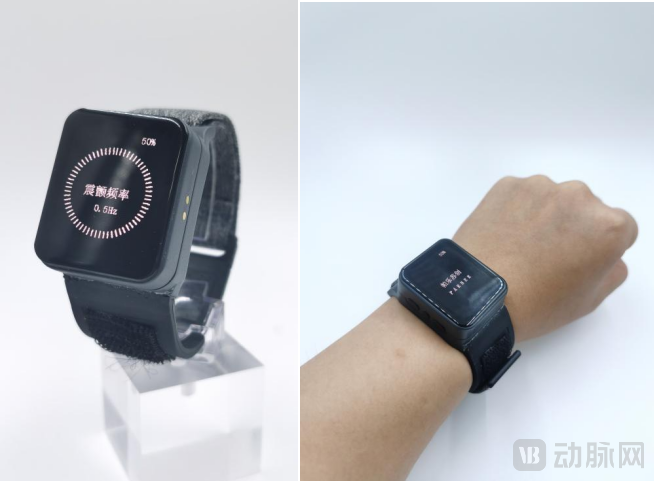
MicroSyne Medical's Self-developed Wearable Nerve Stimulation Wristband
This product is the first wearable nerve stimulation device in China explicitly indicated and intended for use in essential tremor and Parkinson's disease. It requires no additional setup before treatment, is tailored to the usage habits of the Chinese population, and offers both cost-effectiveness and clinical efficacy, thereby filling a gap in the domestic market.
The product has now initiated multi-center registrational clinical trials and is expected to obtain product registration certification in the second half of 2026. In terms of its revenue model, MicroSyne Medical adopts a "device + consumables" approach, combining short-term profitability with long-term growth potential.
Furthermore, MicroSyne Medical is systematically building a portfolio of high-growth innovative pipelines centered around its autonomic neuromodulation platform. This strategy aims to gradually establish a non-invasive neurotechnology product ecosystem that spans multiple indications and application scenarios.
The Transcutaneous Vagus Nerve Stimulation system features multi-indication expansion capabilities. By modulating key pathways within the central neural network, it can address several high-prevalence chronic disease areas, including sleep disorders, depression, migraine, epilepsy, heart failure, and weight management. This product embodies a platform advantage of "one core technology, replicable across multiple diseases," opening up the vast neuropsychiatric health market for MicroSyne Medical.
The Wearable Multimodal Physiological Parameter Monitoring System integrates real-time monitoring with AI algorithm-based early warning to enable epilepsy seizure risk assessment and continuous objective data collection, addressing a long-standing unmet clinical need. Simultaneously, this system empowers MicroSyne Medical to build neurological data assets and enhance its algorithm model iteration capabilities, establishing a long-term technological moat founded on a "hardware + algorithm + data network" synergy.
In parallel, MicroSyne Medical is advancing other innovative pipelines, such as a tibial nerve stimulation system, continuously extending its reach into additional neurological disorder areas.
Through its integrated approach combining "neuromodulation hardware + physiological signal monitoring + algorithm models + data feedback loop," MicroSyne Medical is evolving from a product-driven enterprise into a neurotechnology platform company. This establishes a long-term strategic pathway characterized by synergistic growth across multiple products, compounded expansion across multiple indications, and a progressively strengthened, data-driven competitive moat.