

Is this the BCI takeoff? A ¥2B financing round and Medtronic’s entry say yes

Medtronic
Medical Device Manufacturer

Neuralink
Brain-Computer Interface System Developer
On January 12, medical device giant Medtronic announced a strategic collaboration with Precision Neuroscience (hereinafter referred to as Precision), a leading company in the field of brain-computer interfaces. The two parties will collaborate to develop integrated solutions by combining Precision's Layer 7 brain-computer interface technology with Medtronic's StealthStation surgical navigation system.
This marks the first collaboration between a top-tier medical device company and a brain-computer interface enterprise, signifying the recognition of the clinical potential of brain-computer interfaces by leading players in the medical device industry.
However, this is just one example of the recent surge in attention surrounding brain-computer interfaces—since the beginning of 2026, both domestically in China and internationally, the field has witnessed frequent major developments, and it would be no exaggeration to describe it as "exceptionally booming"!
Precision is a global leader in invasive brain-computer interfaces and a major competitor to the well-known Neuralink, owned by Musk. Its Layer 7 brain-computer interface, which utilizes a high-resolution cortical electrode array, received FDA approval in April of last year. It can be implanted into patients' brains for up to 30 days, enabling individuals with severe paralysis to control electronic devices such as computers and smartphones through their thoughts.
This system is the first of its kind to receive regulatory approval, marking a significant milestone in the field of brain-computer interfaces.
Unlike traditional brain-computer interfaces that rely on needle-like electrodes penetrating brain tissue, Precision's electrode array is installed on the surface of the brain through minimally invasive surgery. The procedure requires an incision of less than 1 mm in the skull for the insertion and removal of the electrode array, eliminating the need for drilling or open cranial surgery. The electrode array consists of 1,024 electrodes with diameters ranging from 50 to 380 micrometers, each only one-fifth the thickness of a human hair. Additionally, the product is designed to be retrievable, ensuring no damage to the brain.
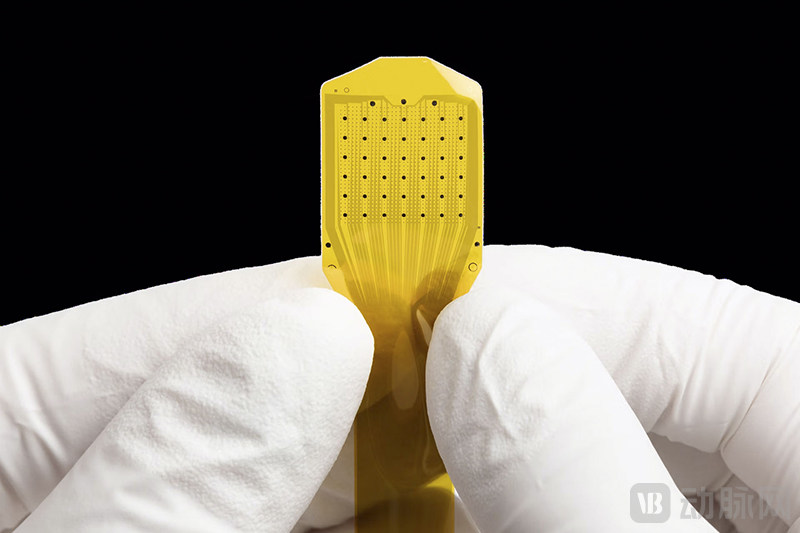
Layer 7 Brain-Computer Interface Electrode Array Amplification Demonstration (Image courtesy of Precision Neuroscience's official website)
Subsequently, in October of last year, Precision published a paper in Nature Biomedical Engineering detailing the design, preclinical validation, and early-stage implantation process of its ultra-thin surface cortical electrode array in five patients.
According to the paper, during the early clinical studies, researchers placed up to four modules covering approximately 8 square centimeters of the cerebral cortex in patients, equipped with a total of 4 × 1,024 electrodes. This paper was the first to demonstrate that high-resolution brain signals could be captured through arrays safely placed on the surface of the brain and used for decoding and neural stimulation. Regardless of whether patients were asleep or awake, high-resolution neural activity could be recorded.
As of October last year, Precision had successfully implanted devices in over 50 patients and conducted long-term application studies across six major medical centers in the United States, helping patients undergoing neurosurgical rehabilitation perform tasks such as typing, playing video games, or controlling robots with Precision's device.
These remarkable advancements have also made it a darling of the capital market. From 2021 to the present, Precision has secured four rounds of financing. Among these, the Series C round completed in 2024 raised $102 million, making it one of the rare large-scale financings of that year.
Brain-computer interfaces are widely acknowledged as a critical technology that could reshape human history in the future. However, due to their technical complexity, even the recent surge in brain-computer interface enthusiasm has been viewed with skepticism, often labeled as a "bubble." The involvement of Medtronic, a leading medical device company, largely dispels such concerns, affirming the clinical value and recent technological progress in brain-computer interfaces, which holds significant implications.
Medtronic's entry into the brain-computer interface field is not entirely unexpected. The company has already established a mature closed-loop neuromodulation system in the deep brain stimulation (DBS) domain, capable of real-time sensing and feedback adjustment based on brain signal states. This collaboration essentially extends the clinically validated engineering capabilities upstream to cortical signal acquisition and functional interpretation.
Based on statements from both companies, the partnership will integrate Precision's high-resolution electrode technology with Medtronic's precise StealthStation real-time 3D surgical navigation system. This will consolidate previously dispersed brain function and structural information into a single system, providing real-time visualization, thereby significantly enhancing the accuracy and speed of decision-making for surgeons during neurosurgical procedures.
From another perspective, the involvement of Medtronic and other major medical device companies is also logical. After all, Musk is not merely known for making bold claims. Tesla's disruption of traditional automakers through electric vehicles remains a vivid memory. Rather than being disrupted in the end, it is wiser to enter and strategically position early in the field and assert dominance swiftly when necessary. This is likely one of the considerations behind Medtronic's move.
For the brain-computer interface sector, which is predominantly composed of startups, the entry of global medical device giants like Medtronic sends a strong signal. History has shown that industry giants have repeatedly leveraged their vast resources to overtake pioneers in the medical device industry. Even a formidable player like Neuralink may need to accelerate its pace to maintain its first-mover advantage. This is just one example of the recent fervor surrounding brain-computer interfaces. On January 1 this year, local time, Musk announced on social media that Neuralink would commence "high-volume production" of brain-computer interface devices in 2026 and transition to a "more streamlined and almost entirely automated surgical process." On January 3, he further stated his confidence in Neuralink's technology to restore full-body functionality for paralyzed individuals.
These two consecutive major announcements not only validated the feasibility of brain-computer interface technology but also sparked a market reassessment of its prospects across multiple critical application areas. This even led to a "collective rally" in related A-share concept stocks on the first trading day of 2026, with share price increases generally ranging from 10% to 25%.
As one of the most closely watched companies in the brain-computer interface field, Neuralink has completed seven rounds of financing to date, raising over $1.3 billion in total. Particularly notable is its impressive $649 million Series E round in June last year, which brought its valuation close to $9 billion.
Clinically, Neuralink is also one of the fastest-advancing companies in the brain-computer interface space. As early as May 2023, it received FDA approval to initiate its first human clinical trial, and in January 2024, it successfully performed the world's first human implantable brain-computer interface surgery. By December 2025, Neuralink had served a total of 20 patients. In September 2025, its "Blindsight" visual implant received the FDA's "Breakthrough Device" designation, making it the first intracortical visual BCI officially included in a fast-track regulatory pathway aimed at restoring vision to the blind.
In terms of individual corporate progress, Neuralink leads globally, which explains Musk's bold claim of "high-volume production in 2026." However, from a practical standpoint, achieving high-volume production within the year may still pose significant challenges. This would require a substantial expansion of the engineering team and significant optimization of existing surgical protocols, with the final outcomes yet to be observed.
China has also made significant strides in the field of brain-computer interfaces. According to incomplete statistics, China ranks second globally in the number of academic papers related to the medical applications of brain-computer interfaces, trailing only the United States. Similarly, China's research influence in this field is second only to that of the United States. Notably, 2025 saw a concentrated emergence of clinical achievements in brain-computer interfaces in China.
This progress has attracted considerable attention from the capital market. According to incomplete statistics from VCBeat, China's brain-computer interface sector completed 24 financing rounds in 2025, marking a 30% year-on-year increase. Among these, StairMed's 350 million RMB Series B financing round, completed last year, set a new record for the largest single financing amount in China's domestic brain-computer interface sector.
Entering 2026, this momentum has intensified further. In early January, the Chinese brain-computer interface company BrainCo completed a financing round of approximately 2 billion RMB, setting a new record for the largest single financing amount in China's brain-computer interface field. Concurrently, it confidentially submitted an IPO prospectus to the Hong Kong Stock Exchange, positioning itself to become the "first brain-computer interface company to go public" in China.
In less than a year, the record for the largest single financing amount in the brain-computer interface field has been broken again, highlighting the remarkable enthusiasm surrounding this sector.
Even from a global perspective, this financing scale is historically second only to Neuralink, making it the second-largest single financing amount in the global brain-computer interface field to date.
In response, representatives from BrainCo confirmed that the financing had indeed been completed, stating that specific details should be referenced from the company's official announcements. The raised funds will be used to accelerate the research and development of core brain-computer interface technologies, achieve breakthroughs in engineering, scale up production, and facilitate mass production. BrainCo also stated that its goal is to assist one million individuals with physical disabilities in restoring their daily lives and reintegrating into society by using neural-controlled prosthetics within the next five to ten years. Additionally, it aims to improve the quality of life for ten million patients suffering from brain-related disorders such as autism, ADHD, Alzheimer's disease, and insomnia. Ultimately, the company envisions enabling ordinary individuals to interact directly with the world through brain-computer interface devices, experiencing the future of human-machine integration.
As one of the "Six Dragons of Hangzhou," (a group of leading tech startups based in Hangzhou) BrainCo is a leading technology enterprise in China's non-invasive brain-computer interface sector and was the first Chinese team selected for Harvard Innovation Labs. Its products are widely applied across various fields, including medical rehabilitation, health management, and education. Furthermore, BrainCo has expanded the application scenarios of brain-computer interfaces, achieving multiple technological breakthroughs in the development of intelligent bionic hands and successfully producing the world's first mass-produced intuitively controlled smart bionic hand.
Last year, BrainCo launched the Revo 2 tactile version of its dexterous bionic hand, which accurately captures users' electromyographic and neural signals, enabling five-finger coordinated operations and helping individuals with upper limb disabilities regain fine motor abilities. In promotional videos, the product not only effortlessly picks up and crushes eggs with considerable force but can also instantly switch to a gentle mode to pick up fragile eggshells—all accomplished autonomously by the tactile bionic hand's force control system without human intervention. This "balance of strength and gentleness" in force control gives the dexterous hand human-like flexibility when handling objects of varying shapes and textures.
Beyond capital interest, companies in the traditional medical device sector are also closely monitoring the brain-computer interface field. Some have decisively entered the arena through strategic collaborations.
On January 5, the listed special robotics company Yijiahe signed a strategic cooperation agreement with the listed rehabilitation medical company Medlander Medical. Centered on the integration of "brain-computer interface + embodied intelligent robotics" technologies, the partnership aims to explore new scenarios in intelligent care, emotional interaction, and health management. A day later, the listed IVD company YHLO Biotech announced a strategic collaboration with NeuraStar to jointly develop brain-computer interface-related products under research and advance subsequent market expansion and promotion.
In November of last year, StairMed's "Implantable Wireless Brain-Computer Interface System" became the first invasive brain-computer interface product to enter the special review process for innovative medical devices in China. This marks a critical step in China's brain-computer interface industrialization journey, transitioning from clinical validation to market access.
All signs indicate that brain-computer interfaces will become a major trend in the coming years. Whether it is the entry of global medical device giants like Medtronic or the favorable conditions both in China and internationally, the evidence undoubtedly points to this direction. Barring unforeseen circumstances, 2026 will likely witness more medical device giants entering the field, and it is almost certain that the first publicly listed brain-computer interface company will emerge. An industry on the verge of taking off is now unfolding before our eyes.
However, history reminds us that any technology detached from clinical value and patient needs risks becoming a massive bubble, destined to burst and leave behind a mess. VCBeat hopes that the domestic brain-computer interface industry in China will learn from history, prioritize research and development alongside clinical validation, and forge robust capabilities. We believe that outstanding enterprises akin to BYD in the brain-computer interface field will emerge, reaching the pinnacle of the industry.