

Topping RMB 6M per unit: why are ophthalmic microscopes so expensive and in such high demand in China?
As one of the core devices with the largest market scale in the ophthalmology field, ophthalmic surgical microscopes have seen continuously rising market attention in recent years and are currently experiencing growth in both volume and price in the Chinese market.
According to procurement bidding data, in the first three quarters of 2025, the publicly disclosed number of winning bids and total winning bid amounts for ophthalmic surgical microscopes both reached five-year highs (excluding bundled procurement and undisclosed bidding data), with the average winning bid price also rising consecutively. Among these, several high-end models equipped with OCT navigation achieved winning bid prices exceeding RMB 5 million, with the highest surpassing RMB 6 million. In contrast, non-navigation surgical microscopes previously peaked at just over 2 million.
Evidently, within the medical device sector influenced by various market and policy factors, ophthalmic surgical microscopes have emerged as one of the most resilient and strongly growing sub-segments in China. While the increase in winning bid volume for these devices is partly driven by rising surgical demand, from a product perspective, why are ophthalmic surgical microscopes selling so well?
The surge in the ophthalmic surgical microscope market is fundamentally driven by leapfrog breakthroughs in product technology.
Since its inception, the ophthalmic surgical microscope has undergone multiple rounds of technological innovation, evolving from a device that merely met the need for magnified surgical observation into a comprehensive surgical platform capable of providing clear imaging and recording functions. In recent years, through innovations in digitization, intelligence, and the integrated design of swept-source OCT, high-end microscopes have achieved real-time 3D visualization of intraocular conditions during surgery, significantly enhancing surgical precision and safety and delivering a qualitative leap in clinical value.
Traditionally, conventional ophthalmic surgical microscopes could only provide two-dimensional planar views, lacking depth information. However, the surgical field in ophthalmology is inherently three-dimensional, and many surgical procedures are not confined to a single cross-section. During surgery, doctors either had to rely on endoscopes to obtain intraocular views (which cannot non-invasively observe the fundus) or depend on personal experience and preoperative examinations to assess tissue layers. This limited the observation of complex intraocular and fundus structures, compromising surgical precision and posing certain safety risks. For instance, in phacoemulsification cataract surgery, traditional devices could not monitor the thickness and tension of the posterior capsule in real time, potentially leading to posterior capsule rupture due to improper manipulation. In vitrectomy, distinguishing pathological from normal tissue was challenging, risking damage to peripheral nerves or blood vessels.
The technological breakthroughs in the new generation of high-end products precisely address these pain points. By integrating the latest OCT technology with surgical microscopes, these devices provide real-time intraoperative imaging with depth information, equipping surgeons with "X-ray vision" to efficiently and conveniently observe surgical dynamics. Particularly with the optimization of integrated design pathways and the enhancement of technologies such as AI, AR, and 4K, swept-source OCT imaging is now highly synchronized with the surgical field, further improving image quality and delivering a superior operative experience for surgeons.
In recent years, multiple high-end surgical microscope models have accelerated their adoption in China.
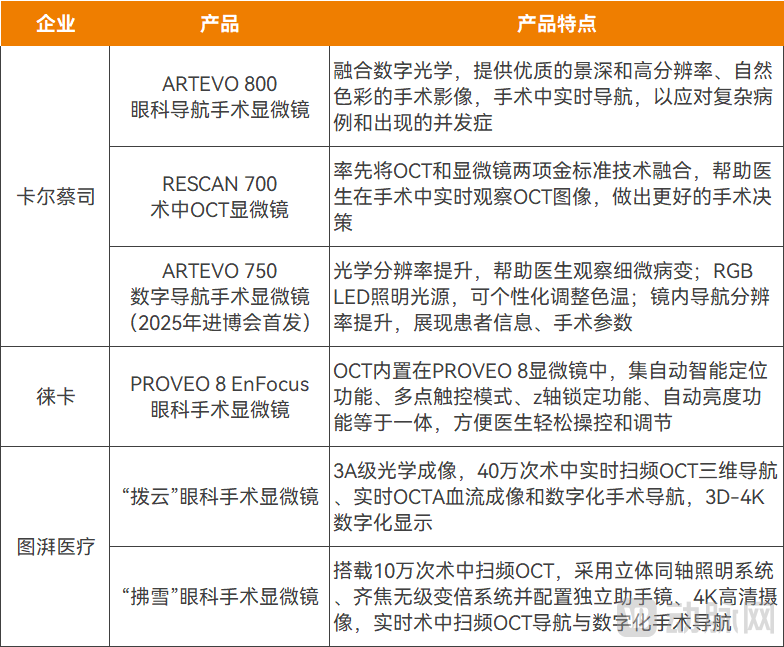 Figure 1. Part of the high-end surgical microscopes integrated with OCT in China, Source: Public information from enterprises
Among international brands, the Zeiss ARTEVO 800 digital navigation 3D microscope is one of the high-end devices currently being heavily promoted in China. This product integrates digital optics and provides precise navigation assistance. At the 2025 China International Import Expo (CIIE), Zeiss also debuted in China the ARTEVO 750 digital navigation surgical microscope, which features significant improvements in key specifications. The Leica Proveo 8 Enfocus combines intelligent surgical microscope imaging and positioning technology, with OCT built directly into the microscope, enabling real-time measurement of critical intraoperative parameters and assisting surgeons in timely adjustments to the surgical plan.
Chinese brands have also achieved key breakthroughs. In September 2024, TowardPi Medical's "Boyun(拨云)" and "Fuxue(拂雪)" series of digital navigation microscopes received regulatory approval. It is understood that the "Boyun" and "Fuxue" series address issues common in previous spectral-domain OCT implementations—such as surgical interruption, image latency, and limited field of view—through the integrated optical design of the spectral-domain OCT and the microscope's main optical pathway. This integration represents one of the core challenges in combining OCT with microscope optics.
"Swept-source OCT-guided intraoperative microscopes are applicable to almost all ophthalmic surgeries," explained Wang Yingqi, Co-founder and CEO of TowardPi Medical. "In cataract surgery, they enable real-time observation of the corneal endothelium, anterior and posterior capsules, zonule status, and anterior chamber stability, thereby improving the precision of capsulorhexis and nucleus segmentation. They are particularly suitable for complex cataracts or cases combined with anterior segment refractive diseases. In vitreoretinal surgery, they can clearly differentiate pathological conditions such as edema, cysts, and tumors, helping surgeons precisely control the depth and extent of tissue removal while avoiding damage to adjacent healthy structures. In surgeries for fundus vascular diseases, OCTA can display intraoperative blood flow information in real time, aiding surgical decision-making."
It is evident that technological breakthroughs represented by swept-source OCT navigation are not merely incremental feature additions. For complex surgeries, they have become essential configurations for enhancing safety and therapeutic outcomes. The significant improvement in clinical value has laid a solid foundation for the explosive growth of the ophthalmic surgical microscope market.
Alongside technological breakthroughs, the direct drivers behind the volume and price increases of ophthalmic surgical microscopes stem from the explosive, multi-layered, and diversified market demand. Different tiers of demand are being precisely met, creating a dynamic where high-end products drive price growth and primary-level institutions fuel volume expansion, collectively propelling market growth.
The main purchasers in the high-end market are top-tier hospitals and large-scale specialized ophthalmic hospitals in China. In recent years, their procurement volume has grown, while the price of the new generation of high-end devices has increased by an order of magnitude compared to previous models, thereby forming a trend of "price appreciation."
Specifically, the growth in procurement of high-end ophthalmic surgical microscopes stems from two primary demands: equipment replacement and the addition of new operating rooms.
Wang Yingqi explained that traditional ophthalmic surgical microscopes were primarily based on optical and mechanical systems. Even with functional upgrades or new product launches, they remained within that technological framework. With limited choices, many hospitals used their equipment until it was beyond repair before replacing it. Over the past two years, microscopes featuring substantial technological breakthroughs in multimodality, digitization, and intelligence have stimulated replacement demand in some hospitals. Furthermore, since 2025, the accelerated establishment of new hospital branches and operating rooms in many regions has directly driven an increase in procurement of high-end equipment.
On the price front, high-end products represented by intraoperative swept-source OCT navigation microscopes have seen significant price increases alongside their technological breakthroughs. According to bidding data, high-end microscopes equipped with intraoperative OCT navigation function fall within a price range of RMB 2.5 million to 6 million. In the past, just over 2 million was the peak price for non-navigation surgical microscopes.
In 2025, high-end models from Zeiss and TowardPi Medical achieved winning bid prices exceeding 5 million in multiple procurement projects. Notably, the Zeiss RESCAN 700 recently secured a winning bid of RMB 6.4926 million in a published tender. Additionally, in 2025, Zhongshan Ophthalmic Center, Sun Yat-sen University, procured 13 units of the Zeiss OPMI Lumera 700, with a total value exceeding RMB 33 million. The increase in similar large-value or batch procurement cases directly fuels high-end market growth. Taking the Zeiss ARTEVO 800 as an example, its installed base has reached 100 units within three years of launch.
It is worth noting that besides public sector bidding and procurement, private ophthalmic hospitals are also a significant source of growth for the high-end market. In Wang Yingqi's view, private ophthalmic hospitals are positioned in the mid-to-high-end segment. Taking several major listed ophthalmic chains as examples, their diagnostic and treatment standards align with tertiary hospitals, and they prefer high-end models when selecting microscopes. On one hand, the core competitiveness of private ophthalmic hospitals lies in high-quality medical services, which require support from advanced equipment. On the other hand, the physician teams in private hospitals include many retired experts or senior doctors from public hospitals, who have stringent requirements for surgical tool performance.
"2025 marks the inaugural year for the concentrated market promotion of high-end navigation microscopes. Following this, as market certification systems gradually establish, the next five years will witness a relatively concentrated wave of equipment replacement," predicted Wang Yingqi.
If high-end products have played a role in driving "price appreciation" within the overall ophthalmic surgical microscope market, then the gradually emerging primary-level ophthalmic market is fueling "volume expansion" in this field.
"There has been a significant growth trend in microscope procurement by primary-level medical institutions in recent years," analyzed Wang Yingqi. "The core reasons are that some hospital accreditation requirements mandate independent ophthalmology departments, and the shifting of some cataract surgeries to the primary level, coupled with growing surgical demand."
Against this backdrop, entry-level models from both Chinese and international brands, with their affordable prices and functionalities tailored to primary-level surgical needs, precisely meet their procurement demands and have gained widespread market acceptance. Among these purchasers are more township health centers and community health service centers, which are leveraging these microscopes to develop specialized primary-level departments. Given the large number and wide geographical coverage of primary-level institutions, they form a broad base driving the overall market sales volume upward.
The rise of Chinese brands has also served as a key force driving the "simultaneous increase in both volume and price" in the ophthalmic surgical microscope market.
To date, 16 domestic Chinese brands of ophthalmic surgical microscopes have obtained approval from the National Medical Products Administration, accounting for half of all registered certificates. However, constrained by gaps in core performance compared to imported products—such as optical imaging technology, equipment stability, and operational precision—the market share growth of Chinese products has historically been slow and has yet to gain widespread clinical acceptance. Meanwhile, Chinese products have primarily captured a portion of the basic demand and mid-range markets, while the high-end market has long been overwhelmingly dominated by imported products.
Currently, with domestic Chinese brands achieving substantial breakthroughs in their push toward high-end products, the entrenched pattern of import monopoly in the high-end market is being disrupted.
For example, after securing regulatory approval in 2024, TowardPi Medical's high-end ophthalmic surgical microscopes officially entered a phase of rapid commercialization in the second half of 2025. It has been disclosed that since August 2025, total sales of the "Boyun" and "Fuxue" surgical microscopes have exceeded 20 units, with a cumulative winning bid amount surpassing RMB 100 million, ranking second only to Zeiss and Leica. Furthermore, according to public data, the highest winning bid price for TowardPi's "Boyun" reached RMB 5.8 million, positioning it at a price level comparable to Zeiss's high-end models.
In addition, other Chinese companies such as Intalight, Sierra Medical, and Zhitong Technology continue to focus on the development of high-end models, including digital microscopes and OCT-integrated navigation microscopes.
These indicators demonstrate that domestic Chinese devices, through key initiatives such as breakthroughs in core technologies and intensified market promotion, are now directly competing in the high-end market.
Therefore, looking across the ophthalmic surgical microscope sector, with Chinese products now filling the gap in the high-end market, a comprehensive product portfolio spanning high, mid, and low-end segments has been established. The full-spectrum layout of Chinese brands contributes to market growth in both volume and price from two perspectives: In the high-end market, domestic Chinese products compete alongside imports, capturing market share, expanding the overall scale of the high-end segment, and raising the industry's average price. In the mid- to low-end markets, Chinese brands leverage their cost and pricing advantages to solidify their market position, particularly by absorbing the incremental demand from primary-level institutions, thereby driving growth in total sales volume.
Of course, bidding data represents only one part of the market. Regarding the overall market situation, Wang Yingqi noted that the annual total bid value for ophthalmic surgical microscopes previously ranged between approximately RMB 1.3 and 1.4 billion and is expected to grow to nearly RMB 1.5 billion in 2025.
In summary, the simultaneous growth in volume and price within the ophthalmic surgical microscope market is an inevitable outcome driven by the combined forces of technological transformation, multi-tiered market demand, and the rise of Chinese high-end products. This represents not merely cyclical growth but a signifier of the industry entering a new phase of development.
Simultaneously, amplified by external factors such as the continuous increase in ophthalmic surgical volume driven by demographic aging and the release of policy dividends, the penetration rate of ophthalmic surgical microscopes will further increase. In this process, more high-quality technologies will become widespread under the trend of adoption led by top-tier hospitals and the downward diffusion of premium resources, ultimately benefiting patients more broadly. This is the fundamental significance behind the rising market penetration rates.