

Chinese Tumor Ablation Devices Gain Strong Traction in Global Markets
Overseas distributors are coming to China to scout for sources, physicians from around the world are traveling to China to learn innovative procedures and then returning home to run training courses, and health delegations from a succession of countries are visiting local innovative device companies... Chinese medical devices going global are staging a landmark role reversal.
In the past, the mainstream route for Chinese devices to go overseas was for manufacturers to carry samples abroad and pry open markets with price advantages. Now the initiative is shifting: invitations to collaborate are issued from the overseas side. CE certification and overseas clinical deployment have become the buzzwords of this industrial cycle, and some collaborations have even drawn the attention of foreign heads of state.
Behind the surface is a switch in the underlying logic: the industry is gradually leaving behind the old low-price breakout path and turning to clinical value and technological strength to attract global partners to its door.
Tumor ablation devices are a highly representative sample of this industrial shift.
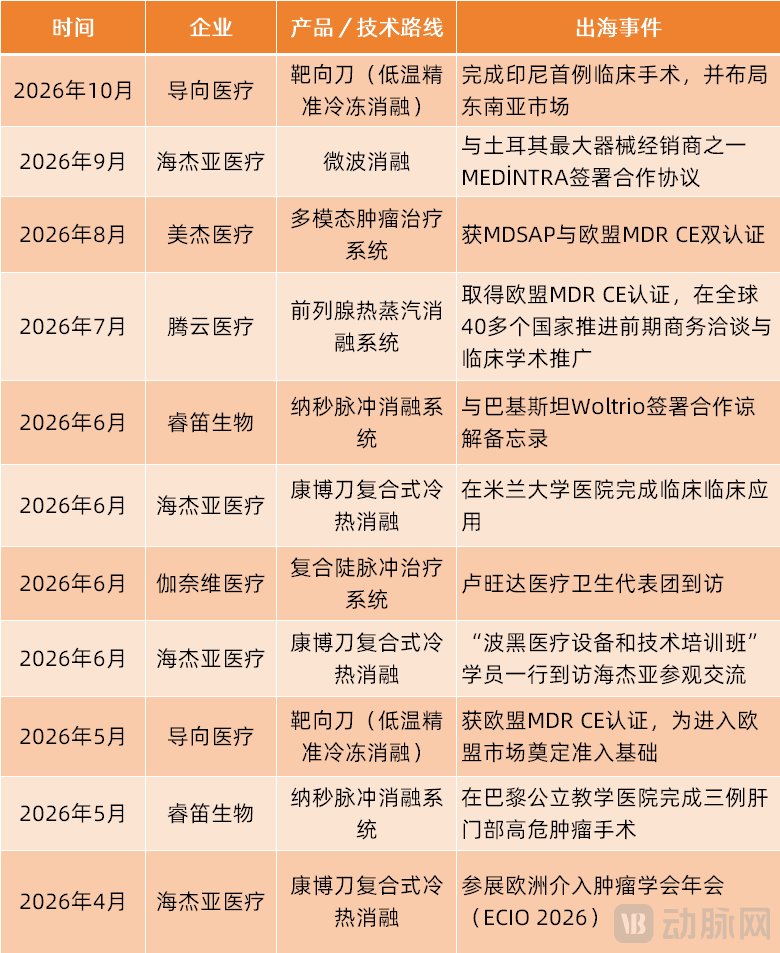
(A look at Chinese tumor ablation device overseas events over the past six months)
Source: compiled from company websites and public reports (as of October 2026)
For a long time, cost-effectiveness was the mainstream path for Chinese medical devices going global.
In the early years, domestic companies had limited innovation to build on, and their products largely benchmarked mature imported solutions. Relying on China's manufacturing cost advantages, makers of medical gloves, infusion systems, patient monitors and similar categories went to overseas trade shows, approached distributors directly and entered global markets with low-price strategies.
That model worked in standardized, homogeneous low-value consumables, but it is hard to replicate in tracks such as tumor ablation, where technology and patent barriers are high.
As the traditional low-price route lost traction, global demand for ablation was rising fast, and growth in overall exports plus accumulated supply chain capability opened new space for Chinese innovative solutions. According to Grand View Research, the global tumor ablation market was worth about USD 2.1 billion in 2025, is expected to grow at a compound annual rate of 14.1% from 2026 to 2033, and could reach USD 6.1 billion by 2033.
Meanwhile, China's medical device exports kept growing, reaching USD 45.796 billion in 2025, up 4.01% year on year, with exports to Belt and Road partner countries rising 10.48%. Expanding overseas clinical demand, combined with an increasingly mature domestic medical device supply chain, created the conditions for tumor ablation devices to go global.
Unlike the playbook of the low-value consumables era, Chinese innovative ablation companies have taken an entirely new route: price is no longer the tool for breaking in; the original clinical value of the product is the core bargaining chip.
Behind this clinical-value-first strategy is the rapid expansion of China's ablation technology map: beyond the three major energy platforms of cryoablation, microwave and radiofrequency, Chinese companies have brought multiple world-first products to market on new energy routes such as irreversible electroporation (IRE) and steam.
Nortion Medical's high-frequency composite irreversible electroporation (H-FIRE) is the world's first device to apply composite pulse technology to prostate cancer ablation. Traditional radical prostatectomy is highly invasive and carries a higher risk of postoperative urinary incontinence and sexual dysfunction, and patients have a clear need for organ preservation. H-FIRE uses composite pulses to sharpen the precision of the ablation boundary and the IRE mechanism to reduce nerve stimulation and muscle contraction, achieving complete lesion ablation while better preserving urinary continence and sexual function, and hitting a clinical pain point that is equally common overseas.
Ruidi Biotech has positioned itself in nanosecond pulsed electric field technology. The approach offers tissue selectivity, low Joule heat accumulation and short transmembrane action time, and its steep pulse ablation system is expected to sidestep the limits of conventional surgery and thermal or cryogenic ablation, enabling safe ablation in high-risk anatomical regions with dense vasculature, such as liver and pancreatic cancer.
Beyond these, AccuTarget's TACTIC targeted knife, Hygea Medical's Co-Ablation System and Curaway Medical's composite steep pulse therapy system are also world-first products. What they share is a focus on clinical gaps that existing solutions struggle to close, differentiated supply built on homegrown original technology, and relatively few overseas competitors in the same track.
Once products constitute a scarce supply of clinical value, the bargaining logic is rebuilt: overseas distributors no longer wait passively for Chinese manufacturers to come selling, but travel to China to compete for distribution partnerships.
Behind the reversal in bargaining power is a repricing, in overseas markets, of low-specification and low-price against high-quality innovation. Most Chinese tumor ablation devices command the core energy platform and algorithms, their clinical data are on par with imported products, and some routes even overtake them on indications and safety.
For overseas medical institutions, bringing in innovative devices backed by solid clinical evidence that solve real clinical problems is a chance to upgrade a department's diagnostic and treatment capability and improve patient outcomes. Against this backdrop, the role of overseas channels shifts from screening suppliers to competing for the rights to distribute quality innovative products. This is the core reason Chinese innovative ablation products can break free of the low-price competition logic and enter mature markets such as Europe and the US.
Turning innovative value into international market trust requires academic influence. Chinese tumor ablation companies have actively built a presence at international academic conferences and in top journals in recent years, bringing local clinical results to global peers.
Academic journals are the most direct channel of evidence. In 2022, Nortion Medical published a multicenter clinical study of its composite steep pulse device in prostate cancer in JAMA Surgery (IF 18.5); the results showed a clinically significant prostate cancer rate of only 6% at six months, significantly lower than the 20% of historical control groups on other energy platforms (p < 0.001), with no damage to nerves, blood vessels or the urethra in the treated area. Its disclosed data on 1,452 patients show that high-frequency IRE achieves a 97% urinary continence preservation rate and a 91% sexual function preservation rate.
At Hygea Medical, in November 2025 a team from Shanghai Pulmonary Hospital published a clinical study of the Co-Ablation System in Signal Transduction and Targeted Therapy (IF 52.7): adding composite hot-cold ablation to immunotherapy to clear oligo-residual lesions extended median progression-free survival from 11.7 months with immunotherapy alone to 26.7 months. These Chinese data from the real world are the most direct reference for overseas clinicians judging a product's value.
More of a milestone is the uptake by international guidelines. The 2026 update of the European Association of Urology (EAU) guidelines on prostate cancer formally included two studies led by Dr. Zhang Kai's team at Beijing United Family Hospital on irreversible electroporation for localized prostate cancer, making IRE a Grade A recommended option that balances tumor control with quality of life. This is a typical case of Chinese clinical evidence flowing back into authoritative European and American guidelines. When international guidelines begin citing Chinese data, Chinese innovative devices are no longer merely followers of international standards but participants in the standard-setting process.
Academic conferences and live surgery are the on-site expression aimed at international physicians. At the 10th International Conference of the Asian Society of Cryosurgery (ASC-10), Indonesian doctors, under the guidance of Chinese experts, independently completed the first clinical use of AccuTarget's TACTIC targeted knife in Indonesia; at the annual meetings of the European Association of Urology and the American Urological Association, Nortion Medical presented the innovativeness and clinical value of its composite steep pulse device through technical displays and live surgery. From top journals and international guidelines to the operating table, the global academic influence of Chinese innovative tumor ablation devices is rising fast.
For hospitals, purchasing an ablation device means following a procedure and a body of clinical evidence over the long term. Publication in top journals and inclusion in international guidelines are important references for overseas hospitals evaluating a product: they demonstrate clinical safety and efficacy, and they shorten the time cost of clinical access and physician education.
Once innovative products and academic influence are seen by the world, overseas channels begin knocking on Chinese companies' doors.
In 2025, Turkish urology experts read Nortion Medical's top-journal paper and made a special trip to China to seek collaboration; distributors and clinical experts from Southeast Asia, the Middle East and Europe followed.
In September 2026, Professor Alan Soo, consultant cardiothoracic surgeon at University Hospital Galway in Ireland, and others visited Ruidi Biotech, while Abay Baigenzhin, director of Kazakhstan's National Scientific Medical Center, visited Hygea Medical.
In June the same year, a Rwandan health delegation visited Curaway Medical, and in October representatives of health authorities from Myanmar, Seychelles, Cape Verde, Guyana, Cambodia and other countries visited Hygea Medical as a group.
Distributors and clinical experts coming to China in the reverse direction is a direct portrait of products moving from being pitched to being sought.
Behind the visits is real commercialization. Nortion Medical's products have landed quickly in Turkey, the Philippines, Spain, Germany, Singapore and other countries, covering 27 countries and regions across four continents within nine months.
Hygea Medical signed a cooperation agreement on microwave ablation products with Turkish distributor MEDINTRA; Ruidi Biotech signed a memorandum of understanding with Pakistan's Woltrio, with Pakistani Prime Minister Shehbaz Sharif witnessing the signing ceremony; more notably, Ruidi's steep pulse ablation system won US FDA approval in October 2026, completing a global footprint rooted in China, covering Europe and reaching North America.
Meanwhile, more companies are accelerating overseas approvals: AccuTarget obtained EU CE MDR certification in May 2026 and moved into Southeast Asia in October; MAaGI Medical's multimodal tumor therapy system received EU CE MDR in September; Tengyun Medical's UroVapor prostate water vapor ablation system obtained EU CE MDR in July and, about two months after certification, was advancing business talks and academic promotion in more than 40 countries.
The deeper change is that Chinese companies are no longer simply exporting hardware but delivering complete Chinese-original technology solutions to the world.
Curaway Medical runs an international training course on PoriNova, with domestic expert teams teaching standardized surgical technique to overseas doctors; 22 trainees, including officials from Bosnia and Herzegovina's health system, public hospital directors, department heads and clinical leads, traveled to China for systematic training at Hygea Medical; Nortion Medical has brought IRE training into clinical circles in Turkey, Malaysia, Italy, Spain and Portugal, and more tellingly, the Turkish team that once trained in China returned home and launched its own Eastern European training program for doctors in Poland, Slovakia and Croatia, achieving a second cross-border spread of the technology.
This playbook is fundamentally different from simply exporting devices: exporting a technology solution means taking China's clinical pathways, surgical standards and training systems abroad, helping local teams build the ability to perform procedures independently. When overseas doctors operate with Chinese techniques and local teams can train the next generation of physicians on their own, a Chinese brand is no longer just a device supplier but a co-definer of treatment protocols, which gives repeat purchases and ecosystem ties a far deeper foundation.
Placed on a timeline, the density and speed of Chinese tumor ablation devices going global becomes immediately clear. In the past six months alone, from EU CE certification and first overseas procedures to international agreements and North American FDA approval, landmark events have landed almost every month, making overseas surgery and CE certification the industry's high-frequency keywords. Below is a summary of the main overseas events of the past six months.
Of course, it should also be seen objectively that this round of globalization storytelling has only just begun. Although overseas certifications have been obtained and academic debuts and technical training completed, large-scale commercialization, the sustained accumulation of overseas real-world evidence and the building of localized operating systems remain real challenges that Chinese innovative companies must clear. From opening the way with price, to innovative value, to exporting standards, the upgrade path of Chinese tumor ablation devices going global has only just reached its second half.