

Through the Skull, Beyond Ultrasound: Krinwave's Neo Lab Ambition in Brain Science
Kunwei
Developer, Manufacturer, and Distributor of Ultrasound Products
Three labels were laid in front of Liu Jiajia, founder of Krinwave: in public records it is a "super-resolution ultrasound imaging technology company"; he himself has told a farther story, of building "an infrastructure company for brain-science AGI"; and many reports file it directly under brain-computer interface.
Which one is Krinwave?
Liu did not follow any of the labels. His own definition: "Strictly speaking, we are a frontier lab (Neo Lab) with commercial capability."
That sentence explains everything about Krinwave that looks contradictory: it holds approved clinical devices and has booked real orders, yet insists on governing its entire business with one fundamental scientific question; it ships ultrasound products today, yet opens its underlying capabilities to many more applications.
According to VCBeat, the company has just closed a new RMB 400 million round, with XVC and HongShan as new shareholders and existing investors Sherpa Healthcare Partners and Tencent increasing their commitments.
Capital habitually slots it into the ready-made frames of medical devices or brain-computer interfaces; the founder wants the "Neo Lab" identity established first.
To understand that identity, one has to go back to a judgment he made more than a decade ago.
1A Chinese Neo Lab's Self-Positioning
In 2008, Liu Jiajia, a biomedical engineering graduate of Xi'an Jiaotong University, joined an ultrasound equipment company. Not long into the job he found an awkward fact: the field he had entered had been stagnant for nearly a decade.
The problem lay in the underlying paradigm the industry runs on.
For half a century, ultrasound imaging has followed one technical logic: echolocation. A probe emits sound waves that pass through tissue and reflect at boundaries, and the device rebuilds an image from the echoes. The higher the frequency and the shorter the wavelength, the higher the resolution, and the faster the attenuation; the lower the frequency, the greater the penetration, and the more resolution degrades.
The industry thus settled into a mutually locking "impossible triangle": frequency, penetration and resolution cannot all be had, and the mainstream answer has always been to keep squeezing frequencies within what attenuation allows.
That paradigm of trading higher frequency for performance, Liu said, hit its ceiling in ultrasound around 2000; by the time he entered the industry in 2008, the fundamental performance of ultrasound had seen no substantive progress for more than a decade.
Spotting this is not hard; the hard part is daring to question common sense itself. In 2009, in his second year in the industry, Liu proposed the opposite judgment: high-performance systems can be built at low frequency too. In the industry context of the time, the idea was close to being dismissed as a perpetual-motion fantasy.
What truly convinced him the path would work was the arrival of AlphaGo in 2016. He realized that spatial perception is itself part of intelligence, just as vision depends not only on the eyes but more on the brain. He summed up this layer in one sentence: "For large language models, compression is intelligence; for spatial intelligence, resolution is intelligence."
At Krinwave, this kind of "intelligence" is named "acoustic spatial intelligence".
The technical route diverged from there. The company built its own small-parameter, high-concurrency, high-bandwidth architecture. Conventional medical imaging focuses, stacks and renders signals into images; Krinwave models the space first, recovering size, position and motion, and renders the image afterwards.
Such a starting point almost predetermined the shape of the company.
It does not back-derive products from market demand; it first answers a fundamental question academia has yet to answer. Nor does it take the conventional route of publishing first and waiting for peer review: core results are protected as trade secrets and validated in-house all the way to engineering deployment. That is how a frontier lab works.
2First, Make Ultrasound Read the Brain Through the Skull
The lab's first technical landing point was ultrasound, where Liu had worked for more than a decade.
Academia already has a tool called functional ultrasound (fUS) for observing cerebral microvascular blood flow. Its temporal and spatial resolution both beat functional MRI (fMRI), which has been in use for more than three decades, yet it has never shaken fMRI's mainstream status.
The bottleneck is very practical: existing fUS largely requires an opened skull and a high-frequency probe to observe microvascular blood flow in the brain. Without opening the skull, the sound cannot pass through it, and that barrier has kept the technique at the paper stage for decades.
The industry thus formed a deep-rooted belief: whole-brain ultrasound imaging either opens the skull or has no answer. Most frontier teams on other ultrasound routes chose to go around the skull: opening it, implanting acoustically transparent materials, or pairing optical measurement with ultrasound modulation.
Krinwave's route was to think differently: lower the frequency to keep penetration, and hand "resolution" to algorithms. Its proprietary UP high-penetration probe, ultrafast plane-wave imaging and SRBF super-resolution beamforming stack together with a GPU computing architecture, so that a single probe placed directly on the skull surface can render intracranial anatomy and microvascular blood flow.
Krinwave is currently the only company in the world reading the brain through the skull with non-invasive ultrasound and achieving high-resolution brain imaging.
On the product side, Krinwave now fields the WE series of portable units and the Rocvue H and Rocvue T series of cart-based systems; they are general-purpose machines able to image the cranium, abdomen, heart and superficial tissue. On progress: the company obtained China's first registration certificate for cranial ultrasound in 2024 and EU CE certification in 2025, and public reports indicate three FDA registrations are in the approval process.
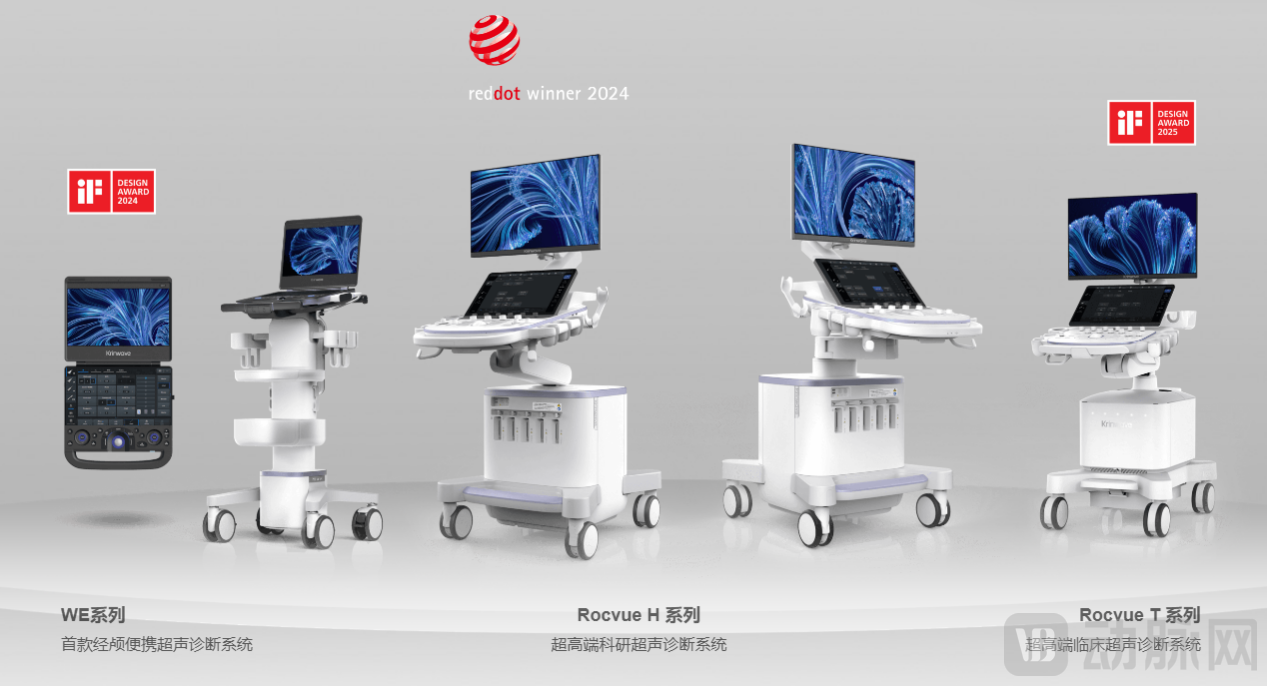
Ultrasound product lineup. Source: Krinwave's official website
Brain science is a later and larger story built on this platform.
3Treating Neuroscience as a Prolonged Process of Data Accumulation
On the brain-science line, Krinwave casts itself as the infrastructure base.
The device itself carries read-write potential: it can image, and it can also deliver ultrasound stimulation, then monitor the response and adjust parameters. The company does not build BCI terminals directly; it supplies hardware and a foundational software platform, positioning itself roughly as Nvidia does for AI.
Last November, at the Chinese Medical Association's annual ultrasound congress in Hangzhou, Krinwave launched the kOS research open platform, opening two layers of capability to third parties: "reading" real-time imaging data and "writing" parameters such as pulse, frequency and acoustic intensity, with collaboration open to universities, hospitals and research institutes.
Underneath that openness lies a methodology about data. Liu believes the marriage of brain science and AI is stuck on data.
Today's acquisition tools each have a weakness: invasive electrodes give clean signals but require opening the skull and cover only a local area; EEG is portable and cheap but its signal-to-noise ratio is too low; fMRI sees the whole brain but is bulky and expensive and cannot follow daily life; fUS sees finely but cannot pass through the skull.
Decoders trained on such data generalize poorly: a single subject's signals drift over time, and there is no cross-individual generality, because the data volume falls short of the threshold by roughly three orders of magnitude. What brain science really needs is the same individual recorded repeatedly over long periods, not a thousand people recorded once each.
That is exactly the position Krinwave wants to occupy: supplying the foundational equipment for large-scale, high-quality cranial data acquisition.
There are three acquisition paths: standard imaging devices entering hospital ultrasound departments, where patient data accumulates naturally during clinical exams; content centers co-built with technology companies that buy the equipment for centralized collection; and, further out, patch-type consumer ultrasound that can be worn 24 hours a day, producing massive data at the fastest rate once adopted.
Liu envisions data at the scale of tens of billions of hours and explicitly frames it as a long-term goal, holding that only once data accumulates to that point can general intelligence in brain science have a basis for realization.
4AI Is Accelerating Scientific Research Itself
Krinwave currently plots its path as three curves.
The first curve is today's ultrasound imaging equipment, a mature market that lets the company fund itself. The second is integrated diagnosis and treatment, combining diagnosis and therapy in one device. The third has the most room: opening up the ability to read and write the brain through the skull and turning it into brain-science infrastructure.
The outside world widely labels brain science and BCI as overheated by capital; Liu's judgment is the opposite: the field is far from overheated, and the funding gap is enormous. The money brain science needs may be 100 times, even 1,000 times, that of embodied intelligence.
He uses embodied intelligence as a reference: data collection centers across the country have gathered more than ten million hours of data and still cannot train an embodied AI that acts autonomously, even though the latter mainly has to solve how ten fingers move; the brain is far more complex, and trying to train a good model on a few thousand hours of neural data is, in his view, unrealistic.
At the end of the interview we asked Liu how many years it would take for the tool ecosystem in brain science to mature.
A year ago, he said, his answer was 20 years; today it is 10, and "ask me again tomorrow and it might be five". What keeps shrinking the number is AI accelerating scientific research itself.
That ever-shortening timeline says more about what Krinwave is betting on than any funding news. It is no longer betting on a product or a pipeline, but on an era that AI has re-accelerated.
From the 2009 judgment dismissed as perpetual motion, to portable adult cranial ultrasound in ambulances in 2026, to a future vision of brain data at the tens-of-billions-of-hours scale, Krinwave has never framed any of these stages as an achievement already in hand.
We close with Liu's own words: science is the source of everything; first comes science, then technology, then products, and finally commercialization. Krinwave chooses to stand at the frontier of basic science, making today's ultrasound business solid first, and leaving the longer horizon of brain science to time and data.