

Overseas Cuts, China's Heavy Bets: Why Is Capital Chasing Domestic CAR-T?
Recently, several star companies in the overseas CAR-T field have announced the termination of CAR-T pipelines. Caribou ended two allogeneic CAR-T programs; Cellectis discontinued two clinical-stage allogeneic CAR-T assets and shifted resources entirely to in vivo gene editing; Arsenal abandoned its ex vivo autologous CAR-T pipeline altogether and redirected all R&D resources to its in vivo CAR-T platform...
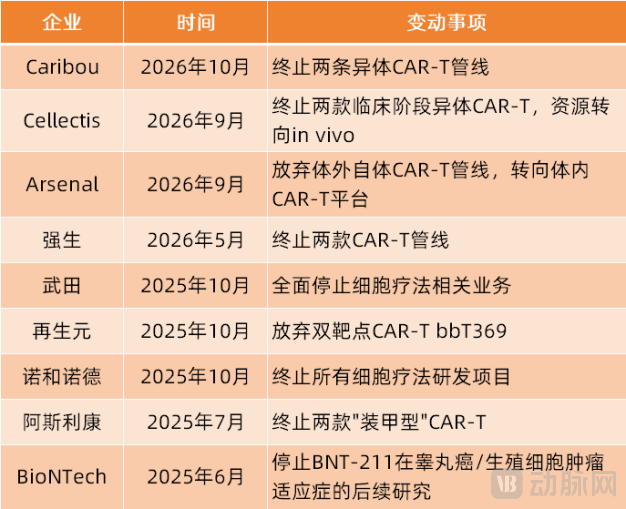
According to VCBeat statistics, at least 12 pharmaceutical companies have terminated or paused their core CAR-T programs in the past year. By technology route, the discontinued pipelines are mainly ex vivo autologous CAR-T and off-the-shelf allogeneic CAR-T, and several companies have even redirected resources entirely to in vivo CAR-T platforms after announcing the terminations.
This has led some in the market to a misreading: that the ex vivo route will be replaced by in vivo CAR-T technology.
That is not the case. To understand the industry's real trajectory, one must first examine why these companies actually cut their pipelines.
Based on interviews, the cuts were driven not by technology route alone but by a combination of factors: the treatment landscape, a changed financing environment, clinical data falling short of expectations and corporate strategy adjustments.
The first is an evolving treatment landscape. Cellectis, for example, attributed the discontinuation of its two allogeneic CAR-T products to changes in the treatment landscape for B-ALL (B-cell acute lymphoblastic leukemia) and NHL (non-Hodgkin lymphoma).
Dr. Xiang Yu, CEO of BRL Medicine, analyzed: "B-ALL and NHL are both B-cell-derived hematologic malignancies, differing only in where they arise and how they present. Competition in hematologic malignancies is fierce and highly homogeneous: seven CAR-T therapies have been approved in the US and seven to eight in China."
With more mature clinical evidence, new regimens are moving to earlier lines. Progress in frontline therapy has lowered relapse rates, leaving fewer patients reaching later-line treatment and shrinking the corresponding market. At the same time, bispecifics, T-cell engagers (TCEs) and other novel modalities keep emerging, intensifying competition in second- and third-line settings. Against this backdrop, a new CAR-T, even if effective, must still answer one question: what additional clinical value does it offer over existing therapies?
Dr. Xiang Yu added: "In high-end overseas markets, cost is less sensitive than in China. In Europe and the US, for instance, CAR-T therapies for hematologic malignancies have entered reimbursement at prices of several hundred thousand dollars. The manufacturing cost of autologous CAR-T is only tens of thousands of dollars, a modest share of the total cost of treatment. Novel approaches such as allogeneic and in vivo CAR-T must prove clinical advantages beyond low cost; otherwise, the market will prefer autologous CAR-T, whose efficacy has already been validated."
The second is the changed financing environment. A few years ago, global capital was still chasing allogeneic CAR-T. At the time, autologous CAR-T had reached the market, offering initial validation of a commercial path, but it carried multiple constraints: manufacturing took weeks, costs were high and processes were hard to standardize.
To address these pain points, the industry developed an allogeneic route: T cells from healthy donors or iPSCs (induced pluripotent stem cells) are engineered so that one product can serve multiple patients. Compared with autologous CAR-T, allogeneic CAR-T offers off-the-shelf availability and lower cost, and it was once favored by investors.
The industry then explored in vivo CAR-T. This approach skips T-cell collection and ex vivo manufacturing, delivering genes encoding a CAR (chimeric antigen receptor) directly into a patient's native T cells through non-viral or viral vectors, so that T cells are reprogrammed in situ into CAR-T cells capable of targeted tumor killing. In principle, in vivo CAR-T offers a simpler manufacturing process, shorter treatment cycles, lower cost, preserved T-cell function and no need for lymphodepleting conditioning.
Professor Yang Hanshuo, founder of CR Therapeutics, told VCBeat: "Since in vivo CAR-T emerged, virtually all domestic and international investors have pivoted to backing in vivo CAR-T."
According to statistics, since 2025 AstraZeneca, AbbVie, Gilead, BMS, Eli Lilly, Johnson & Johnson and other giants have spent nearly USD 20 billion in total to build in vivo CAR-T positions. In China, more than 16 in vivo CAR-T financings have closed this year, raising over RMB 2.7 billion.
As money flows toward in vivo CAR-T, allogeneic CAR-T companies find fundraising markedly harder. Caribou is a case in point. Its CEO said: "The current financing environment for allogeneic CAR-T makes it difficult for the company to raise the capital needed to advance the programs, leaving us no choice but to terminate our two remaining allogeneic CAR-T pipelines", even though the data previously released for those programs were impressive.
Dr. Xiang Yu offers another perspective on the financing shift. Technology route does matter, but which therapeutic area it enters matters more. Take mRNA: its value surged on vaccine demand and later cooled. Yet in October 2026 Novartis struck a BD deal with Abogen Biosciences for RNA therapies, with a USD 575 million upfront payment and a potential total value of about USD 7.2 billion. The technology was still mRNA; the difference was that it entered autoimmune disease.
In CAR-T, competition in hematologic malignancies is highly homogeneous, and the pipelines cut by Caribou, Cellectis and Johnson & Johnson were all in hematologic indications. Autoimmune disease and solid tumors offer large markets, and regardless of technology route, be it autologous, allogeneic, in vivo or even mRNA, programs and companies with strong clinical data continue to attract capital.
Dr. Xiang Yu said: "Professional investors look at a product's future commercial returns, not at chasing hot technology labels; the core question is the market ceiling of the disease area. In autoimmune disease and solid tumors, a single blockbuster can generate USD 20 billion in annual sales, and the market is broader. CAR-T in particular can achieve deep B-cell depletion and immune reset, enabling a new long-term treatment model distinct from existing monoclonal antibodies."
Beyond the treatment landscape and financing environment, clinical data falling short of expectations and corporate strategy also drove the cuts. Johnson & Johnson terminated two CAR-T therapies in May 2026. Two months later it announced a strategic collaboration with Sail Biomedicines to advance in vivo CAR-T, paying a USD 785 million upfront (including USD 465 million in equity investment) and up to about USD 2.72 billion more if it exercises acquisition options and reaches related milestones.
Overall, when leading overseas CAR-T companies cut autologous and allogeneic pipelines, their considerations center on pipeline data, corporate strategy and the financing environment.
Since the start of 2026, several star CAR-T companies overseas have scaled back pipelines, while more than 10 in vivo CAR-T companies in China have closed financings.
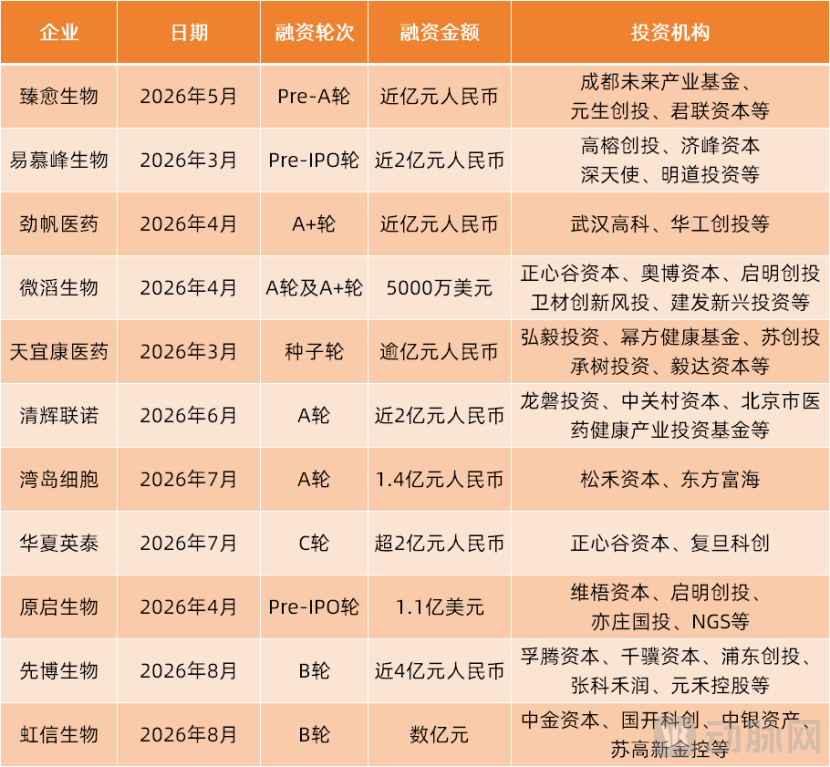
(CAR-T companies that closed financings in 2026; not an exhaustive list)
According to statistics, the vast majority of these companies have in vivo CAR-T technology. CR Therapeutics, MagicRNA and Vivacta Bio, for example, focus exclusively on in vivo CAR-T.
Among them, CR Therapeutics has produced breakthrough work in efficient delivery, CAR molecule design and long-acting mRNA expression, validated in patients. MagicRNA's in vivo CAR-T program HN2301 has enrolled dozens of patients with various autoimmune diseases and has shown durable, excellent safety. Vivacta Bio's lead product GT801 has shown encouraging safety and efficacy in patients with hematologic malignancies and autoimmune diseases.
Many allogeneic and autologous CAR-T companies have also used this financing wave to build in vivo CAR-T positions. Simnova, for instance, plans to use its proceeds to accelerate the confirmatory clinical study of SNC103, its core allogeneic CAR-NK program, and to advance registrational clinical development of its in vivo CAR-T platform SNC116. Skye Medicine will mainly use its funds to develop next-generation autologous rapid-process multi-target CAR-T candidates and in vivo multi-target cell therapy candidates for autoimmune diseases. Immunofoco, which covers solid tumors, hematologic malignancies and autoimmune diseases across ex vivo and in vivo CAR-T, will mainly use this round to build out in vivo CAR-T, constructing its proprietary iMAGIC in vivo CAR-T platform.
According to industry sources, more than 100 companies in China have now positioned themselves in in vivo CAR-T; at a macro level the field is already highly crowded, with homogenized pipelines.
Investors are nonetheless willing to place heavy bets because in vivo CAR-T, as a new technology, is compelling in principle and already has clinical signals validating its value. Fearing to miss the next-generation technology opportunity, investors are piling into in vivo CAR-T, much as huge amounts of capital rushed into ADC and other new technologies and targets when they first appeared. In vivo CAR-T is precisely a new direction at an early stage of the industry.
At the micro level, moreover, most in vivo CAR-T companies have differentiated technical innovations.
Professor Yang Hanshuo said: "In vivo CAR-T is arguably one of the most complex biopharmaceutical technologies today. The chain is long, every step involves many choices and the variables are numerous: delivery vectors include lentivirus (LV), mRNA-LNP, AAV and VLP. Take mRNA-LNP: LNPs themselves vary widely, and different lipid molecules perform differently; antibody types and conjugation methods differ; CAR designs vary enormously; the choice of targeting binder, whether against CD3, CD4, CD8 or CD7, leads to different designs; and then there are the enormous CMC and manufacturing challenges. This means every company can innovate at every step and build its own technical edge."
Not every in vivo CAR-T company can raise money, however. Those that close rounds have clearly competitive core strengths.
CR Therapeutics, for example, has years of accumulated work in tumor therapy, CAR research and nanoparticle delivery. From early on it designed from the perspective of the final product: lipid molecule selection, CMC processes, binder (targeting binder) conjugation, CAR design and antitumor potency enhancement were all systematically planned at an early stage. Each module has since made its own advances, and together they form a clear combined advantage.
MagicRNA has solved the "extrahepatic, non-APC-targeted delivery of mRNA" problem that had constrained the field, developing a proprietary engineered cell-targeted delivery platform that is internationally leading in engineering and targeting efficiency. On that platform it built the in vivo CAR-T program HN2301.
These companies have targeted autoimmune disease and solid tumors, not just a technology route, which supports Dr. Xiang Yu's point: professional investors do not chase hot technology routes but back competitive pipelines and companies in large disease areas.
Capital, in other words, is not paying for a technology label but for the disease opportunity, human clinical data, use cases and real product value.
Overseas companies are pursuing in vivo technology as well. Since 2025 AstraZeneca, AbbVie, Gilead, BMS and other global giants have acquired in vivo CAR-T companies, spending nearly USD 20 billion. Their strategy, however, is to cut existing pipelines and redirect resources to in vivo technology: Cellectis ended allogeneic CAR-T and moved to in vivo gene editing; Arsenal abandoned autologous CAR-T entirely for an in vivo CAR-T platform; even Johnson & Johnson cut two autologous CAR-T therapies, citing pipeline priorities and a changing market landscape.
Chinese companies have taken a different approach, preferring to keep advancing existing core pipelines, both autologous and allogeneic, while building in vivo CAR-T platforms on that foundation.
BRL Medicine, for example, has built autologous CAR-T, allogeneic off-the-shelf CAR-T and in vivo CAR-T in parallel around autoimmune disease. It has not pivoted wholesale to in vivo CAR-T and continues to advance its autologous and allogeneic programs.
The IND for BRL-303, its allogeneic off-the-shelf CAR-T product, in relapsed/refractory systemic sclerosis (SSc) has received implied clinical trial approval and been included in the "Care Program - Extension" pilot of the Center for Drug Evaluation (CDE) under the National Medical Products Administration. A Phase I study of BRL-303 in moderate or severe refractory systemic lupus erythematosus (SLE) is also proceeding well.
CARsgen Therapeutics, for its part, says it will go all in on allogeneic and in vivo CAR-T. Two of its allogeneic CAR-T products have filed INDs, with complete response rates above 70%, on par with autologous CAR-T, and it is advancing investigator-initiated trials in in vivo CAR-T.
In June 2026, the autologous humanized CAR-T product CARsgen had developed was approved by the NMPA for CLDN18.2-positive, HER2-negative advanced gastric/gastroesophageal junction adenocarcinoma after at least two prior lines of therapy, making it the world's first approved CAR-T drug for a solid tumor.
Overseas companies are cutting allogeneic CAR-T pipelines while Chinese companies pursue both in vivo and allogeneic CAR-T. Will the Chinese players stumble?
Amid the overseas shifts, some in the Chinese industry now argue that in vivo CAR-T will replace allogeneic CAR-T. From a scientific standpoint, however, that conclusion may be premature.
For one thing, most in vivo CAR-T programs are still preclinical or in investigator-initiated trials (IITs), leaving much uncertainty ahead.
Manufacturing is a formidable challenge, for example. With lentiviral vectors, lentiviruses carry vector-related side effects and long-term safety risks: whether a vector may insert into the genome unexpectedly, and whether insertion into T cells could trigger T-cell lymphoma, remain open questions.
The LNP route has its own difficulties: mRNA delivered subcutaneously in the past used doses of only 25-50 micrograms, whereas in vivo CAR-T requires high-dose intravenous administration in the milligram range. High-dose IV dosing brings new toxicity risks, and LNPs tend to accumulate in the liver. How to widen the safety window, in vivo pharmacokinetics and many other questions cannot be fully resolved until late-stage clinical testing.
On the other hand, several allogeneic CAR-T therapies have entered clinical validation but remain at an early stage of development. On April 4, 2026, Allogene published preclinical data for its allogeneic CAR-T candidate ALLO-329 in autoimmune disease: allogeneic CD19 CAR-T cells engineered with an anti-rejection CD70 CAR retained potent anti-CD19 activity, avoided rejection and promoted CAR-T cell expansion.
In June this year, Caribou reported long-term follow-up data from the Phase I ANTLER study of vispa-cel, its allogeneic CD19 CAR-T cell therapy: median progression-free survival (PFS) reached 17.1 months, confirming that the off-the-shelf therapy's efficacy in lymphoma is comparable to autologous CAR-T products.
Even with clinical validation, allogeneic CAR-T must still overcome technical hurdles such as further reducing immune rejection and improving long-term safety, which entails uncertainty. The route also has to solve the problem of outpatient administration.
In Dr. Xiang Yu's view, therefore, in vivo and allogeneic CAR-T are better understood as parallel technology routes. In GLP-1, oral agents are clearly more convenient and better adhered to than subcutaneous injections, yet approval of orals did not strip value from injectables; it opened a new market. Likewise in CAR-T, allogeneic and in vivo approaches need not be simple substitutes; each may find the settings and patient groups it fits best.
From a corporate development standpoint, in vivo CAR-T is an emerging technology no company should miss, but given current uncertainty, companies should keep backup pipelines and allocate resources sensibly between old and new programs.
Ultimately, a technology label is only a tool; clinical benefit and commercial potential determine a product's value. Whichever route a company chooses, anchoring in large fields such as solid tumors and autoimmune disease and delivering solid human clinical data is what gives a cell and gene therapy company the confidence to grow fast.