

Eight Years to Sharpen the Blade: MicroPace Brings Leadless Pacing to China

MicroPace
Developer of Cardiovascular Nerve Stimulators
On September 18, 2026, a tiny leadless pacemaker, iPace™, traveled through the femoral vein into the patient's body and was finally deployed at the right ventricular septum. This was the first implant of MicroPace's self-developed iPace™ in a registrational clinical trial.
The recipient was a 72-year-old male patient. Twelve years earlier, he had received a conventional pacemaker for atrioventricular block, and he had recently developed a pocket infection.
During the procedure, the physician advanced the delivery system through the right femoral vein and positioned iPace™ at the target site. An intraoperative tug test showed that the device's fixation mechanism had anchored to the myocardium; the pacing threshold was 0.5 V and the R-wave sensing amplitude was 6 mV, with all parameters meeting clinical requirements.
For MicroPace, this is not simply a matter of shrinking a pacemaker. It answers a more specific engineering question: when the pulse generator, battery, circuitry, and electrodes are all compressed into a device that must be delivered into the heart through a catheter, how can it work continuously and reliably within a limited space?
Starting from Clinical Pain Points, Seeking a New Solution for Pacemakers
To understand what MicroPace is doing, it helps to return to the clinical setting first.
For patients who need long-term cardiac pacing, the conventional pacemaker is already a mature treatment, yet it still has problems that are difficult to avoid entirely.
A conventional pacemaker usually requires implanting the pulse generator under the skin of the chest and connecting it to the heart with a lead. Over time, problems such as pocket infection, lead damage, or lead displacement can place an additional treatment burden on patients.
The patient mentioned at the outset received a leadless pacemaker precisely because a pocket infection developed years after his conventional implant.
Leadless pacemakers offer another approach: core components such as the battery, circuitry, and electrodes are integrated into a miniature device that is implanted directly into the heart chamber through a catheter, eliminating the subcutaneous pocket and the conventional lead and potentially reducing some related complications.
Medtronic's Micra received U.S. Food and Drug Administration (FDA) approval in 2016, and Abbott later launched a related product; this route has been validated clinically.
But removing the lead raises the engineering difficulty. Implantation may also bring new risks such as cardiac perforation, pericardial effusion, or device dislodgement, and the management of battery depletion and the applicable scope of fixation methods all have to be weighed.
For MicroPace, the real challenge is how to balance pacing and sensing function, energy consumption, device fixation, and delivery reliability within a limited space. The smaller the device, the higher the demands on the chip, energy management, and overall system design.
MicroPace's choice to start with leadless pacemakers reflects both a judgment about clinical need and the pacemaker R&D experience that founder He Yuping accumulated over the years.
To understand why the company took this technical route and how it turned the idea into a product step by step, one has to turn the clock back to He Yuping's career and to the starting point of MicroPace.
From Pacemaker Veteran to Founder, He Started with In-House Chips
He Yuping's connection with cardiac pacemakers began more than four decades ago.
In 1985, while pursuing a master's degree at the 771 Microelectronics Institute under the Ministry of Aerospace Industry, he learned about a pacemaker R&D project in Shaanxi Province. He later went to Texas A&M University in the United States for his doctorate and did postdoctoral work at the pacemaker company Intermedics.
From 1995 to 1999, he worked at Medtronic and took part in the Kappa 700 series pacemaker program; he subsequently held positions at Boston Scientific and in the cardiac rhythm management business of MicroPort, accumulating experience from device development to product industrialization.
Years on the front line of pacemaker R&D also led him to think about miniaturization early on. He Yuping recalls that as early as around 2000, he wanted to shrink a conventional pacemaker by 10% to 20%. In engineering R&D, that was already a considerable challenge.
Later, the emergence of leadless pacemakers gave the idea new momentum. A leadless pacemaker integrates all components, so it is no longer a matter of making the existing device smaller but of rethinking and restarting from product structure to system design.
After leaving MicroPort in 2015, He Yuping had the option to continue developing conventional pacemakers, but he chose another path. By then he had already noted the trend toward pacemaker miniaturization and had seen the new direction of leadless pacemakers.
"When the tip of the mast first appears, one can tell that this is going to grow into something massive and universal, and can grasp it." A new thing had appeared; the logic was simple: keep pace with the most advanced.
A year later, Medtronic's Micra leadless pacemaker won FDA approval, and this technical route entered a new stage of development.
In 2018, MicroPace was founded in Xi'an and made leadless pacemakers its core R&D direction. This choice was not simply a chase after a new product but a hope to apply years of experience in low-power circuits, chip design, and device development to the most advanced pacemaker of this generation.
The path has not been easy, and team building has also taken time. At the time, China lacked talent with leadless pacemaker R&D experience, so the core team could only be trained gradually through practice. Today, MicroPace has an R&D and production team of about 60 people and has built laboratories for chip testing, mechanical micromachining, catheters, and reliability, as well as a Class 10,000 cleanroom for production.
From the early wish to make conventional pacemakers a little smaller to the later decision to start over from the chip and the whole system, MicroPace's research and development direction has gradually become clear, and it is moving toward its goal step by step.
Putting a Whole Hospital into a Chip, Trimming Another 10% Off the Volume
A leadless pacemaker integrates core components such as the battery, circuitry, and electrodes into a miniature device, so chip power consumption, battery capacity, packaging structure, and overall performance must be designed in coordination.
This is why MicroPace makes in-house chips an R&D priority. A pacemaker must continuously sense the heart's own electrical activity and deliver electrical pulses when needed. The chip must handle both sensing and pacing control while minimizing energy consumption.
Power consumption affects battery configuration, while battery size and the integration level of the circuit board determine how the internal space of the device is allocated.
He Yuping likens the chip to "a cardiology hospital": it first senses the heart's electrical activity, then makes judgments through algorithms and parameters, and finally controls the device to deliver electrical pulses. From sensing to decision-making to execution, these functions must work together within a limited space and energy budget.
According to MicroPace, iPace™ uses a self-developed pacemaker-specific chip with quiescent power consumption about 38% that of competing products and a chip area of 1.90 x 1.95 mm. The low-power design and system integration lay the foundation for miniaturizing the whole device.
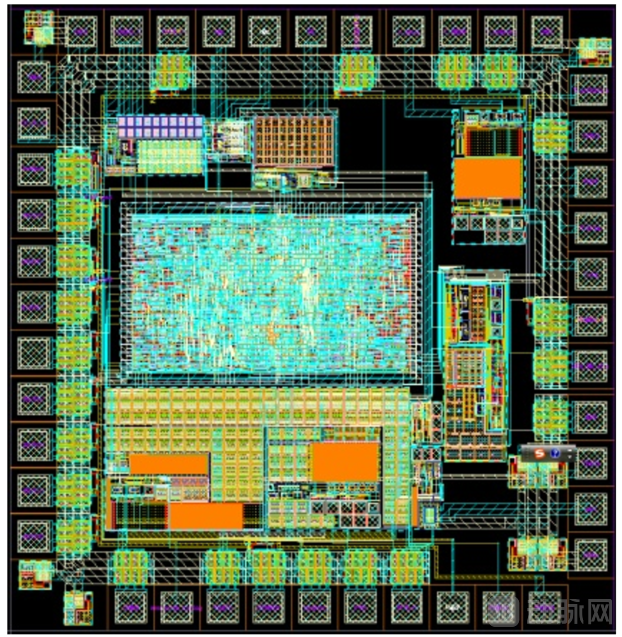
Pacemaker chip layout: 1.90 mm x 1.95 mm
Chip design must ultimately translate into the complete device. MicroPace's published iPace design parameters are a length of about 24.1 mm, a diameter of about 6.7 mm, a volume of about 0.77 cc, and a weight of about 1.6 g. For reference, the competing product is about 25.9 mm long and 6.7 mm in diameter, with a volume of about 0.8 cc and a weight of about 1.8 g.
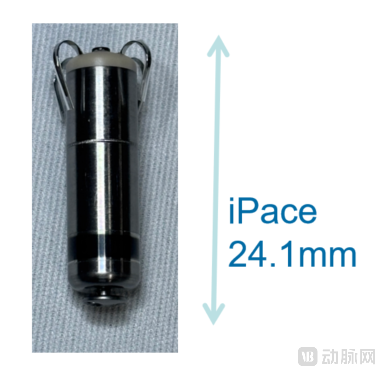
Reference image of the physical iPace™ device
If the competing product is already the world's smallest pacemaker, then MicroPace's iPace™ can be described as a pacemaker smaller than "the world's smallest pacemaker" (Smaller Than The Smallest).
For leadless pacemakers, miniaturization is not merely a contest over dimensions. Reliable fixation after implantation in the heart chamber, risks during implantation such as cardiac perforation, pericardial effusion, and device dislodgement, and battery management after long-term implantation all have to be considered.
Whether a product can truly build competitiveness therefore depends on whether miniaturization can be reconciled with pacing performance, reliability, and long-term safety.
In MicroPace's vocabulary, "small" is not a marketing word but a physical question and, more importantly, a clinical one.
A leadless pacemaker is not "buried" in tissue but suspended on the inner wall of the heart chamber, swinging with every heartbeat on the order of 100,000 times a day.
"It is in motion. If you hang something horizontally on a wall, the shorter the length and the lighter the mass, the smaller the torque, and the lower the risk of it coming loose over time." Every bit less chip power consumption means a lighter device and a bit more long-term safety for the patient, a causal chain that runs straight from the circuit board to the hospital bed.
Eight Years of In-House R&D: At the Threshold of Clinical Validation
Back to the September 18 procedure. MicroPace's iPace™ leadless pacemaker completed the first implant in a registrational clinical trial, and the product thus entered a new stage of systematically accumulating clinical evidence.
Before that, iPace™ had already traveled a considerable distance: in June 2025 it entered the NMPA's Special Review Procedure for Innovative Medical Devices; in March 2026 it completed five first-in-human (FIM) implants, with stable pacing and no adverse events through 180 days of follow-up.
This registrational trial is led by Professor Hua Wei of Fuwai Hospital and conducted across 13 centers nationwide, with plans to enroll more than 100 subjects, each followed for at least six months. Under the company's plan, the team hopes to complete all implants before the second half of 2027, finish follow-up of the last patient by the end of that year, and then initiate registration submission between the end of 2027 and 2028.
MicroPace spent nearly eight years advancing the product to the clinical validation stage. That also makes the two characters of "Dunbo" easier to understand. "Dun" means solid and substantial; "Bo" means broad and extensive. He Yuping's tone when he talks about the company name is as steady as when he talks about technology.
Starting from in-house chips, advancing step by step to full-device development, and then reaching clinical validation, MicroPace has chosen a hard road of long-term investment. The end point of R&D is not a smaller pacemaker but one that works more reliably in real clinical settings and delivers better practical benefit to patients.
This long-cycle, capital-intensive underlying technology route has never been a solo effort. From TigerYeah Capital's entry in the angel round, to Proxima Ventures and Qiming Venture Partners adding capital, to Xinke Capital joining as a co-investor, investors' trust has allowed MicroPace to settle down to build chips and endure the long clinical grind.
For MicroPace, eight years of in-house accumulation have finally reached the clinical validation stage. Whether the product can withstand clinical scrutiny next is something the industry will be watching closely.