

In Conversation with Scinetics' Post-2002 Co-Founder: The Value Density and Scaling Law of AI4S
Scinetics
Life Sciences R&D Service Provider
In the last century, the philosopher of science Karl Popper argued in The Logic of Scientific Discovery that scientific progress does not come from an accumulation of correct answers but from the cycle of "conjecture and refutation": scientists advance bold hypotheses and then rigorously try to falsify them, and scientific knowledge grows in the process.
Years later, the idea has not dated; it lands precisely on what is awkward about AI4S today: more and more players can "conjecture," while those able to "refute," to validate, are increasingly scarce.
Over the past few years, AlphaFold has almost redefined the ceiling of structure prediction, generative models have raised the efficiency of designing molecules, proteins, and nucleic acids by orders of magnitude, and primary-market money has rushed in behind the compute-plus-pipeline story. Yet for all the excitement, one underlying contradiction remains unresolved: a model can spit out tens of thousands of candidate molecules in one night, while wet-lab work is stuck on materials, staffing, and turnaround time and can only proceed one at a time. The gap between the pile-up of predictions upstream and the validation bottleneck downstream keeps widening.
Erik, Chief Operating Officer of Scinetics, puts the industry's pain point bluntly: "AI can generate ten thousand protein sequences in one go, but if none of them delivers the desired function, burning more compute will not conjure scientific value out of thin air. Conversely, even one or two discoveries that are actually validated in experiments can carry astonishing industrial value."
Facing that pain point, Scinetics, founded in August 2026, chose to start from the most fundamental and hardest place. The young AI4S company has neither done a vertical fine-tune on a general-purpose model nor stopped at polishing a single-point tool; instead it proposes a complete framework covering science-native representation, reasoning paradigms, and iteration paths, and has released a series of technical reports alongside it, in an attempt to reconstruct from the root how AI and scientific discovery work together.
The team is led by two young founders with both academic and industrial perspectives. CEO and CTO Zhang Zaixi was born in 1998, attended the Special Class for the Gifted Young at the University of Science and Technology of China (USTC), earned a PhD in computer science at USTC, conducted research at Harvard Medical School and Princeton, and joined HKUST as an assistant professor in the summer of 2026. Co-founder and COO Erik was born in 2002, holds a bachelor's degree from Cornell University, has research experience at the University of Michigan and Princeton, worked as an automation engineer at Regeneron Pharmaceuticals, and received investment from a U.S. campus fund for his undergraduate startup.
When a Language Model Cannot Explain an Enzyme, Build Science Its Own Set of "Words"
To understand why Scinetics chose to bypass the mainstream route, one first has to look at a "crash" scenario that keeps repeating.
Erik describes how, when a large language model is asked to optimize a protein, it reports that it has "completed three rounds, five rounds," while the scientific result does not improve and may even get worse. The problem is not whether it talks well; it is that its entire reasoning is trapped inside words, whereas the critical reasoning in the life sciences does not happen between words at all.
Moving a purely textual chain of thought onto enzyme design runs into three walls. First, three-dimensional structures, bond angles, and steric hindrance cannot be clearly expressed in text. Second, logical self-consistency in text does not equal physical or biological feasibility. Third, the reasoning process lacks a directly testable, correctable scientific state; every step stays at the level of adjectives.
The first key Scinetics offers is called a Science Token. Put simply, it breaks protein or nucleic acid sequences, local 3D geometry, microscopy images, omics states, and measured values with units and experimental conditions into individual "native units," which are read and written by the same model that handles text. The model no longer has to translate a structure into words before thinking; it can operate directly in the representation space of the scientific object itself.
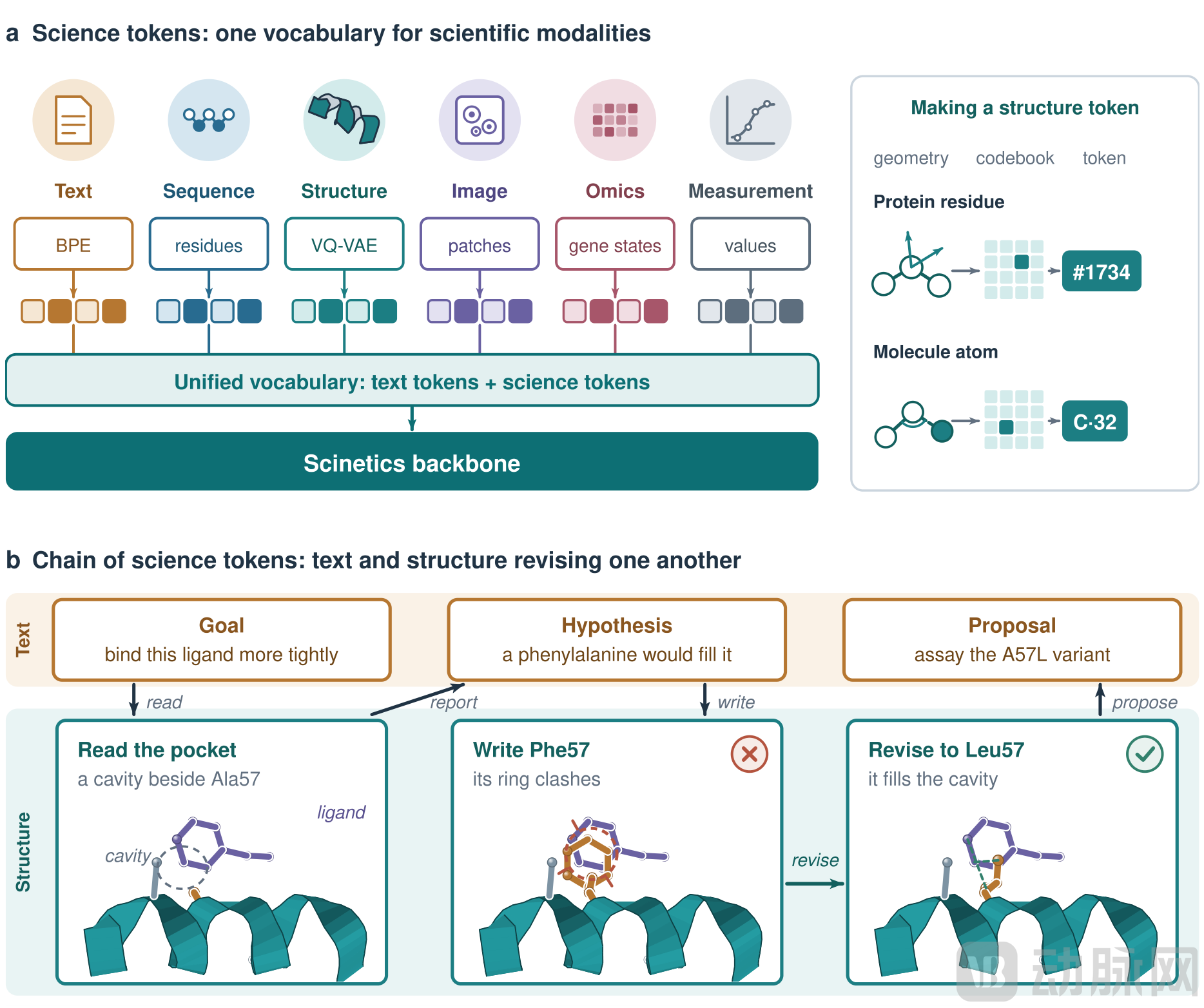
Multimodal interface and structural reasoning of Science Tokens, conceptual illustration (image source: Scinetics)
Its Perspective also stresses a professional detail: these representations must "preserve scientific meaning." A value must carry units, a measurement must carry conditions, and a structure must state whether it comes from prediction or experiment.
The accompanying Chain of Science Tokens can be understood as the counterpart of chain of thought in the scientific world. In a conventional chain of thought, every step is a sentence; in a Chain of Science Tokens, every intermediate step is a "decodable scientific state."
Scinetics offers an intuitive example. The model first reads a protein pocket and tries to insert a larger side chain to fill the cavity; a geometry check finds that it clashes with the ligand, so the model switches to a more suitable side chain, and only then proposes an experimental suggestion. Change the pocket geometry, and the model should adjust its design accordingly; merely rotate the same molecule, and the conclusion should stay stable. Such testability is exactly what is used to judge whether a model is truly drawing on scientific information.
"This does not mean abandoning language. Language is an important way for scientists to ask questions, build hypotheses, and communicate. We want natural language and science-native representations to be deeply integrated, so that the model performs computation and reasoning in scientific space itself," Erik stresses. "This differs from agents that call external tools, or pipelines that serially stitch together expert models. Those two pass information through interfaces, and every hand-off loses a layer of detail."
This idea first landed on protein design, embodied in the Chain of Structures (COS) in a technical report released at the same time, work completed jointly by MIT, Harvard, Cambridge, HKUST, and Scinetics.
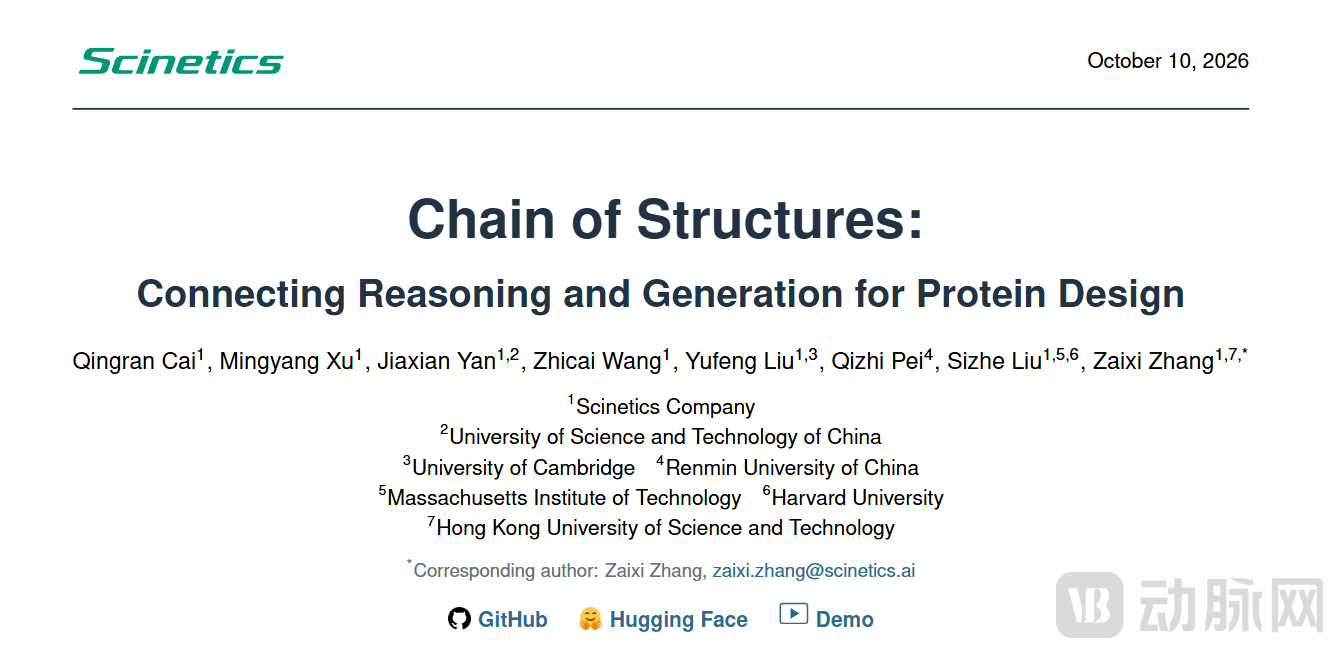
Title and author team of the Chain of Structures technical report (image source: Scinetics)
Interestingly, the team did not pick the relatively easy task of folding prediction but chose enzymes as the entry point: disturb the relative positions of a few key amino acid sites slightly, and catalytic activity may go from present to absent. This is precisely the hard bone for testing whether "chemical intent can land in local geometry." In comparisons on enzyme design benchmarks, COS took first place in five of six metrics: EC3, the agreement rate of third-level enzyme classification, reached 57.0%, above CodeFP's 55.3%; structural confidence pLDDT was 79.3, and structural self-consistency TM-score was 0.729. After removing the reasoning chain, EC3 fell to 53.4%, supporting the role of intermediate reasoning steps.
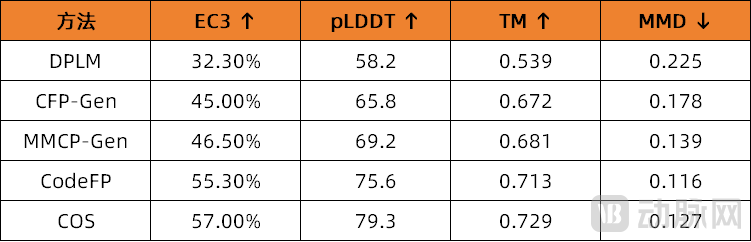
Excerpt of main results (data provided by Scinetics, chart by VCBeat)
"SOTA" is limited to the methods compared in the report and a unified evaluation setting; see Table 3 of the COS report for the full six metrics.EC3 represents functional prediction classification matching, pLDDT indicates predicted confidence, TM reflects structural self-consistency, and MMD measures sequence distribution differences.
A Verifiable Yardstick for Scientific Intelligence
With the concept in place, a goal has to be set. In its Perspective, Scinetics formally defines SSI (Scientific Super Intelligence): the same fixed model must beat the corresponding vertical expert models on professional scientific tasks, and also beat general-purpose language models of comparable parameter scale on broad scientific reasoning.
Scinetics Perspective: From Science Tokens to ScienceRSI (image source: Scinetics)
In one sentence: it has to be both "specialized" and "general."
"The first thing we want to build is a general scientific reasoning model," Zhang Zaixi explains. "It has to do better than before on vertical tasks such as protein structure prediction, DNA mutation prediction, and small nucleic acid design, and it also needs cross-modal scientific reasoning. Optimizing a gene-editing system, for example, involves DNA, proteins, and functional text at once, so at the same scale the model has to understand science better than a general-purpose model."
The report offers a scale window worth testing: 100 billion to 300 billion parameters, together with 10 trillion to 30 trillion training tokens. Zhang Zaixi acknowledges that the team is extrapolating from trends observed in small models, where capability rises steadily with parameters and data: "There is a good chance we can reach SSI at that scale, but it remains a hypothesis, not a conclusion."
The Perspective adds a key reminder: training tokens must be counted separately from independent evidence. Feeding the same data to a model repeatedly only adds computation; it does not conjure new experimental facts. The larger the model, the more likely that what is truly scarce is high-quality scientific feedback.
Harder than the goal is the path. ScienceRSI is the recursive self-improvement loop toward SSI: the current generation of models and agents generates candidate reasoning chains; validators outside the model, such as simulators, databases, wet labs, and domain experts, screen and score them; and the surviving evidence is then used to train a stronger next generation, with the cycle amplifying itself.
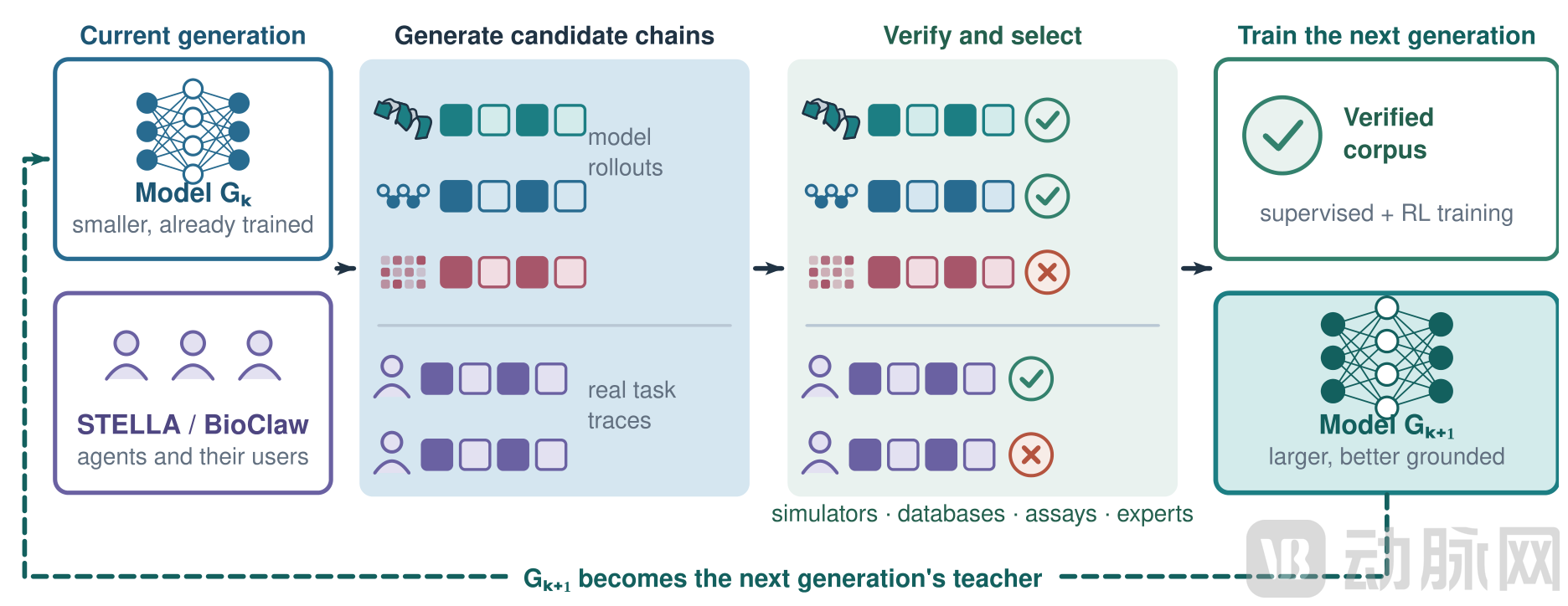
ScienceRSI research concept: generate candidates, validate externally, train the next generation of models (image source: Scinetics)
In this loop, failure is just as valuable: a structural clash, a result that cannot be reproduced, tells the model which paths are not worth taking again. The Perspective sets three hard metrics for this route: validation pass rate, validation coverage, and independent-evaluation gain. If any one of them fails to rise, it is time to stop.
Notably, the team does not sidestep its shortcomings. The COS report notes that these designs have not yet been validated in wet labs and are currently only a demonstration of potential in computational evaluation; real enzyme activity still awaits wet-lab testing.
Labeling the four evidence states of prediction, simulation, measurement, and independent replication separately is precisely ScienceRSI's hard requirement for honesty.
Brain and Hands and Feet: Why the Single-Point Tool Route Was Never an Option from Day One
In the AI4S field, most companies enter through single-point tools: those doing molecule screening only do screening, those doing structure prediction only do structure, and people carry results between the steps. From its founding, Scinetics made clear a dual-engine approach of "AI4S foundation model plus physical AI": the foundation model is the brain responsible for cognition, the automated lab is the hands and feet responsible for execution, and the two feed back to each other through a dry-wet loop.
The reason for the dual-engine layout lies in the "hierarchy of optimal solutions," Erik tells VCBeat. "Many AI algorithms are essentially looking for an optimal solution, doing gradient descent. The so-called optimum reached in a single modality is often a local optimum after parameters have been deliberately simplified; without considering more facets and modalities, you cannot find the global optimum. Science is generalizable; if you slice intelligence into vertical boxes, you cannot assemble a complete capability for scientific discovery."
But two engines do not mean betting heavily on both lines at once. Over the past year, Scinetics has deliberately focused on training and iterating the foundation model. On the physical AI side, it starts with a lightweight Agent form, and once model capability is in place, it will build its own automated lab to close the loop.
Zhang Zaixi explains that in earlier academic work such as LabOS and STELLA, the team built both dry-side models and hardware automation and embodied manipulation models for lab benches, so it knows how to build the loop: "We simply chose to strengthen the brain first. Before the foundation model matures, we see Agent as the better solution in the life sciences at this stage. That is a stage-specific judgment, not the endpoint."
STELLA + LabOS automated laboratory (video provided by Scinetics)
Scinetics says its agents have served more than 1,000 research users, about 70% of them international users from top institutions such as Stanford and Princeton, while in China they cover national key laboratories and universities; its community has gathered more than 1,200 members and received over 500 co-creation applications. The systems have appeared at NVIDIA GTC and CES, and the company has established a partnership with Ginkgo Bioworks, a U.S.-listed synthetic biology company.
More noteworthy is the user mix. Among early users are a Peking University team working on breeding and molecular docking, a hematology teacher at Peking Union Medical College Hospital, and a dental research institute in southern China. These fields sit far from the spotlight, have low levels of AI adoption, and are short of both tools and data. Scinetics therefore launched a "Co-Creator Program," inviting experts from various fields to bring real tasks and scarce data, with the platform returning usage credits; the two sides build a data platform together. Nearly 500 co-creators have joined so far, and a professional database has grown that is "more scientific" than some closed-source libraries.
Erik believes that "solving the real, everyday tasks of users in research, clinical work, and experiments, rather than letting the model set its own questions, is exactly what can curb the risk of narrowing diversity in generation-by-generation training, and that is the scarcest link in the ScienceRSI loop."
Beyond Token Billing: The Value Density of Science and Long-Termism
The fourth concept, which extends naturally from the Science Token system, is the most industrially disruptive part of the framework: Science-token economics. General-purpose models bill by the number of input and output tokens, but that logic does not hold in research: for a 300-residue enzyme design, whether the output is a hallucination or a catalyst that actually works, the number of tokens burned is almost identical.
Scinetics sets a starting point for this economics: two protein sequences of the same length may consume the same output tokens, yet their scientific value can be worlds apart. One is merely a candidate; the other has been experimentally measured and can carry out the target reaction under defined conditions.
So Scinetics simply splits the accounting into two books. Model tokens only measure the computational cost of training and inference; what actually gets priced are "scientific assets." These are versioned, long-lived data packages containing the scientific object itself; the context (units, conditions, experimental protocols); the evidence (measurement results and uncertainty); and the provenance (version, validation records, reuse permissions). Evidence is further divided into four levels: prediction, simulation, measurement, and independent replication. For the same sequence, different evidence states mean vastly different value.
On commercialization, Scinetics is currently advancing cooperation with key university laboratories, companies, and lab automation vendors. But Erik judges that in the short term, agent services will contribute little to the company's long-term profit; the real long-term value will come from the high-value scientific discoveries the company produces, such as a drug IP or a biomaterial, commercialized in a product model.
On how hot the sector is, Zhang Zaixi believes AI4S as a whole is still undervalued: compared with world models, physical AI, and embodied intelligence, AI4S involves a dry-wet loop, longer cycles, and heavier investment, yet its valuation is not in the same league; in conversations with U.S. peers, most see AI4S as the next "Copilot-scale" opportunity.
Erik offers a bold timeline: "In my ideal scenario, in less than three years, AI itself will be able to produce scientific discoveries better than domain experts." He says the team expects that by next summer or the second half of the year, the model will reach the scale and capability of SSI described in the Perspective, at which point emergent capabilities and the potential commercialization story will be far richer. The team is expanding hiring in parallel and welcomes large-model talent and pharmaceutical researchers.
Finally, Zhang Zaixi sums up Scinetics with three keywords: science-native, meaning the model is compatible with all kinds of scientific data from the very beginning of its architecture design and exists to solve systemic scientific problems; self-evolving, meaning it grows upward along model size and data volume while also using ScienceRSI to train large models on validation corpora produced by small models; and open exploration, since AI for Science is one of the most important holy grails on the road to AGI and, as a quest for scientific discovery, one of humanity's broadest and most fundamental revolutions.
Back to Popper's standard, the ambition of this system is clear: to mechanize "falsifiability," so that every conjecture can reach a place where it can be tested, so that the evidence that survives trains the next generation, and so that pricing follows evidence rather than word count. The road to general scientific intelligence will not be built overnight; Scinetics chooses to ride out the cycle with long-termism and to turn "falsifiability" into sustainable evidence infrastructure.